The volume of a parallelepiped is how much space it occupies. Ever thought about those solid shapes with six rectangular faces? They have quite a few names: cuboid, rectangular hexagon, or rectangular prism.
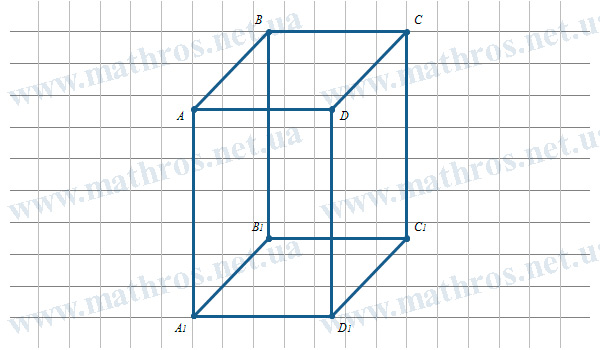
To find the volume of a rectangular parallelepiped, you just need to multiply its length, width, and height. Sounds simple, right? In this article, we’ll dive into the formula for calculating the volume of a rectangular parallelepiped and walk through several examples to see how it all works in practice. Ready to explore? Let’s get started!
Volume of a Rectangular Parallelepiped: Basic Formula
As we mentioned earlier, the formula for the volume of a rectangular parallelepiped is straightforward: just multiply its length, width, and height.

So, if we look at the parallelepiped ABCDA1B1C1D1, the volume can be calculated using this formula:

To make it even simpler, if we denote the length, width, and height by the letters l, w, and h, the formula looks like this:

How to Calculate the Volume of an Oblique Rectangular Parallelepiped?
Now, what if the parallelepiped isn’t perfectly straight? There are two types of rectangular parallelepipeds: straight and oblique. In a straight one, the bases are perpendicular to the other faces. But in an oblique one, they’re not. Don’t worry, though-the formula stays the same!

To find the volume of an oblique rectangular parallelepiped, just use the same formula as for a straight one. The key is to use the perpendicular height, dropped from the top of one base to the other base. So, the formula remains:

Whether it’s straight or oblique, the volume of a rectangular parallelepiped is always calculated using this formula. Isn’t that handy?
Volume of a Parallelepiped: Practical Examples with Answers
The formula for the volume of a rectangular parallelepiped is used to solve the following examples. Try to solve the problems yourself before looking at the solutions.
Example 1: A rectangular parallelepiped is 5 cm long, 4 cm wide, and 4 cm high. What is its volume?
Alright, let’s break it down! We’ve got a rectangular parallelepiped with:
- Length (l) = 5 cm;
- Width (w) = 4 cm;
- Height (h) = 4 cm.
So, how do we find the volume? Simple! We use the parallelepiped volume formula. Plugging in our values, it looks like this:

So, the volume of a rectangular parallelepiped is 80 cubic centimeters.
Example 2: What is the volume of a rectangular parallelepiped with a length of 7 cm, a width of 6 cm, and a height of 8 cm?
Great question! Here’s what we’ve got:
- Length (l) = 7 cm;
- Width (w) = 6 cm;
- Height (h) = 8 cm.
Using the same volume of parallelepiped formula, we plug in these values:

So, the volume of a parallelepiped is 336 cubic centimeters.
Example 3: A rectangular parallelepiped is 8 cm long, 12 cm high, and 11 cm wide. What is its volume?
Alright, let’s figure this one out! We’ve got:
- Length (l) = 8 cm;
- Width (w) = 11 cm;
- Height (h) = 12 cm.
Again, using our trusty volume formula:

So, the volume of parallelepiped is 1056 cubic centimeters.
Example 4: What is the height of a rectangular parallelepiped with a volume of 168 cm3, if its length is 6 cm and its width is 4 cm?
Alright, now we’re flipping the script! We know the volume and need to find the height. Here’s what we know:
- Volume (V) = 168 cm3;
- Length (l) = 6 cm;
- Width (w) = 4 cm;
We use the volume formula and solve for height (h):

So, the height of the rectangular parallelepiped is 7 cm.
Example 5: What is the height of a rectangular parallelepiped with a volume of 360 cm3, a width of 5 cm, and a length of 8 cm?
How about another one? Here’s what we know:
- Volume (V) = 360 cm3;
- Length (l) = 8 cm;
- Width (w) = 5 cm.
Using the formula:

So, this parallelepiped’s height is 9 cm.
Dive Deeper: More About Parallelepipeds
Curious to learn more about these fascinating shapes? Check out these interesting topics:
- Rectangular Parallelepiped: Types, Properties, Formulas – Discover the different types, their properties, and useful formulas.
- Diagonal of a Rectangular Parallelepiped: Formula and Examples -Learn how to calculate the diagonal. It’s simpler than you think!
- Surface Area of a Rectangular Parallelepiped: Formula and Examples – Explore how to find the surface area with some cool examples.
Volume of a Parallelepiped: A Programmer’s Perspective
Love coding? Why not combine geometry with programming? Create a program to calculate the volume of a rectangular parallelepiped. Use a flowchart to guide your coding process, making it both fun and educational.
