Ever looked at a box and wondered, “What’s the surface area of this thing?”. That’s essentially what a rectangular parallelepiped is-a fancy name for a 3D box with rectangular faces. Calculating its surface area might seem tricky at first, but it’s actually quite straightforward once you know the formula. So, let’s dive in and uncover the secrets of finding the surface area of a rectangular parallelepiped, step by step!
The Formula for the Surface Area of a Rectangular Parallelepiped: How Does It Work?
Alright, let’s get to the good stuff. The surface area of a rectangular parallelepiped is simply the sum of the areas of all six of its faces. To find the area of each face, you just multiply the length by the width-easy, right? After all, the area of a rectangle is just the product of its sides.

So, imagine we have a parallelepiped with vertices labeled ABCDA1B1C1D1. To find the area of face ABCD, the formula is: AABCD=AB⋅AD.
But we want the total surface area of all six faces. Here’s the complete formula:

Now, if we denote the length, width, and height of the parallelepiped by l, w and h, respectively, the surface area formula becomes a bit more familiar:

And there you have it! The surface area of a rectangular parallelepiped, broken down into a formula that’s easy to remember and use.
Surface Area of a Rectangular Parallelepiped: Examples and Solutions
Now that we know the formula for calculating the surface area of a rectangular parallelepiped, let’s look at some examples to see it in action. Try to solve these on your own first, and then check the solutions!
Example 1: A rectangular parallelepiped is 5 cm long, 4 cm wide, and 4 cm high. What is its surface area?
Alright, let’s break it down! We’ve got a rectangular parallelepiped with:
- Length (l) = 5 cm;
- Width (w) = 4 cm;
- Height (h) = 4 cm.
So, how do we find the surface area? Simple! We use the parallelepiped surface area formula. Plugging in our values, it looks like this:

So, the surface area of a rectangular parallelepiped is 112 square centimeters.
Example 2: What is the surface area of a rectangular parallelepiped with a length of 7 cm, a width of 6 cm, and a height of 8 cm?
Great question! Here’s what we’ve got:
- Length (l) = 7 cm;
- Width (w) = 6 cm;
- Height (h) = 8 cm.
Using the same surface area formula, we plug in these values:

So, the surface area of a rectangular parallelepiped is 292 square centimeters.
Example 3: A rectangular parallelepiped is 8 cm long, 12 cm high, and 11 cm wide. What is its surface area?
Alright, let’s figure this one out! We’ve got:
- Length (l) = 8 cm;
- Width (w) = 11 cm;
- Height (h) = 12 cm.
Again, using our trusty surface area formula:

So, the surface area of a rectangular parallelepiped is 632 square centimeters.
Example 4: What is the height of a rectangular parallelepiped with a surface area of 148 cmІ, if its length is 6 cm and its width is 4 cm?
Alright, now we’re flipping the script! We know the surface area and need to find the height. Here’s what we know:
- Total Surface Area (TSA) = 148 cm2;
- Length (l) = 6 cm;
- Width (w) = 4 cm;
We use the same surface area formula but solve for height (h):

So, the height of the rectangular parallelepiped is 5 cm.
Example 5: What is the height of a rectangular parallelepiped with a surface area of 340 cmІ, a width of 5 cm, and a length of 8 cm?
Just like in the last example, we need to find the height. Here’s what we know:
- Total Surface Area (TSA) = 340 cm2;
- Length (l) = 8 cm;
- Width (w) = 5 cm.
We plug these values into the formula and solve for height (h):

So, the height of the rectangular parallelepiped is 10 cm.
Deeper into the Geometry of the Rectangular Parallelepiped: Consider Even More Aspects!
Want to dive even deeper into the world of rectangular parallelepipeds? Here are some pages to expand your knowledge:
- Rectangular parallelepiped: Types, properties, formulas – Get all the details on different types of rectangular parallelepipeds, their properties, and useful formulas.
- Diagonal of a rectangular parallelepiped: Formula and examples – Learn how to calculate the diagonal of this 3D shape. It’s easier than you think!
- Volume of a rectangular parallelepiped: Formula and examples – Find out how to compute the volume and see how much space these shapes really take up.
Combine Coding and Geometry: Create a Program to Calculate Surface Area
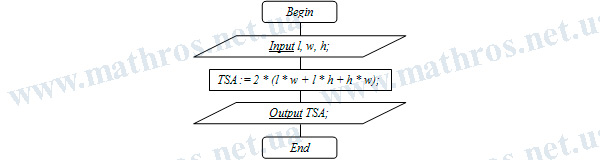
Do you enjoy programming? Why not create a program that calculates the surface area of a rectangular parallelepiped? It’s a great way to merge your coding skills with geometry knowledge. Try it out, and you’ll see how fun and practical it can be to calculate the surface area of a parallelepiped using a bit of code!