Hey there, curious minds! Have you ever wondered about the diagonal of a rectangular parallelepiped? Sounds fancy, right? But don’t worry, it’s pretty straightforward. Imagine a box-just your typical rectangular box. Now, think about a line that stretches from one corner of the box to the opposite corner. That’s your diagonal! Cool, huh?
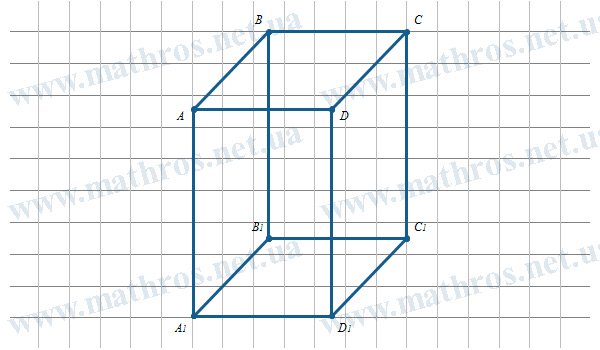
So, let’s break it down. A rectangular parallelepiped (try saying that five times fast!) is just a 3D geometric shape with six rectangular faces. And guess what? It has four diagonals, all of which are equal in length. These diagonals meet at one point right in the middle of the box and cut each other in half.
Diagonal of a Rectangular Parallelepiped: Basics and Explanation
Alright, let’s dive deeper. The diagonal of a rectangular parallelepiped is that line connecting opposite corners of the shape. It’s like taking the shortest path through the middle of the box from one corner to the other.
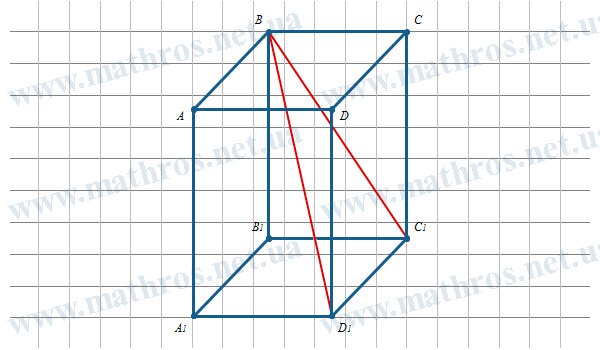
Just like in a cube, these diagonals can go through the interior of the shape, the side faces, or the base faces. For example, if you have a rectangular parallelepiped labeled ABCDA1B1C1D1, the diagonals could be on the faces (like BC1) or the interior (like BD1).
Properties of Diagonals of a Rectangular Parallelepiped: What’s So Special?
Let’s chat about some interesting properties of these diagonals:
- A rectangular parallelepiped has four internal diagonals;
- All these diagonals are equal in length;
- They intersect at one point and are bisected there;
- The sum of the squares of all the diagonals equals the sum of the squares of all the edges;
- The square of the diagonal is equal to the sum of the squares of its three sides.
Pretty neat, right? It’s like geometry magic!
Formula for Calculating the Diagonal of a Rectangular Parallelepiped: How Do You Do It?
Now, let’s get to the juicy part-how to calculate this diagonal. The formula is pretty straightforward. The square of the diagonal equals the sum of the squares of the three sides.
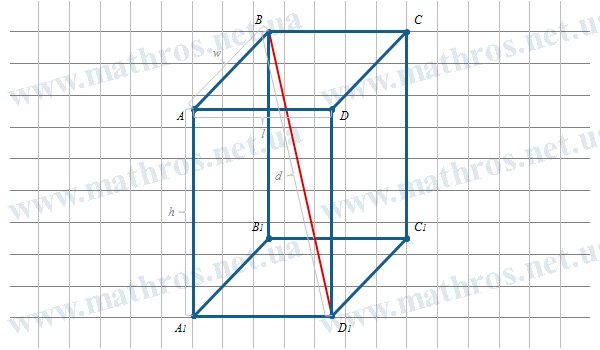
So, if you know the length (l), width (w), and height (h) of your box, you can find the diagonal (d) using this formula:

Calculation of the Diagonal of a Rectangular Parallelepiped: Examples
Let’s put this formula to work with a few examples!
Example 1: How many diagonals does a rectangular parallelepiped have?
Well, let’s break it down! Imagine our rectangular parallelepiped with its four lateral faces and two base faces. On each of these faces, you can draw two diagonals connecting the non-adjacent vertices. Pretty cool, right? Now, don’t forget about the four diagonals that pass right through the interior of the parallelepiped.
So, how many do we have in total? Let’s add them up: 8 diagonals from the faces, 4 more from the bases, and another 4 from the interior. That makes 8+4+4, which gives us a grand total of 16 diagonals in a rectangular parallelepiped!
Example 2: What is the formula for calculating the length of the diagonal of a rectangular parallelepiped?
Great question! The length of the diagonal of a rectangular parallelepiped is calculated using this formula: d=√(l2+w2+h2), where l is the length, w is the width, and h is the height of the parallelepiped.
Example 3: What’s the length of the diagonal of a rectangular parallelepiped with dimensions 5 cm, 4 cm, and 3 cm?
Alright, let’s break it down! We’ve got a rectangular parallelepiped with:
- Length (l) = 5 cm;
- Width (w) = 4 cm;
- Height (h) = 3 cm.
So, how do we find the diagonal? Simple! We use the parallelepiped diagonal formula. Plugging in our values, it looks like this:

So, the length of the diagonal of our rectangular parallelepiped is about 7.07 centimeters.
Example 4: What’s the length of the diagonal of a rectangular parallelepiped with dimensions 6 cm, 5 cm, and 7 cm?
Great question! Here’s what we’ve got:
- Length (l) = 6 cm;
- Width (w) = 5 cm;
- Height (h) = 7 cm.
Using the same diagonal formula, we plug in these values:

So, the length of the diagonal of this rectangular parallelepiped is about 10.49 centimeters.
Example 5: What’s the length of the diagonal of a rectangular parallelepiped with dimensions 12 cm, 11 cm, and 8 cm?
Alright, let’s figure this one out! We’ve got:
- Length (l) = 12 cm;
- Width (w) = 11 cm;
- Height (h) = 8 cm.
Again, using our trusty diagonal formula:

So, the length of the diagonal of this rectangular parallelepiped is about 18.14 centimeters.
Getting Geeky with Geometry: More Fun with Rectangular Parallelepipeds
Want to dive even deeper? Check out these pages:
- Rectangular Parallelepiped: Types, Properties, Formulas – Get all the deets on this shape.
- Surface Area of a Rectangular Parallelepiped – Learn how to calculate the surface area.
- Volume of a Rectangular Parallelepiped – Find out how to compute the volume.
Diagonal of a Rectangular Parallelepiped: Quick and Easy Calculation Flowchart
Feeling techy? Why not code your way to calculating the diagonal of a rectangular parallelepiped? Here’s a flowchart to get you started on creating a program that does just that. Combine your love for programming and geometry, and you’ve got yourself a fun and practical project!

Give it a try and see how satisfying it is to compute the diagonal with a few lines of code. It’s not just useful; it’s downright fascinating!
So, there you have it-everything you need to know about the diagonal of a rectangular parallelepiped. Go impress your friends with your newfound knowledge!