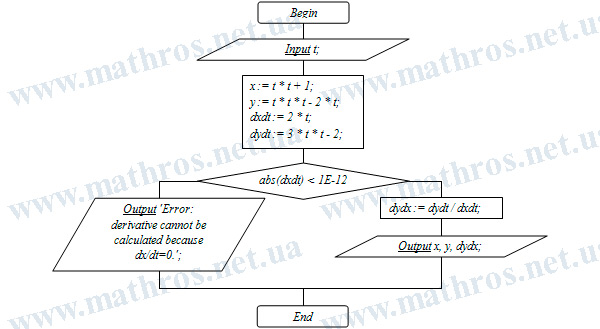
Derivatives of parametric equations are needed when the relationship between two variables is not given directly, but in terms of a parameter. Most often, this parameter is denoted by the letter \( t \).
In this case, we do not work with the usual form where one variable is directly expressed through another. Instead, the curve is described by two equations: one gives the coordinate \( x \), and the other gives the coordinate \( y \). At first glance, this may seem more difficult. But this form is often very convenient when a point moves along a curve, and its coordinates change depending on one common parameter.
Derivatives of Parametric Equations: Main Formula
Suppose a curve is given parametrically:
\[
x=\varphi(t), \qquad y=\psi(t).
\]
Here, \( t \) is the parameter, and \( x \) and \( y \) depend on it. This leads to a natural question: how do we find the derivative \( \dfrac{dy}{dx} \) if \( y \) is not given explicitly in terms of \( x \)?
In this case, we use the formula:
\[
\frac{dy}{dx}=\frac{\dfrac{dy}{dt}}{\dfrac{dx}{dt}}.
\]
If \( x=\varphi(t) \), \( y=\psi(t) \), then the same formula is written as:
\[
\frac{dy}{dx}=\frac{\psi'(t)}{\varphi'(t)}.
\]
At the same time, we need to remember an important condition:
\[
\varphi'(t)\neq 0.
\]
Why is this important? Because the formula contains division by \( \dfrac{dx}{dt} \). If \( \dfrac{dx}{dt}=0 \), then this formula cannot be applied directly at that point.
So, to find the derivative of a parametrically defined function, we need to differentiate \( y \) with respect to the parameter \( t \), then differentiate \( x \) with respect to the same parameter \( t \), and after that divide the first derivative by the second.
Why the Formula Works: Proof Using a Composite Function
Let us return to the parametric form:
\[
x=\varphi(t), \qquad y=\psi(t).
\]
Suppose that the functions \( \varphi(t) \) and \( \psi(t) \) have derivatives on some interval of parameter values. We also assume that \( \varphi'(t)\neq 0 \). Under this condition, the parameter \( t \) can be considered locally as a function of \( x \). Let us denote this relationship by:
\[
t=g(x).
\]
Then the function \( y=\psi(t) \) can be written as a composite function of \( x \):
\[
y=\psi(g(x)).
\]
What does this mean? First, the parameter \( t \) is determined from \( x \), and then \( y \) is determined from this parameter. In other words, \( y \) depends on \( x \) through the intermediate variable \( t \).
Now let us differentiate the equality \( y=\psi(g(x)) \) with respect to \( x \). By the chain rule, we get:
\[
\frac{dy}{dx}=\psi'(g(x))\cdot g'(x).
\]
Next, let us find \( g'(x) \). Since \( t=g(x) \), and \( x=\varphi(t) \), we have the equation:
\[
\varphi(g(x))=x.
\]
Differentiate both sides of this equation with respect to \( x \):
\[
\varphi'(g(x))\cdot g'(x)=1.
\]
From this, we get:
\[
g'(x)=\frac{1}{\varphi'(g(x))}.
\]
Now substitute this expression into the formula for \( \dfrac{dy}{dx} \):
\[
\frac{dy}{dx}
=
\psi'(g(x))\cdot \frac{1}{\varphi'(g(x))}.
\]
That is,
\[
\frac{dy}{dx}
=
\frac{\psi'(g(x))}{\varphi'(g(x))}.
\]
Since \( g(x)=t \), we have:
\[
\frac{dy}{dx}=\frac{\psi'(t)}{\varphi'(t)}.
\]
So, the formula follows from the chain rule and from the fact that both variables depend on the same parameter.
Derivatives of Parametric Equations: Practical Use of the Formula
Now let us move on to practice. In the examples, we will see how the same formula works for polynomials, trigonometric functions, an exponential function, and fractional expressions. The main thing is to carefully find the derivatives with respect to the parameter, and then form their ratio.
Example 1. Find the derivative of the parametrically defined function:
\[
x=t^2+1, \qquad y=t^3-2\cdot t.
\]
We have a parametric form where both variables depend on the parameter \( t \). To begin, we use the main formula:
\[
\frac{dy}{dx}=\frac{\dfrac{dy}{dt}}{\dfrac{dx}{dt}}.
\]
First, find the derivative of \( x \) with respect to the parameter \( t \):
\[
\frac{dx}{dt}=\left(t^2+1\right)’=2\cdot t.
\]
Now find the derivative of \( y \) with respect to the same parameter:
\[
\frac{dy}{dt}=\left(t^3-2\cdot t\right)’=3\cdot t^2-2.
\]
Substitute the derivatives we found into the formula:
\[
\frac{dy}{dx}=\frac{3\cdot t^2-2}{2\cdot t}.
\]
So,
\[
\frac{dy}{dx}=\frac{3\cdot t^2-2}{2\cdot t}, \qquad t\neq 0.
\]
The condition \( t\neq 0 \) appears because the denominator contains \( 2\cdot t \). If \( 2\cdot t=0 \), the formula cannot be used in this form.
Example 2. Find the derivative of the parametrically defined function:
\[
x=\cos(t), \qquad y=\sin(t).
\]
Here, the coordinates of the point are given through trigonometric functions. We follow the same plan: first differentiate \( x \), then \( y \), and then form the ratio.
Find the derivative of \( x \) with respect to the parameter \( t \):
\[
\frac{dx}{dt}=\left(\cos(t)\right)’=-\sin(t).
\]
Next, find the derivative of \( y \):
\[
\frac{dy}{dt}=\left(\sin(t)\right)’=\cos(t).
\]
Now form the ratio of these derivatives:
\[
\frac{dy}{dx}=\frac{\cos(t)}{-\sin(t)}.
\]
Therefore,
\[
\frac{dy}{dx}=-\frac{\cos(t)}{\sin(t)}, \qquad \sin(t)\neq 0.
\]
Example 3. Find the derivative of the parametrically defined function:
\[
x=t^2-4\cdot t, \qquad y=t^3+3\cdot t.
\]
First, find the derivative of \( x \) with respect to the parameter \( t \). Here we have a polynomial, so we differentiate each term separately:
\[
\frac{dx}{dt}=\left(t^2-4\cdot t\right)’=2\cdot t-4.
\]
Now find the derivative of \( y \):
\[
\frac{dy}{dt}=\left(t^3+3\cdot t\right)’=3\cdot t^2+3.
\]
Next, form the ratio of the derivative of \( y \) to the derivative of \( x \):
\[
\frac{dy}{dx}=\frac{3\cdot t^2+3}{2\cdot t-4}.
\]
We can factor out common factors to make the expression a little more compact:
\[
\frac{dy}{dx}=\frac{3\cdot \left(t^2+1\right)}{2\cdot \left(t-2\right)}.
\]
So,
\[
\frac{dy}{dx}=\frac{3\cdot \left(t^2+1\right)}{2\cdot \left(t-2\right)}, \qquad t\neq 2.
\]
Here, the restriction \( t\neq 2 \) appears because of the denominator. If \( t=2 \), then \( \dfrac{dx}{dt}=0 \), so the formula cannot be applied directly.
Example 4. Find the derivative of the parametrically defined function:
\[
x=e^t, \qquad y=t^2.
\]
In this example, one coordinate is given by an exponential function, and the other by a power function. But the order of steps does not change.
Find the derivative of \( x \):
\[
\frac{dx}{dt}=\left(e^t\right)’=e^t.
\]
Now find the derivative of \( y \):
\[
\frac{dy}{dt}=\left(t^2\right)’=2\cdot t.
\]
After substituting into the formula, we get:
\[
\frac{dy}{dx}=\frac{2\cdot t}{e^t}.
\]
Since \( e^t\neq 0 \) for any \( t \), there are no additional restrictions for the denominator here.
Example 5. Find the derivative of the parametrically defined function:
\[
x=t+\frac{1}{t}, \qquad y=t-\frac{1}{t}.
\]
Here, the formulas contain fractional expressions, so we need to differentiate each part carefully. First, find the derivative of \( x \):
\[
\frac{dx}{dt}
=
\left(t+\frac{1}{t}\right)’.
\]
Since \( \dfrac{1}{t}=t^{-1} \), we have:
\[
\frac{dx}{dt}=1-\frac{1}{t^2}.
\]
Now find the derivative of \( y \):
\[
\frac{dy}{dt}
=
\left(t-\frac{1}{t}\right)’.
\]
The derivative of \( t \) is \( 1 \), and the derivative of \( -\dfrac{1}{t} \) is \( \dfrac{1}{t^2} \). Therefore,
\[
\frac{dy}{dt}=1+\frac{1}{t^2}.
\]
Now substitute these expressions into the formula:
\[
\frac{dy}{dx}
=
\frac{1+\dfrac{1}{t^2}}{1-\dfrac{1}{t^2}}.
\]
To simplify the fraction, multiply the numerator and denominator by \( t^2 \). So, finally, we get:
\[
\frac{dy}{dx}
=
\frac{t^2+1}{t^2-1}.
\]
Here we need to consider the restrictions. First, \( t\neq 0 \), because the original formulas contain fractions. Second, \( t^2-1\neq 0 \), that is, \( t\neq -1 \) and \( t\neq 1 \), because the denominator of the derivative cannot be equal to zero.
What to Study Next: Topics for Further Learning
After parametric differentiation, it is useful to move on to topics that are often used together with it. This will make it easier to see the connection between different ways of finding derivatives and to work more confidently with new problems.
- Implicit Differentiation: Formula and Examples — This article will explain how to find a derivative when variables are connected by an equation without one variable being explicitly expressed through the other.
- Derivative of a Power Function: Formula, Proof, Examples — This article will explain the rule for differentiating power functions, its justification, and its use in typical problems.
- Derivative of an Exponential Function: Formula, Proof, Examples — This article will look at how to find derivatives of exponential functions and why these rules are important in calculus.
Derivatives of Parametric Equations: From Formula to Code
If you are interested not only in solving problems by hand, but also in turning mathematical formulas into program code, try implementing this algorithm in your favorite programming language. The flowchart already shows the main logic: input the parameter, calculate the coordinates of the point, find the derivatives with respect to the parameter, check the denominator, and output the answer. This simple task clearly shows how derivatives of parametric equations move from theory into a small but fully working program.