Implicit differentiation is needed when the relationship between the variables \( x \) and \( y \) is not given in the usual form \( y=f(x) \), but through an equation that contains both variables at the same time. For example, in some equations, it may be difficult or even impossible to express \( y \) explicitly in terms of \( x \). What should we do in such a situation? This is exactly where implicit differentiation helps.
The idea of the method is quite simple. We assume that \( y \) depends on \( x \), even if this relationship is not written directly. Then we differentiate the entire equation with respect to the variable \( x \) and find the derivative. Thanks to this, we can work with circles, ellipses, complex algebraic equations, and many other types of relationships.
Implicit Differentiation: The Main Formula
Suppose a function is given implicitly by the equation
\[
F(x,y)=0.
\]
Here \( x \) is the independent variable, and \( y \) is treated as a function of \( x \). In other words, we actually have \( y=y(x) \). If the function \( F(x,y) \) has partial derivatives with respect to \( x \) and \( y \), and also \( F_y(x,y)\ne 0 \), then the derivative of an implicitly defined function can be found using the formula
\[
\frac{dy}{dx}=-\frac{F_x(x,y)}{F_y(x,y)}.
\]
In this formula, \( F_x(x,y) \) means the partial derivative of the function \( F \) with respect to the variable \( x \), and \( F_y(x,y) \) means the partial derivative with respect to the variable \( y \). It is important to remember this: when we find \( F_x \), we temporarily treat \( y \) as a constant. And when we find \( F_y \), we treat \( x \) as a constant.
The condition \( F_y(x,y)\ne 0 \) means that, at the point being considered, we can correctly find the derivative of \( y \) with respect to \( x \) using this formula. If \( F_y(x,y)=0 \), then the denominator of the fraction is equal to zero. So, such a situation needs to be considered separately.
So, the formula gives us a very convenient method. We do not always need to express \( y \) in terms of \( x \). It is enough to find two partial derivatives and substitute them into the ratio. That is why this formula often makes calculations much simpler.
Formula Derivation: Why the Minus Sign Appears
Consider an implicitly defined relationship
\[
F(x,y)=0.
\]
Since \( y \) depends on \( x \), we can understand this equation in the following way:
\[
F(x,y(x))=0.
\]
Now it is important to notice one thing. The left-hand side is a function of \( x \), even though it is written using two variables. The variable \( x \) affects \( F \) in two ways: directly through the variable \( x \) itself and indirectly through \( y(x) \). That is why two terms appear during differentiation.
Let us differentiate both sides of the equation with respect to \( x \). The derivative of the right-hand side is zero, because the number \( 0 \) is a constant. For the left-hand side, we use the chain rule for a function of two variables:
\[
\frac{d}{dx}F(x,y(x))=F_x(x,y)\cdot \frac{dx}{dx}+F_y(x,y)\cdot \frac{dy}{dx}.
\]
This equality shows exactly how \( F \) changes when \( x \) changes. The first term \( F_x(x,y)\cdot \dfrac{dx}{dx} \) accounts for the change in the function \( F \) through the variable \( x \). The second term \( F_y(x,y)\cdot \dfrac{dy}{dx} \) accounts for the change in the function \( F \) through the variable \( y \), which itself depends on \( x \).
Since
\[
\frac{dx}{dx}=1,
\]
this equality becomes
\[
\frac{d}{dx}F(x,y(x))=F_x(x,y)+F_y(x,y)\cdot \frac{dy}{dx}.
\]
So, the first term simplifies to \( F_x(x,y) \), while the second term remains with the factor \( \dfrac{dy}{dx} \), because \( y \) is a function of \( x \). This is important not to miss, because this factor is exactly what will help us find the derivative of an implicitly defined function.
Since the original equation is equal to zero, after differentiation we get
\[
F_x(x,y)+F_y(x,y)\cdot \frac{dy}{dx}=0.
\]
Now all that remains is a standard algebraic transformation. Move \( F_x(x,y) \) to the right-hand side:
\[
F_y(x,y)\cdot \frac{dy}{dx}=-F_x(x,y).
\]
Now divide both sides of the equality by \( F_y(x,y) \). This can be done under the condition that
\[
F_y(x,y)\ne 0.
\]
As a result, we get
\[
\frac{dy}{dx}=-\frac{F_x(x,y)}{F_y(x,y)}.
\]
Thus, the formula is derived without unnecessary complications. The main thing is to remember that \( y \) is not an independent variable. It depends on \( x \), so when differentiating the part that contains \( y \), the factor \( \dfrac{dy}{dx} \) must appear. This point is often the key in problems involving implicit differentiation.
Implicit Differentiation: Practical Use of the Formula
Now let us move on to the practical part. Here, it is important not only to remember the formula, but also to see how it works in different equations. In each example, we will follow the same approach: first, we write the function \( F(x,y) \), then we find \( F_x \) and \( F_y \), and after that we substitute them into the formula.
In the examples below, we will write the derivative for those points where the denominator of the resulting fraction is not equal to zero. This is exactly the condition that is written in the general formula as \( F_y(x,y)\ne 0 \).
Example 1. Find the derivative of the implicitly defined function \( x^2+y^2=25 \)
We have the equation of a circle. In this equation, the variable \( y \) is not explicitly expressed in terms of \( x \), so we will use the formula for an implicitly defined function.
Move all terms to the left-hand side:
\[
x^2+y^2-25=0.
\]
So,
\[
F(x,y)=x^2+y^2-25.
\]
Now let us find the partial derivatives. First, we differentiate with respect to \( x \), treating \( y \) as a constant:
\[
F_x(x,y)=2\cdot x.
\]
Next, we differentiate with respect to \( y \), treating \( x \) as a constant:
\[
F_y(x,y)=2\cdot y.
\]
Using the formula for the derivative of an implicitly defined function, we have:
\[
\frac{dy}{dx}=-\frac{F_x(x,y)}{F_y(x,y)}.
\]
Substitute the partial derivatives we found:
\[
\frac{dy}{dx}=-\frac{2\cdot x}{2\cdot y}.
\]
After canceling \( 2 \), we get the final answer:
\[
\frac{dy}{dx}=-\frac{x}{y}.
\]
Example 2. Find the derivative of the implicitly defined function \( x\cdot y+y^2=x^2+1 \)
First, write the equation in the form \( F(x,y)=0 \). To do this, move all terms to the left-hand side:
\[
x\cdot y+y^2-x^2-1=0.
\]
Therefore,
\[
F(x,y)=x\cdot y+y^2-x^2-1.
\]
Find the partial derivative with respect to \( x \). Here, we treat \( y \) as a constant. The derivative of the product \( x\cdot y \) with respect to \( x \) is \( y \), the derivative of \( y^2 \) is zero, and the derivative of \( -x^2 \) is \( -2\cdot x \). So,
\[
F_x(x,y)=y-2\cdot x.
\]
Now find the partial derivative with respect to \( y \). This time, we treat \( x \) as a constant. The derivative of \( x\cdot y \) with respect to \( y \) is \( x \), and the derivative of \( y^2 \) is \( 2\cdot y \). We get:
\[
F_y(x,y)=x+2\cdot y.
\]
Now we apply the main formula:
\[
\frac{dy}{dx}=-\frac{F_x(x,y)}{F_y(x,y)}.
\]
Substitute the expressions we found:
\[
\frac{dy}{dx}=-\frac{y-2\cdot x}{x+2\cdot y}.
\]
The minus sign in front of the fraction can be moved into the numerator. So, the final answer is:
\[
\frac{dy}{dx}=\frac{2\cdot x-y}{x+2\cdot y}.
\]
Example 3. Find the derivative of the implicitly defined function \( x^3+y^3-3\cdot x\cdot y=0 \)
In this example, the equation is already written in the form \( F(x,y)=0 \), so we immediately have:
\[
F(x,y)=x^3+y^3-3\cdot x\cdot y.
\]
Now find the partial derivative with respect to \( x \). We treat \( y \) as a constant. The derivative of \( x^3 \) is \( 3\cdot x^2 \), the derivative of \( y^3 \) with respect to \( x \) is zero, and the derivative of \( -3\cdot x\cdot y \) with respect to \( x \) is \( -3\cdot y \). Therefore,
\[
F_x(x,y)=3\cdot x^2-3\cdot y.
\]
Next, find the partial derivative with respect to \( y \). Now we treat \( x \) as a constant. The derivative of \( x^3 \) with respect to \( y \) is zero, the derivative of \( y^3 \) is \( 3\cdot y^2 \), and the derivative of \( -3\cdot x\cdot y \) with respect to \( y \) is \( -3\cdot x \). So,
\[
F_y(x,y)=3\cdot y^2-3\cdot x.
\]
Substitute these expressions into the formula:
\[
\frac{dy}{dx}=-\frac{3\cdot x^2-3\cdot y}{3\cdot y^2-3\cdot x}.
\]
We can factor out \( 3 \) in the numerator and denominator:
\[
\frac{dy}{dx}=-\frac{3\cdot (x^2-y)}{3\cdot (y^2-x)}.
\]
Cancel \( 3 \):
\[
\frac{dy}{dx}=-\frac{x^2-y}{y^2-x}.
\]
If we want, we can move the minus sign into the numerator. So, finally, we have:
\[
\frac{dy}{dx}=\frac{y-x^2}{y^2-x}.
\]
Example 4. Find the derivative of the implicitly defined function \( \sin(x\cdot y)+x^2-y=0 \)
Write:
\[
F(x,y)=\sin(x\cdot y)+x^2-y.
\]
Now find \( F_x(x,y) \). When differentiating with respect to \( x \), we treat \( y \) as a constant. We need to be especially careful with the expression \( \sin(x\cdot y) \). This is a composite function, so its derivative is the cosine of the inner expression multiplied by the derivative of \( x\cdot y \) with respect to \( x \). Since \( y \) is constant, the derivative of \( x\cdot y \) with respect to \( x \) is \( y \). We get:
\[
F_x(x,y)=y\cdot\cos(x\cdot y)+2\cdot x.
\]
Now find \( F_y(x,y) \). Here, we treat \( x \) as a constant. The derivative of \( \sin(x\cdot y) \) with respect to \( y \) is \( x\cdot\cos(x\cdot y) \), because the derivative of \( x\cdot y \) with respect to \( y \) is \( x \). The derivative of \( x^2 \) with respect to \( y \) is zero, and the derivative of \( -y \) is \( -1 \). Therefore,
\[
F_y(x,y)=x\cdot \cos(x\cdot y)-1.
\]
Apply the formula:
\[
\frac{dy}{dx}=-\frac{F_x(x,y)}{F_y(x,y)}.
\]
Substitute and get the final answer:
\[
\frac{dy}{dx}=-\frac{y\cdot \cos(x\cdot y)+2\cdot x}{x\cdot \cos(x\cdot y)-1}.
\]
Example 5. Find the derivative of the implicitly defined function \( e^{x+y}+x^2\cdot y-y^2=0 \)
In this example, we have an exponential function and the product \( x^2\cdot y \). But the general algorithm remains the same. Write:
\[
F(x,y)=e^{x+y}+x^2\cdot y-y^2.
\]
Find the partial derivative with respect to \( x \). We treat \( y \) as a constant. The derivative of \( e^{x+y} \) with respect to \( x \) is \( e^{x+y} \), because the derivative of the inner expression \( x+y \) with respect to \( x \) is \( 1 \). The derivative of \( x^2\cdot y \) with respect to \( x \) is \( 2\cdot x\cdot y \), and the derivative of \( -y^2 \) with respect to \( x \) is zero. Therefore,
\[
F_x(x,y)=e^{x+y}+2\cdot x\cdot y.
\]
Now find the partial derivative with respect to \( y \). We treat \( x \) as a constant. The derivative of \( e^{x+y} \) with respect to \( y \) is also \( e^{x+y} \), because the derivative of \( x+y \) with respect to \( y \) is \( 1 \). The derivative of \( x^2\cdot y \) with respect to \( y \) is \( x^2 \), and the derivative of \( -y^2 \) is \( -2\cdot y \). So,
\[
F_y(x,y)=e^{x+y}+x^2-2\cdot y.
\]
Now we use the formula for the derivative of an implicitly defined function:
\[
\frac{dy}{dx}=-\frac{F_x(x,y)}{F_y(x,y)}.
\]
Substitute the partial derivatives we found and get the final answer:
\[
\frac{dy}{dx}=-\frac{e^{x+y}+2\cdot x\cdot y}{e^{x+y}+x^2-2\cdot y}.
\]
Where to Go Next: Topics for Further Study
After implicit differentiation, it is natural to move on to related topics where finding a derivative requires additional techniques. This makes it easier to see how different differentiation rules work in more complex situations.
- Derivative of an Exponential Function: Rule and Examples — This article will discuss how to find derivatives of exponential functions and how to handle typical transformations in such problems.
- Derivative of a Parametrically Defined Function: Calculation Algorithm — This article will show how to find a derivative when the variables are expressed in terms of a common parameter.
- Logarithmic Differentiation: A Method for Complex Expressions — This article will explain a convenient way to differentiate products, quotients, powers, and more complex expressions.
Implicit Differentiation: From Formula to Code
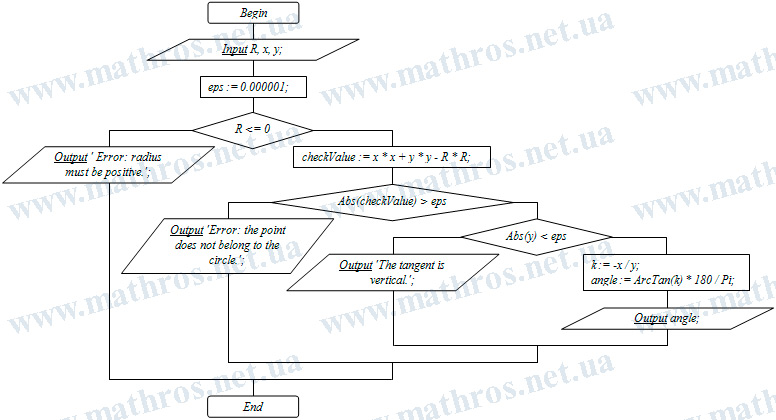
If you are interested in programming, this topic can be seen not only as a mathematical rule, but also as a ready-to-use algorithm for calculations. The flowchart below shows how to check the input data, determine whether a point belongs to a circle, handle the case of a vertical tangent separately, and find the angle of inclination of the tangent in degrees.
Try to implement this algorithm in your favorite programming language — Pascal, Python, C++, JavaScript, or any other language. In this way, implicit differentiation turns from a formula into a small practical tool.