The derivative of sine is a fundamental concept in mathematical analysis and a convenient starting point for learning derivatives of trigonometric functions. It shows how the value of sine changes when its argument shifts slightly. Why does this matter? Because the rate of change helps us understand growth and decline, locate maxima and minima, and construct tangent lines. First, let’s state the main formula and explain its meaning. After that, we’ll derive it from the strict definition.
Formula and Meaning: Derivative of Sine is Cosine
The key fact is:
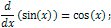
What does this mean in practice? The derivative gives the slope of the tangent to the graph of sin(x). So, at any point x, this slope equals cos(x). From here we can make several quick observations:
- Near x=0, sine grows the fastest since cos(0)=1.
- At the maximum and minimum points of sin(x), the derivative equals zero, because there cos(x)=0.
- The sign of cos(x) shows where sin(x) is increasing (cos(x)>0) or decreasing (cos(x)<0).
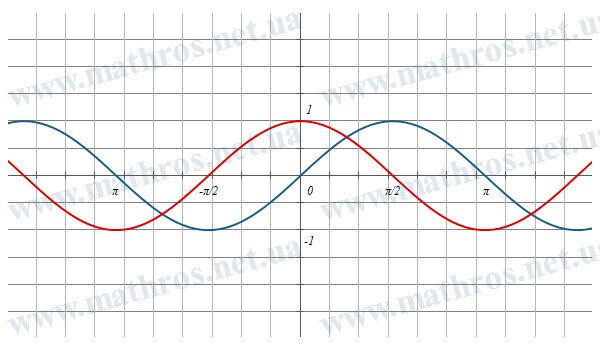
A useful observation: cos(x) is just the same sine wave shifted left π/2: cos(x)=sin(x+π/2). This means the graph of the derivative “leads” the original wave by a quarter of a period. That’s why the derivative becomes zero at the peaks and valleys of sin(x).
The geometric perspective helps too. On the unit circle, the point with angle x has coordinates (cos(x),sin(x)). When we increase the angle by a small h, the vertical coordinate changes by approximately cos(x)⋅h. That’s exactly what the derivative captures: the “speed” of change of sin(x) at point x equals cos(x).
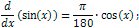
Finally, a note on units. The formula d/dx(sin(x))=cos(x) is correct only if the argument is in radians. If x is in degrees, an extra multiplier appears:
Proof from the Definition: Step by Step to the Result
Where do we begin? With the very definition. For any function, the derivative at a point is the limit of the ratio of increments. For sine, this looks like:

Now comes the key step. Let’s expand sin(x+h) using the addition formula:

Substitute this into our expression and carefully rearrange terms. In the numerator we get:

So, the fraction becomes:

Everything now depends on two limits.
The first is a famous one:

Where does it come from? Think of the unit circle. The length of a small arc with angle h (in radians) is about h, and the vertical height is sin(h). By applying the squeeze theorem, we can show that the ratio tends to 1. And here’s the important detail: this works cleanly only in radians, which is why we always emphasize using radians.
The second limit looks suspiciously like zero, but we need to prove it:

We use the identity 1-cos(h)=2⋅sin2(h/2). Then:

It’s convenient to set t=h/2. As h→0, we also have t→0. The product becomes:

The first factor tends to 0, the second tends to 1. Altogether, the limit equals 0. Exactly what we need!
Now we return to our expression. The first term with sin(x) vanishes, while the second term with cos(x) remains:

We arrive at a clean conclusion. The formula comes directly from the definition and a few simple identities. And if you like quick checks, recall the small-angle approximations: sin(h)≈h, cos(h)≈1-h2/2. These agree with our result, though they aren’t a full proof.
In the end, everything fits: the derivative of sine is cosine. That’s why the graph of the derivative looks like a familiar wave, just shifted by a quarter of a period.
Practice: Applying the Formula on Examples
Theory becomes much more valuable once we put it into practice. The derivative of sine is no exception. To better reinforce the formula and learn how to apply it in different situations, let’s look at a few examples with step-by-step solutions.
Example 1: Find the derivative of f(x)=sin(4⋅x)
Here we have sine of an inner function 4⋅x. This is where the chain rule comes into play. Let’s set u=4⋅x. Then f(u)=sin(u), so:

Now return to the variable x by substituting u=4⋅x:

So, when the argument of sine is multiplied by a number, the derivative of sine is multiplied by that same number.
Example 2: Find the derivative of f(x)=x⋅sin(x)
Here sine is part of a product of two functions. This means we use the product rule:

Take u=x and v=sin(x). Then:
- u’=1
- v’=cos(x)
Substitute into the formula:

So the derivative of x⋅sin(x) is sin(x)+x⋅cos(x).
Example 3: Find the derivative of f(x)=(sin(2⋅x))2
Here we have a composition of functions: first the square, then sine, and inside it, a linear function. We differentiate layer by layer:

Now find the derivative of sin(2⋅x) using the chain rule:

For convenience, apply the trig identity 2⋅sin(α)⋅cos(α)=sin(2⋅α):

Thus, the derivative of (sin(2⋅x))2 is 2⋅sin(4⋅x).
Example 4: Find the derivative of f(x)=sin(x)/x
This is a quotient, so we use the quotient rule:
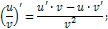
Here u=sin(x), v=x. Then:
- u’=cos(x)
- v’=1
Substitute into the formula:

So, the derivative of sin(x)/x is (x⋅cos(x)-sin(x))/x2.
Example 5: Find the derivative of f(x)=10/sin(x)
Again, this is a quotient. We set u=10 (a constant) and v=sin(x). Then:
- u’=0
- v’=cos(x)
Apply the quotient rule:

For a more compact form, we can use the standard notations csc(x)=1/sin(x) and cot(x)=cos(x)/sin(x). Then: f'(x)=-10⋅csc(x)⋅cot(x).
Next Step: Exploring Derivatives of Other Trigonometric Functions
We have already learned that the derivative of sine is cosine and have looked at several examples of how to apply this formula. But trigonometry does not stop with sine. To build a complete understanding, it’s important to know the derivatives of other trigonometric functions as well. These will help you feel confident when solving more complex problems in analysis.
Here are some recommended topics for further study:
- Derivative of Cosine: Formula, Proof, Examples – In this lesson, we explore how to find the derivative of cosine, using principles similar to those applied for sine. We also provide several examples to reinforce the concept in practice.
- Derivative of Tangent: Formula, Proof, Examples – Tangent is an important function that appears in many mathematical problems. Just like with sine, we’ll break down the formula for its derivative and demonstrate how to use it effectively.
- Derivative of Cotangent: Formula, Proof, Examples – Cotangent is the reciprocal of tangent. In this article, we’ll determine its derivative, prove the formula, and work through examples to ensure a deeper understanding.
Derivative of Sine in Code: Combining Math and Programming
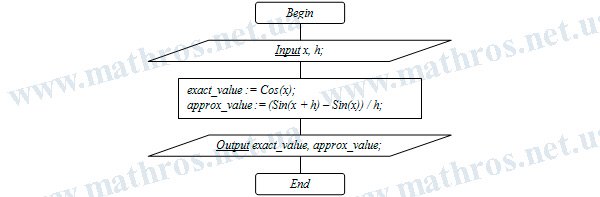
How about a practical challenge? Below you have a flowchart of an algorithm that calculates the derivative of sine at a chosen point in two ways:
- Exact (using cosine).
- Approximate (using the difference of increments).
Your task is to implement this algorithm in any programming language you know or are currently learning. It could be Pascal, Python, C++, or even JavaScript. Then, compare the results you get and see how close the values are.
This exercise is a great way to connect mathematical theory with programming. It shows how formulas from a textbook can turn into real calculations inside a program.