The derivative of tangent function is an essential tool in mathematical analysis, with widespread applications in various fields, from physics to programming. It allows us to analyze how the value of the tangent function changes when the argument undergoes small changes. This is important because the derivative helps determine the rate of change of a function, identify extrema, and draw tangents to graphs. In this article, we will explore the formula for the derivative of the tangent and derive it step-by-step through the definition of a derivative.
Derivative of Tangent: The Square of the Reciprocal Cosine in Action
Let’s start with the basic formula. For every x where cos(x)≠0, we have:
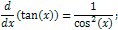
This expression can also be written using the secant function:
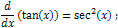
since sec(x)=1/cos(x). This formula works for all intervals where the tangent is defined, meaning between discontinuities at π/2+k⋅π, where k – is an integer.

The graph of the tangent function has an interesting characteristic: it rises steeply when cos(x) approaches zero. This is because the derivative of tangent is expressed in terms of the square of the reciprocal cosine, which gives it a huge rate of change near the points of discontinuity.
Proof Through Definition: Step by Step to the Formula
Let’s begin with the fundamental definition. The derivative of the function tan(x) at a point x is the limit of the difference quotient:

How can we transform this expression so that the limit becomes computable? Let’s use the fact that tan(x)=sin(x)/cos(x). Then, the difference in the numerator can be written as the difference of two fractions:

Next, we’ll bring the fractions to a common denominator, cos(x+h)⋅cos(x), and focus on the numerator:

What happens in the numerator? We see the classic identity for the sine of a difference of angles: sin(α)⋅cos(β)-cos(α)⋅sin(β)=sin(α-β). So, for α=x+h and β=x, we get: sin(x+h)⋅cos(x)-cos(x+h)⋅sin(x)=sin(h). Substituting this back into the difference quotient, we get:

Now, the limit clearly separates into the product of two parts. The first part is sin(h)/h, and the second part is 1/(cos(x+h)⋅cos(x)). Why is this convenient? Because there is a well-known basic trigonometric limit:

Moreover, the cosine function is continuous, so:

Combining these facts, we get:

As a result, we obtain:
Thus, we’ve derived the exact result that matches the basic formula for the derivative of tangent function. This proof is fundamental and relies only on the basic properties of trigonometric functions, limits, and the definition of a derivative. As a result, we get the precise outcome without using complex transformations.
Practical Block: Problems on the Derivative of Tangent
To better understand the formula for the derivative of tangent function, let’s go through a few practical examples. This will help you see how to apply the formula in real-world problems. Before looking at the solutions, try solving these examples on your own. Ready? Let’s get started!
Example 1: Find the derivative of f(x)=tan(3⋅x)
This is a composite function: the outer function is f(u)=tan(u), and the inner function is u=3⋅x. Using the chain rule, we first differentiate the outer function while keeping the inner function unchanged, and then multiply by the derivative of the inner function. So:

Thus, the final result is: f'(x)=3/cos2(3⋅x).
Example 2: Find the derivative of f(x)=x⋅tan(x)
In this case, we have the product of two functions, so we use the product rule. Let one part be u=x and the other v=tan(x). Then u’=1 and v’=1/cos2(x). Substituting these values into the product rule formula:

Thus, the result is: f'(x)=tan(x)+x/cos2(x).
Example 3: Find the derivative of f(x)=tan2(3⋅x)
We have a composite function with three levels: the square, the tangent, and the linear function inside. We differentiate each level step by step. The derivative of the square gives the factor 2⋅tan(3⋅x). Then, the derivative of the tangent is 1/cos2(3⋅x). Finally, the derivative of the inner function 3⋅x is 3. So we get:

Thus, the final result is: f'(x)=(6⋅tan(3⋅x))/cos2(3⋅x).
Example 4: Find the derivative of f(x)=tan(x)/(1+x2)
Here we have the quotient of two functions, so we use the quotient rule. Let u=tan(x) and v=1+x2. Then u’=1/cos2(x) and v’=2⋅x. Substituting these values into the quotient rule formula:

Simplifying the numerator:

This is the correct final answer.
Example 5: Find the derivative of f(x)=e2⋅x⋅tan(x)
ЦThis is also the product of two functions, so we again use the product rule. Let u=e2⋅x and v=tan(x). For u, we apply the chain rule, as the exponent is 2⋅x, so u’=2⋅e2⋅x. For v, we have v’=1/cos2(x). Now, we combine these steps:

Thus, the final result is:

Next Steps: Where to Go After the Tangent Derivative
Now that you’ve mastered the derivative of tangent function, it’s time to expand your knowledge and explore the derivatives of other important trigonometric functions. This will allow you to confidently tackle more problems and apply your knowledge in practice. Here are a few topics that will make a great next step in your learning journey:
- Derivative of Arcsine: Formula, Derivation, Examples – In this article, we will explore how to correctly differentiate the arcsine function, examine the main formula, and derive it step-by-step using the definition of the derivative.
- Derivative of Arccosine: Formula, Derivation, Examples – Since arcsine and arccosine are closely related, it’s important to learn how to find the derivative of the arccosine function, using the formula and practical examples.
- Derivative of Cotangent: Formula, Derivation, Examples – In this article, we will explain how to find the derivative of the cotangent function and provide examples of its practical applications.
Additionally, for those working on derivative problems but not always confident in the accuracy of their solutions, an online derivative calculator can be quite useful. It’s a quick and convenient way to check your calculations and ensure you get accurate results.
Derivative of Tangent in Programming: Implementing an Algorithm for the Tangent Line Equation
To wrap up, here’s an exciting challenge for those who enjoy programming and want to combine their mathematical knowledge with practical skills. Using a pre-designed flowchart, you can create a program that calculates the equation of the tangent line to the graph of the tangent function at a given point. This task will not only enhance your programming skills but also provide a deeper understanding of how the derivative of tangent function is applied in real-world problems. Try implementing this algorithm on your own, and you’ll discover how easily math and programming can work together!
