Geometry helps us make sense of the world by studying shapes and how they relate to one another. Among these shapes, the circle is one of the most explored. Within it, the diameter of a circle plays a special role—it’s the line that passes through the center and helps define many of the circle’s properties. In this article, we’ll explain what the diameter is, how to find it, and how to apply it in different types of problems.
Diameter of a Circle: Definition and Features
The diameter of a circle is a straight line segment that passes through the center and meets the circle at two opposite points. In fact, it’s the longest chord of a circle.
A key feature of the diameter is its direct relationship with the radius. The diameter is twice the radius, so it’s easy to move between these two measurements. The radius goes from the center to any point on the circle, while the diameter stretches from one side to the other through the center. In formulas, the diameter is usually denoted by the letter D.

To visualize the connection between the diameter and the radius, imagine a line passing through the center of a circle. This line is twice as long as the radius and forms the diameter.
Here’s an interesting fact: every circle has infinitely many diameters, and all of them are equal in length. This makes the diameter a universal element in many circle-related calculations.

How to Find the Diameter of a Circle: Simple Formulas for Calculation
The simplest way to find the diameter of a circle is to double the radius. This follows directly from the definition: the diameter is twice the distance from the center to the circle. Because geometry is about problem-solving, let’s also look at other situations where we can find the diameter using different circle parameters.
Diameter of a Circle Using the Radius
As mentioned, you can find the diameter by doubling the radius:

where D is the diameter and R is the radius. This gives a quick and reliable result.
Diameter of a Circle Using the Circumference
You can also find the diameter if you know the circumference. Use the well-known formula: C=π⋅D, where D is the diameter, C is the circumference, and π≈3.14.
Rearranging for the diameter:

Diameter of a Circle Using the Area
It’s also useful to find the diameter when the area is given. The area relates to the radius by: S=π⋅R2. Since R=D/2, substitute to get:
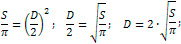
So, the diameter can be found using: D=2⋅√(S/π).
Using Geometric Knowledge: Examples
To solve the following examples, apply what you learned in the previous sections. Try each exercise on your own before checking the solutions—this helps reinforce your understanding and builds your independent problem-solving skills.
Example 1: What is the radius and diameter of a circle?
The radius and diameter are closely related. The radius is a line segment from the center to the circumference; it is half of the diameter: R=D/2.
The diameter passes through the center with endpoints on the circumference; it is twice the radius: D=2⋅R.
Example 2: Is the diameter really half of the radius?
No. The diameter is twice the radius. As stated above: D=2⋅R.
Example 3: How can we find the diameter of a circle?
Depending on what you know, use:
- D=2⋅R (when the radius is known);
- D=C/π (when the circumference is known);
- D=2⋅√(S/π) (when the area is known).
Example 4: Find the diameter of a circle with a radius of 3 cm
Here, the radius is given as 3 cm. Substituting this into the formula D=2⋅R, we get:

So, the diameter of the circle is 6 cm.
Example 5: Find the diameter of a circle if its circumference is 12⋅π cm
In this case, we are given the circumference. Using C=12⋅π in the formula D=C/π, we get:

Thus, the diameter of the circle is 12 cm.
Example 6: What is the diameter of a circle whose area is 25⋅π cm2?
Here, the area is given as 25⋅π cm2. Substituting this value into the formula for finding the diameter through the area, we have:

Therefore, the diameter of the circle is 10 cm.
See Also: Expand Your Knowledge of Circles
Learning about the diameter of a circle is just the beginning! To deepen your understanding, explore these related topics:
- Circle in Detail: From Definition to Core Properties – Fundamental characteristics of a circle and why they matter.
- Center of a Circle: From Theory to Practice – Why the center is essential and how it links to other circle properties.
- Circumference Formula: From Theory to Use – How to compute a circle’s boundary length and where it’s useful.
- Area of a Circle: From Definition to Practical Problems – How to calculate area and apply it in real problem-solving.
Programming Challenge: Build Your Own Circle Calculator
If you enjoy programming, here’s a great task to put your skills into practice! Below you’ll find a flowchart that shows the algorithm for calculating the diameter of a circle based on different inputs—radius, circumference, or area. Your challenge is to take this algorithm and implement it in any programming language you like, whether it’s Pascal, Python, Java, or another one you’re learning. This exercise will not only help you understand geometry better but also strengthen your problem-solving and coding abilities.
