Today, let’s dive into a topic that will be useful for anyone interested in geometry—the area of a trapezoid. What is this shape, and how do we correctly calculate its area? The good news is that it’s much simpler than it might seem at first glance. All you need to do is understand the basic formulas and learn how the bases, height, and diagonals play their part. Let’s go step by step to make this topic as clear as possible!
Area of a Trapezoid Using Bases and Height: The Classic Method
Let’s start with the simplest and most commonly used formula for finding the area of a trapezoid. Suppose we have a trapezoid ABCD, where sides AB and CD are parallel bases, and CH is the height dropped from vertex C perpendicular to base AD.

The area formula for this trapezoid is very simple:

What does this mean in practice? It’s straightforward! To find the area, add the lengths of the two parallel bases, divide the sum by 2, and multiply it by the height.
Where does this formula come from? Let’s quickly prove it. Imagine dividing trapezoid ABCD into two triangles using diagonal AC. The area of the trapezoid will be the sum of the areas of triangles ΔABC and ΔACD.
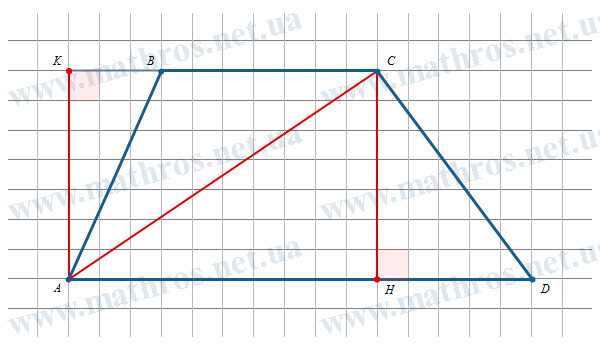
By adding an extra height AK to triangle ABC, which is perpendicular to base BC, we’ll notice an interesting thing: the heights AK and CH are equal, as they are the distances between the two parallel bases.
So, we have:

Thus, we arrive at the same formula we started with.

By the way, there’s another neat way to write this formula, using the concept of the midsegment of the trapezoid. The midsegment is the line that connects the midpoints of the non-parallel sides. It’s equal to half the sum of the bases. If we label the midsegment as KL, the formula can be rewritten as:

Convenient, right?
Another Method: How to Calculate the Area Using Diagonals
Next, let’s look at another interesting way to find the area of a trapezoid: using the lengths of its diagonals and the angle between them. Let’s say in trapezoid ABCD, the diagonals AC and BD are drawn, and the angle between them is α.

The area formula in this case looks like this:
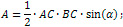
Why is it like this? Here’s a brief explanation. When you draw two diagonals in a trapezoid, it divides the shape into four triangles. The area of each triangle is found using the standard formula: half the product of two sides times the sine of the angle between them. Adding the areas of all four triangles leads us to this compact formula.
It’s important to remember that you can choose either of the two angles formed at the intersection of the diagonals since the sine of both angles is the same:

So feel free to pick the angle that’s most convenient for you.
Test Your Knowledge: Hands-On Exercises for Trapezoid Area
To make sure you understand how to apply these formulas, let’s work through a few problems. These will help reinforce the material and give you a chance to see how the theory works in practice.
Example 1: Find the Area of a Trapezoid with Bases 3 cm and 5 cm, and Height 4 cm
To solve this, we’ll use the formula for the area using the bases and height. We plug in the values and easily get the answer:

So, the area of the trapezoid is 16 cm2.
Example 2: Find the Area of a Right-Angled Trapezoid, Given One Diagonal is 4 cm, the Other is Twice as Long, and the Angle Between the Diagonals is 30°
First, we find the length of the second diagonal. Since it’s twice as long as the first, we have: AD=2⋅BC=2⋅4=8 cm.
Now, with the lengths of both diagonals and the angle between them, we can use the diagonal formula for the area of the trapezoid. Plugging in the known values:

Therefore, the area of this trapezoid is 8 cm2.
Example 3: A Trapezoid ABCD Has Bases AD=18 cm, BC=8 cm, and Equal Non-Parallel Sides AB=CD=13 cm. Find Its Area

First, we draw the heights of the trapezoid, BE and CF. Two right-angled triangles, ABE and FCD, are formed, and since they are congruent, AE=FD. Now, we focus on the quadrilateral EBCF, which is a rectangle, and its opposite sides are equal. This gives us: EF=BC=8 cm.
We can now calculate the length of segment AE:

Next, we use the Pythagorean theorem in triangle ABE to find the height BE:

Now that we have the height and both bases, we can find the area of the trapezoid:

So, the area of this isosceles trapezoid is 156 cm2.
Example 4: Find the Area of a Trapezoid with Bases 10 cm and 35 cm, and Non-Parallel Sides 15 cm and 20 cm

Let’s start by drawing a line through vertex C, parallel to side AB. This creates a parallelogram ABCE. Since opposite sides of a parallelogram are equal, we have: CE=AB=15 cm and AE=BC=10 cm. Now, we can easily find the segment ED: ED=AD-AE=35-10=25 cm.
Next, take a look at triangle ECD. The lengths of its sides (15 cm, 20 cm, and 25 cm) form a 3:4:5 ratio. This means the triangle is a right triangle, and the hypotenuse is the side ED=25 cm.
Now, we need to find the height CF, which is also the height of the trapezoid. We can use the property of right triangles:

With the height determined, we can now easily calculate the area of the trapezoid using the classic formula. Let’s substitute the numbers:

Therefore, the area of this trapezoid is 270 cm2.
Example 5: The Diagonal of an Isosceles Trapezoid Bisects Its Acute Angle of 60°. Find the Area of the Trapezoid if the Smaller Base is 10 cm

Since diagonal AC is an angle bisector, it divides the angle into two equal parts: ∠1=∠2. Moreover, angle ∠2 is also equal to angle ∠3 because they are alternate interior angles formed by the parallel lines BC and AD and the transversal AC. Therefore, we have ∠1=∠3. This means that triangle ABC is isosceles, where AB=BC=10 cm.
To find the area of the trapezoid, let’s draw the heights BK and CH (which are equal to each other). This gives us two congruent triangles, ABK and HCD, sharing a common hypotenuse and equal legs. This means we can conclude that AK=HD.
Since in the right triangle ABK, angle ∠A is 60° and angle ∠B is 30°, we can use the properties of a 30°-60° triangle. In such a triangle, the leg opposite the 30° angle is half the length of the hypotenuse. So, we have: AK=AB/2=10/2=5 cm.
Thus, HD=5 cm. Since KH coincides with the smaller base BC, we can now calculate the longer base AD:

Now, we need to find the height of the trapezoid. Using the Pythagorean theorem in triangle ABK, we can determine the length of BK:

Now we can easily calculate the area of the trapezoid using the classic formula:

Therefore, the area of this isosceles trapezoid is 75⋅√3 cm2.
What’s Next? Additional Resources for a Deeper Understanding
Now that you know how to find the area of a trapezoid using different methods, you can dive even deeper into understanding this geometric shape. Here are some helpful materials to continue your learning:
- What is a Trapezoid – Explore the different types of trapezoids and learn how their unique properties can be used in various calculations.
- Midsegment of a Trapezoid – Why is the midsegment so important? Discover how to find it and how it can help you determine other key properties of a trapezoid.
- Perimeter of a Trapezoid – While the area helps us understand the size of the shape, the perimeter gives us the total length of its sides. This resource will guide you through different methods to calculate the perimeter.
By expanding your knowledge of trapezoids, you’ll become even more confident in solving problems and applying these formulas in various mathematical calculations. So don’t stop here—keep exploring!
Area of a Trapezoid: Flowchart for Writing Code
Calculating the area of a trapezoid is not only a useful mathematical task but also a great opportunity for those interested in programming. If you want to combine geometry with algorithmic thinking, try writing a program that automatically calculates the area of a trapezoid based on the given values for bases and height. This will help you better understand the calculation process and improve your algorithm skills. The flowchart below illustrates the main steps of the process, which you can use as a guide to create your own code.
