An isosceles trapezoid is a special kind of trapezoid whose legs (the non-parallel sides) are equal in length. It has exactly one pair of parallel sides, known as the bases. Thanks to its symmetry and unique geometric features, the isosceles trapezoid frequently appears in geometry problems. But how can you recognize this shape, and what are its most important characteristics? Let’s explore these questions step by step.
Isosceles Trapezoid: What It Is and How It Looks
An isosceles trapezoid is a quadrilateral with:
- One pair of parallel sides (called the bases).
- Two legs that are equal in length.
The equal legs give this trapezoid its special symmetry. There is a line of symmetry that runs through the midpoints of both bases and is perpendicular to them. This symmetry sets the isosceles trapezoid apart from the general trapezoid, in which the non-parallel sides can be any length.

A helpful way to visualize this shape is to see it as part of an isosceles triangle. If you draw a line parallel to the base of that triangle, the enclosed portion is an isosceles trapezoid.
Geometric Properties of the Isosceles Trapezoid: Proofs and Explanations
An isosceles trapezoid has several important properties that make it especially interesting. It’s symmetrical, and its angles and diagonals have unique relationships. Let’s look at these properties in more detail.
Equal Angles at Each Base
One defining feature of an isosceles trapezoid is that the angles adjacent to each base are equal. This means:
- The angles at the longer base are equal.
- The angles at the shorter base are also equal.

Why is this True?
Consider an isosceles trapezoid ABCD, where AD and BC are the bases, and AB and CD are the equal legs. Now, draw a line from C parallel to AB, intersecting AD at point K.
Since CK is parallel to AB, the quadrilateral ABCK forms a parallelogram. In a parallelogram:
- Opposite sides are equal, so CK=AB.
- By the isosceles trapezoid condition, AB=CD, which means CK=CD.
This shows that triangle CKD is isosceles, and its base angles are equal. Thus, ∠A=∠D.
Similarly, the sum of angles on the same leg must be 180°, proving that ∠B=∠C.
Equal Diagonals
Another special property of an isosceles trapezoid is that its diagonals are always equal.

Proof Sketch:
In trapezoid ABCD, we need to prove that diagonal AC equal to diagonal BD. If we look at triangles ABD and ACD, we can see that:
- AD is a common side.
- AB=CD (equal legs).
- ∠BAD=∠ADC (from the previous property about equal angles).
Since these two triangles have two equal sides and the included angle is the same, they are congruent by the SAS (Side-Angle-Side) criterion. This means their corresponding sides are also equal, so AC=BD.
Key takeaway: If the diagonals of a trapezoid are equal, then it must be isosceles!
Isosceles Trapezoid as Part of an Isosceles Triangle
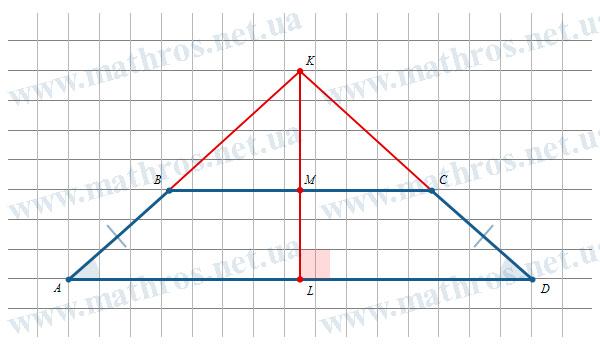
A cool way to look at an isosceles trapezoid is by considering it as part of a larger isosceles triangle. If you extend the equal legs, they will meet at a point, forming an isosceles triangle with the longer base of the trapezoid.
Why is this Interesting?
- If you extend AB and CD, they intersect at point K.
- The triangle AKD is isosceles because AB=CD.
- If you draw a perpendicular KL from K to AD, it acts as a line of symmetry for both the trapezoid and the triangle.
This explains why an isosceles trapezoid maintains symmetry and is closely related to an isosceles triangle.
Practical Problems: Applying Isosceles Trapezoid Properties
To gain a better grasp of the isosceles trapezoid, it’s helpful to apply these properties in practice. Here are a few examples to help you solidify your understanding and build problem-solving skills.
Example 1: In an Isosceles Trapezoid ABCD, the Heights From Vertices B and C Onto the Base AD Intersect It at Points K and L, Respectively. Find the Lengths of AK and LD If AD=15 cm and BC=5 cm

Since the trapezoid is isosceles, the heights BK and CL divide it into three figures: two congruent right triangles ABK and CLD, plus a rectangle KBCL. In a rectangle, opposite sides are equal, so KL=BC=5 cm.
To find segments AK and LD:

So, AK=LD=5 cm.
Example 2: In an Isosceles Trapezoid ABCD, ∠ABC is Three Times Larger than ∠BAD. Find All the Angles of the Trapezoid
The sum of the angles adjacent to the same leg in an isosceles trapezoid is 180°. Let ∠BAD=x. Then, according to the problem, ∠ABC=3⋅x.
We have:

Since the trapezoid is isosceles, angles at the same base are equal:

Hence, the angles of the trapezoid are 45°, 135°, 45°, 135°.
Example 3: The Height of an Isosceles Trapezoid Is 10 cm, and Its Diagonals Intersect at a 60° Angle. Find the Length of the Trapezoid Diagonals

Let O be the intersection point of the diagonals. In an isosceles trapezoid, triangle AOD is isosceles, meaning AO=OD. The angle ∠COD=60° is an external angle to triangle AOD. This makes the angles ∠OAD and ∠ODA each 30°.
Now, consider the right triangle BKD, where BK is the trapezoid’s height. The angle ∠BDK=30°. Using the relationships in a 30°-60°-90° right triangle, the hypotenuse BD is twice the shorter leg BK:

Thus, BD=20 cm. And since an isosceles trapezoid has equal diagonals, AC=BD=20 cm.
Keep Learning: More Resources to Boost Your Geometry Skills
Mastering the isosceles trapezoid is just the beginning! If you want to expand your knowledge and build even more confidence in solving geometry problems, here are a few key topics worth exploring:
- Midsegment (Median) of a Trapezoid – Learn how to calculate the midsegment (sometimes called the median) of a trapezoid and see how to apply this in practice.
- Perimeter of a Trapezoid – Discover quick methods for finding the perimeter, which is often crucial for solving more complex geometry questions.
- Area of a Trapezoid – Explore various ways to calculate the area and find practical examples demonstrating each method.
Diving into these topics will strengthen your understanding, sharpen your problem-solving skills, and prepare you for even more challenging geometry concepts. Keep practicing, and soon, you’ll be tackling any trapezoid problem with confidence!
Isosceles Trapezoid in Programming: How to Check?
Modern technology makes it easier than ever to explore geometry through programming. If you enjoy both math and coding, why not combine them by writing a simple program to identify an isosceles trapezoid? By using logical conditions and geometric properties, you can create an algorithm that quickly determines whether a given quadrilateral meets the criteria for being an isosceles trapezoid.

The flowchart above provides a great starting point for your program. Your code should check whether exactly one pair of opposite sides is parallel and whether the other two sides are equal. Based on these conditions, the program should output either “Yes, this is an isosceles trapezoid” or “No, this is not an isosceles trapezoid”. Try implementing this logic in your favorite programming language and see how quickly your algorithm can classify different quadrilaterals!