If you’ve ever wondered about the structure of a trapezoid or how certain special segments within it work, this article is here to help. In particular, we’ll focus on the midsegment of a trapezoid — what it is, why it’s always parallel to the bases, and how you can use it in problem-solving. We’ll explore clear examples and easy-to-follow explanations so you can confidently put your knowledge into practice. Let’s dive in!
What Is the Midsegment of a Trapezoid? Definition and Properties
A trapezoid (in British English, often called a trapezium) is a quadrilateral with exactly two sides parallel to each other. These parallel sides are called the bases, and the other two sides are called the legs (or non-parallel sides). If the legs are equal, the trapezoid is called isosceles; if one of the legs is perpendicular to the bases, we have a right trapezoid.
So, what is the midsegment of a trapezoid and why is it important? Simply put, the midsegment is the line segment connecting the midpoints of the trapezoid’s legs. One of its coolest properties is that it’s always parallel to both bases.

Imagine a trapezoid ABCD where AD and BC are the bases, and AB and CD are the legs. If you label the midpoints of the legs as K (on AB) and N (on CD), the segment KN is the midsegment. Remarkably, it will be parallel to AD and BC.
The reason this works involves the properties of midsegments in triangles. If you draw a diagonal (say AC), you split the trapezoid into two triangles, ABC and ACD. Each triangle has its own midsegment that is parallel to one side. Putting these two midsegments together forms the single line KN, which then proves to be parallel to both bases of the trapezoid.
Key Properties of the Midsegment
- It Passes Through the Midpoints of the Diagonals: In trapezoid ABCD, if you draw both diagonals AC and BD, the midsegment will intersect each diagonal at its midpoint.
- It’s Parallel to the Bases: As noted, the midsegment (let’s denote it KN) is parallel to both AD and BC. Symbolically, KN||AD and KN||BC.
- It’s Length Is Half the Sum of the Bases: Perhaps the most commonly used property in problem-solving is that the length of the midsegment is the average of the lengths of the two bases:

This stems from the fact that each segment in the triangles formed by drawing a diagonal is half the length of one of the trapezoid’s bases.
Midsegment of a Trapezoid: Problem-Solving Examples
It’s one thing to know the properties; it’s another to see them in action. Below are a few classic examples that illustrate how to apply the concept of the midsegment in practical geometry problems.
Example 1: The Larger and Smaller Bases of a Trapezoid Measure 4 cm and 8 cm, Respectively. Find the Length of the Longer Segment that One of the Diagonals Divides the Midsegment Into

We know that the midsegment of trapezoid ABCD coincides with the midsegments of triangles ABC and ACD. Since the midsegment passes through the midpoint of the shared side (the diagonal) and is parallel to the bases, we can define the required segment as LM in triangle ACD. Using the property of midsegments in triangles, we get:

Thus, the length of segment LM is 4 cm.
Example 2: The Bases of a Trapezoid Measure 10 cm and 20 cm. Find the Segment that Connects the Midpoints of the Diagonals of this Trapezoid
Since the midsegment of a trapezoid contains points that are the midpoints of the diagonals, we define this segment as LM, which is a part of the midsegment KN. At the same time:

Thus,

So, the length of segment LM is 5 cm.
Example 3: The Bases of a Trapezoid Are in a 1:3 Ratio. The Midsegment Measures 30 cm. Find the Lengths of the Bases
Let the smaller base be BC=x. Then, the larger base is AD=3⋅x. Using the midsegment formula, we write:

Since KN=30, we get:

Thus, BC=15 cm and AD=45 cm.
Example 4: In an Isosceles Trapezoid ABCD, the Diagonals Are Perpendicular. The Height is 14 cm. Find the Midsegment of the Isosceles Trapezoid

Since the diagonals are perpendicular, the triangles AOD and BOC are right and isosceles. The heights KO and OL in these triangles are also medians, and the median to the hypotenuse in a right isosceles triangle always equals half of the hypotenuse. Therefore:
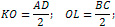
Since KL is the height of the trapezoid, we write:

Thus, the midsegment of the isosceles trapezoid is also 14 cm long.
Want to Learn More? Useful Resources for Expanding Your Knowledge
If this topic has sparked your interest in trapezoids and geometry in general, there’s plenty more to explore. The more you know about various geometric figures, the faster you can tackle complex problems. Here are a few ideas to keep you going:
- What Is a Trapezoid – A thorough breakdown of trapezoid characteristics, plus essential calculations.
- Perimeter of a Trapezoid – Learn to find the perimeter quickly and accurately with practical problem-solving tips.
- Area of a Trapezoid – Dive into area calculations for trapezoids, complete with detailed examples and hints.
By exploring these resources, you’ll deepen your geometric knowledge and become more adept at solving a wide range of problems. Keep pushing forward—there’s always something new and exciting to learn in geometry!
Flowchart for Programmers: Finding the Midsegment
Sometimes, geometry pairs perfectly with programming. If you’re looking to automate your calculations—say, for a personal project or a classroom demo—you can translate geometric methods into a short piece of code. Below is a simple step-by-step flowchart outline you might use as a starting point:

Using this as a guide, you can write a program in your favorite language (Python, C++, Java, etc.). It’s a neat way to blend geometry with coding and sharpen your algorithmic thinking. Give it a try and enjoy seeing math and programming come together!