Adding fractions is one of those essential skills that everyone dealing with mathematics needs. Whether you encounter simple numerical fractions or more complex algebraic ones, the fundamental approach remains the same. The key is to understand the difference between adding fractions with like denominators and adding fractions with unlike denominators. So, let’s go through both cases step-by-step and learn how to solve such examples effectively.
Adding Fractions with Like Denominators: The Easy Way
When fractions have the same denominators, adding them becomes very straightforward. These fractions are also called similar fractions. For example, how do we add the fractions 2/(x+5) and 3/(x+5)? Here, it’s clear: we keep the denominator as is, and simply add the numerators.
The algorithm is simple:
- Combine the fractions under a common denominator. The denominator is already the same, so no extra work is required.
- Add the numerators, combining like terms.
- Simplify the expression if possible.
That’s it! Using this method, even complicated expressions become easy.
Adding Fractions with Unlike Denominators: What to Do?
But what if the fractions have different denominators? For instance, fractions 1/(x-2) and 4/(x+3) cannot be immediately added. In these cases, you need to find the Least Common Denominator (LCD).
The steps are:
- Find the Least Common Denominator (LCD).
- Convert each fraction so that denominators become the same. Adjust the numerators by multiplying them with the factors obtained from dividing the new denominator by the old one.
- Combine the fractions under one common denominator and add their numerators.
- Simplify the resulting fraction, if possible.
Although this process takes a bit longer, it’s still simple and clear. Just make sure not to skip any step.
Reinforcing Knowledge with Practice: Solving Examples
Now, it’s time to apply the knowledge we’ve acquired in practice and solve some fraction addition problems. We’ll go through them step-by-step together, so you can confidently master this essential skill. Let’s move to practical exercises!
Example 1: Add the Fractions and Simplify the Result

Here, we have fractions with like denominators. This means we can immediately combine them under a common denominator by adding their numerators together:

Now, let’s combine like terms in the numerator:
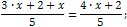
This expression can’t be simplified further, so it’s our final result.
Example 2: Find the Sum of the Following Fractions

Now, we’re dealing with fractions with unlike denominators, so we first find the Least Common Denominator (LCD). Here, the LCD is the product of both denominators: (x-1)⋅(x+3). We convert fractions to have this common denominator by multiplying their numerators appropriately:

Now that denominators match, we can combine numerators:

This fraction cannot be simplified further, so that’s our final answer.
Example 3: Perform the Addition of Fractions
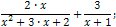
Notice the denominator of the first fraction is a quadratic trinomial. We can factor it as follows: x2+3⋅x+2=(x+1)⋅(x+2). Thus, the Least Common Denominator will be exactly (x+1)⋅(x+2).
We convert the second fraction to have this denominator:

Now, combine fractions under one common denominator:

This result is already simplified, making it our final solution.
Want to Go Deeper? Recommended Topics for Further Study
If you’re interested in further mastering operations with algebraic fractions, we suggest exploring the following useful resources. These topics perfectly complement the skills you’ve already acquired and help build confidence when working with fractions:
- Subtracting Algebraic Fractions: Examples and Solutions – Master subtracting fractions with like and unlike denominators. Clear explanations and detailed solutions help avoid common mistakes.
- Multiplying Algebraic Fractions: Examples and Solutions – Learn how to multiply algebraic fractions correctly. Step-by-step examples clarify even complex expressions easily.
- Dividing Algebraic Fractions: Examples and Solutions – Learn quick and effective fraction division. Step-by-step instructions and simple examples make this topic easily understandable even for beginners.
And if you’ve thoroughly grasped the theory and are now solving fraction problems, but you’re unsure about your answers, try using an online fraction calculator. This convenient tool instantly checks your solutions, giving you confidence in your skills!
From Calculations to Automation: Transforming Fraction Addition into a Program!
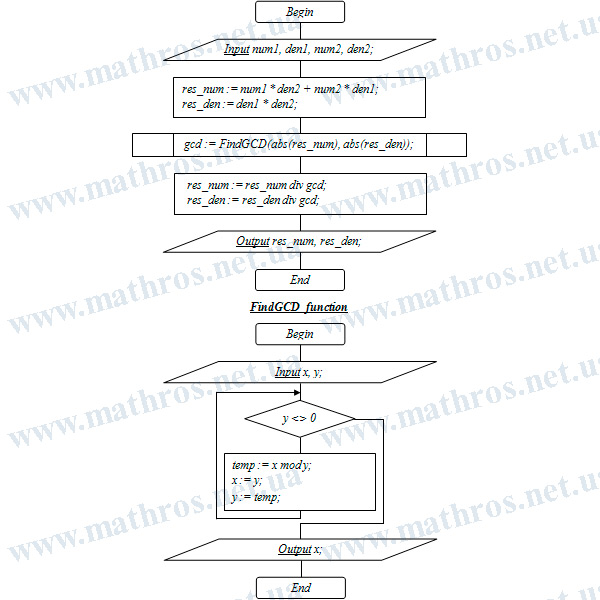
Now that you’re comfortable adding algebraic fractions manually, it’s the perfect moment to automate this process using programming! Use the provided flowchart below, detailing each step of the algorithm, allowing you to quickly transform mathematical calculations into practical programming code. With this approach, you can easily create your own application for adding fractions and see how mathematics integrates into the modern technological world!