Dividing fractions is a topic that often leads to confusion—especially when algebraic expressions come into play. But is it really that difficult? Not at all. Once you understand a few basic rules, the process becomes clear and logical. In this article, we’ll walk you through dividing fractions step by step, so you can confidently handle even the most challenging problems.
Dividing Fractions: What Do You Need to Know?
So how does dividing fractions actually work?
Let’s begin with the key idea—to divide one fraction by another, simply convert the division into multiplication. This single step makes everything easier. But how do you do it correctly?
First, find the reciprocal of the second fraction—flip it upside down so the numerator becomes the denominator and vice versa. That’s the trick that allows you to turn division into multiplication.
Next, multiply the first fraction by the reciprocal of the second. Multiply the numerators together, then do the same with the denominators. Finally, simplify the result if possible. If simplification isn’t possible, leave the answer in its current form.
Here’s a quick summary of the steps:
- Flip the second fraction.
- Change the division sign to a multiplication sign.
- Multiply the numerators.
- Multiply the denominators.
- Simplify the result if possible.
With this structure in mind, dividing fractions becomes much more manageable. In the next section, we’ll see how these steps work in actual examples.
Let’s Solve It Together: Practical Examples of Dividing Fractions
Learning the rules is just the beginning. To really understand how dividing fractions works, you need to see the rules applied in real problems—and even better, practice them yourself. Let’s explore a few examples step by step so that everything becomes crystal clear.
Example 1: Divide Fractions and Simplify the Result

First, we find the reciprocal of the second fraction: x/5 becomes 5/x. Then we replace division with multiplication and multiply the fractions:

Now multiply the numerators and the denominators:

Since the expression cannot be simplified further, this is the final answer.
Example 2: Find the Result of the Following Fractions Division
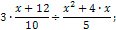
Again, we follow the same steps: flip the second fraction and multiply:

Now in the numerator we have multiplication: 3⋅(x+12)⋅5. In the denominator: 1⋅10⋅(x2+4⋅x). Remember, 3 is also a fraction 3/1, so the full expression is:

Both parts have a common factor of 5. Let’s simplify:

This is the simplified result.
Example 3: Perform Fractions Division
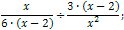
We begin by flipping the second fraction: (3⋅(x-2))/x2 becomes x2/(3⋅(x-2)). Then we multiply:

Now multiply the numerators: x⋅x2, and the denominators: 6⋅(x-2)⋅3⋅(x-2):

Since the expression can’t be simplified further, this is the final result.
Want to Know More? Topics Worth Exploring
If you’re now feeling confident with dividing fractions, why not explore further? Every new algebra topic you learn builds on your foundation and helps you understand math more deeply. Here are a few valuable topics to explore next. They directly connect to what we’ve already discussed.
- Adding Algebraic Fractions: Examples and Solutions – Learn how to find a common denominator and add fractions step by step with clear explanations and practice problems.
- Subtracting Algebraic Fractions: Examples and Solutions – Understand the process of subtracting fractions with different denominators. Even tricky expressions become manageable with step-by-step reasoning.
- Multiplying Algebraic Fractions: Examples and Solutions – Learn how to multiply fractions and simplify expressions without unnecessary complications.
Choose the topic that interests you most and continue your journey through algebra. And if you’re practicing on your own—working through problems and unsure whether your answer is right—try using an online fraction calculator. It’s a fast, accurate way to check your results and build confidence.
From Calculation to Code: Your First Step to Building a Program
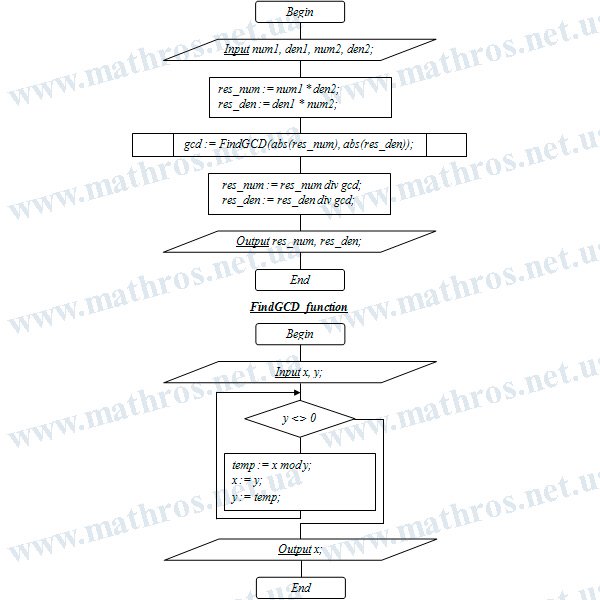
Now that you’ve mastered dividing fractions and explored related topics, why not level up? Try building a simple program of your own. Imagine this: you enter two fractions, and the program handles everything—converts division to multiplication, performs the calculations, simplifies the answer, and displays the final result.
To help you bring this idea to life, we’ve included a flowchart below that outlines all the key steps. It’s a great starting point for anyone interested in combining math with coding—and creating their very own educational tools.