The mechanical and geometric interpretation of the derivative shows that the derivative is not just a rule for calculations. It helps us understand how a quantity changes at a certain point or at a certain moment in time. First, we look at the change over a small interval. Then we gradually make this interval smaller until it approaches zero. This is exactly how the main idea of the derivative appears: the transition from average change to instantaneous change.
Geometric Interpretation of the Derivative: The Slope of the Tangent to a Graph
Let’s begin with the geometric interpretation. Suppose we have a function \( y=f(x) \) and a point \( M_0(x_0,f(x_0)) \) on its graph. What does the derivative show at this point? It describes the slope of the graph near the point \( M_0 \).
To see this more clearly, take another point on the graph: \( M(x_0+h,f(x_0+h)) \). Through the points \( M_0 \) and \( M \), we can draw a secant line. This line intersects the graph at two points and shows the average slope of the graph on the interval from \( x_0 \) to \( x_0+h \).
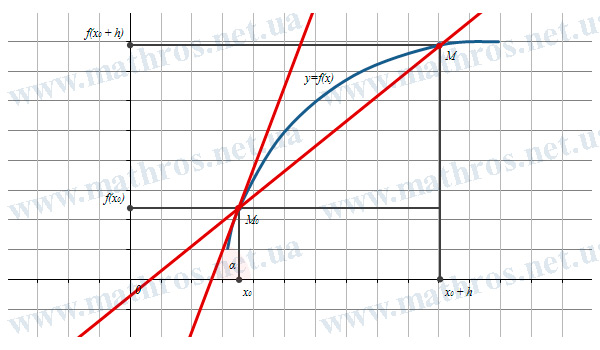
Let us denote the slope of this secant line by \( k_{M_0M} \). Then:
\[
k_{M_0M}=
\frac{f(x_0+h)-f(x_0)}{h}.
\]
In this formula, \( h \) is the change in the argument. The expression \( f(x_0+h)-f(x_0) \) is the change in the function. So, the ratio \( \frac{f(x_0+h)-f(x_0)}{h} \) shows how the function changes on average over this interval.
Now imagine that the point \( M \) moves closer to the point \( M_0 \). Then \( h\to 0 \), and the secant line gradually turns into the tangent line to the graph at the point \( M_0 \). Therefore, we denote the slope of the tangent line by \( k \) and find it as a limit:
\[
k=
\lim_{h\to 0}k_{M_0M}=
\lim_{h\to 0}
\frac{f(x_0+h)-f(x_0)}{h}.
\]
If this limit exists, then it is the derivative of the function at the point \( x_0 \). So, we have:
\[
k=
\lim_{h\to 0}
\frac{f(x_0+h)-f(x_0)}{h}
=
f'(x_0).
\]
If we denote the angle between the tangent line and the positive direction of the \( OX \)-axis by \( \alpha \), then the slope of the tangent line is equal to \( \tan(\alpha) \). Therefore, we can write: \( f'(x_0)=\tan(\alpha) \).
Thus, the geometric interpretation of the derivative means that the derivative of a function at a point is equal to the slope of the tangent line to the graph of the function at that point. Simply put, the derivative shows how the graph behaves near the chosen point: whether it rises, falls, or has a horizontal direction.
Mechanical Interpretation of the Derivative: Instantaneous Speed of Motion
Now let’s move on to the mechanical interpretation. Suppose a point moves along a straight line, and its position or displacement is given by the law \( S=S(t) \). Here, \( S \) is the coordinate or displacement of the point at time \( t \), and \( t \) is time.
Assume that at time \( t \), the point is in the position \( M \), and at time \( t+h \), it is in the position \( M_1 \). During this time interval, its position changes by the amount \( S(t+h)-S(t) \).
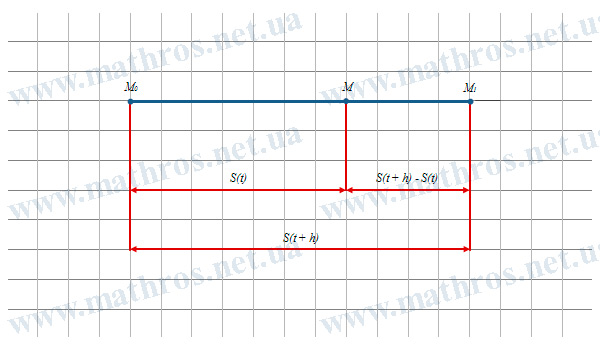
Let us denote the average speed over this time interval by \( v_{MM_1} \). Then:
\[
v_{MM_1}=
\frac{S(t+h)-S(t)}{h}.
\]
This is the ratio of the change in the point’s position to the time interval. It shows how fast the point moved on average during the interval from \( t \) to \( t+h \). But in mechanics, it is often important to know not the average speed, but the speed at one exact moment. How can we do that?
To do this, we need to make the time interval smaller. In other words, we consider the situation when \( h\to 0 \). Then the average speed turns into instantaneous speed:
\[
v(t)=
\lim_{h\to 0}v_{MM_1}.
\]
Since \( v_{MM_1}=\frac{S(t+h)-S(t)}{h} \), we get:
\[
v(t)=
\lim_{h\to 0}
\frac{S(t+h)-S(t)}{h}.
\]
If this limit exists, then it is equal to the derivative of the position or displacement with respect to time. Therefore, we obtain:
\[
v(t)=S'(t).
\]
So, the mechanical interpretation of the derivative means that the derivative of position or displacement with respect to time is equal to the instantaneous speed of motion. In other words, the derivative shows how quickly the position of a point changes at a given moment in time.
Let’s summarize the main idea. In geometry, the derivative helps us move from the average slope of a secant line to the slope of a tangent line. In mechanics, it helps us move from average speed to instantaneous speed. That is why, in both cases, the derivative describes the instantaneous change of a quantity.
Mechanical and Geometric Interpretation of the Derivative: Practical Application in Problems
Now let’s move from explanation to practice. Examples make it much easier to see how the derivative helps us find the slope of a tangent line, the angle of inclination of a graph, and the instantaneous speed of motion.
Example 1. Find the slope of the tangent line to the graph of \( f(x)=5\cdot x^3+3\cdot x \) at the point with \( x \)-coordinate \( 1 \)
From the geometric interpretation of the derivative, we know that the slope of the tangent line is equal to the value of the derivative of the function at the given point. So, we need to find \( f'(1) \).
First, let’s find the derivative of the function:
\[
f'(x)=
\left(5\cdot x^3+3\cdot x\right)’.
\]
Now we apply the differentiation rule for a power function:
\[
f'(x)=
5\cdot 3x^2+3=
15\cdot x^2+3.
\]
Now substitute \( x=1 \):
\[
k=f'(1)=
15\cdot 1^2+3=
15+3=
18.
\]
So, the slope is \( k=18 \). This means that at the point with \( x \)-coordinate \( 1 \), the graph of the function has a rather large positive slope. In other words, the tangent line at this point rises sharply upward.
Example 2. Find the angle the tangent line makes with the ( OX )-axis for the graph of \( f(x)=-\frac{1}{x} \) at the point \( M(1,-1) \)
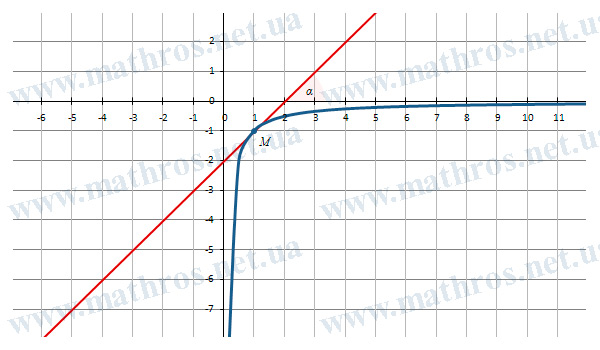
First, let’s make sure that the point really belongs to the graph of the function. If \( x=1 \), then \( f(1)=-\frac{1}{1}=-1 \). So, the point \( M(1,-1) \) belongs to the graph.
Next, we use the geometric interpretation of the derivative. If \( \alpha \) is the angle of inclination of the tangent line to the positive direction of the \( OX \)-axis, then we have \( \tan(\alpha)=f'(x_0) \).
In our problem, \( x_0=1 \). So first we find the derivative of the function:
\[
f(x)=
-\frac{1}{x}
=
-x^{-1}.
\]
Then:
\[
f'(x)=
\left(-x^{-1}\right)’=
x^{-2}=
\frac{1}{x^2}.
\]
Now let’s calculate the value of the derivative at \( x=1 \):
\[
f'(1)=
\frac{1}{1^2}=
1.
\]
So:
\[
\tan(\alpha)=1.
\]
From here, we find the angle:
\[
\alpha=
\arctan(1)=
\frac{\pi}{4}.
\]
Therefore, the angle of inclination of the tangent line to the \( OX \)-axis is \( \frac{\pi}{4} \). That is, the tangent line forms an angle of \( 45^\circ \) with the positive direction of the \( OX \)-axis. Why exactly? Because the value of the derivative is \( 1 \), and this means that the tangent line has a slope for which the tangent of the angle equals one.
Example 3. The motion of a material point is given by \( S(t)=t^2-6\cdot t-3 \). Determine the time when the speed of the point equals zero
Here we need to use the mechanical interpretation of the derivative. If the position of a point is given by the function \( S(t) \), then the instantaneous speed is equal to the derivative of this function with respect to time. That is, \( v(t)=S'(t) \).
In the first step, let’s find the derivative of the function \( S(t) \):
\[
v(t)=
S'(t)=
\left(t^2-6\cdot t-3\right)’.
\]
Differentiate each term separately:
\[
v(t)=
2\cdot t-6.
\]
According to the condition of the problem, the speed must equal zero. So, we write the equation:
\[
2\cdot t-6=0.
\]
Now solve it:
\[
2\cdot t=6,
\qquad
t=3.
\]
Therefore, the speed of the material point equals zero at time \( t=3 \).
How can we interpret this in mechanics? At this moment, the instantaneous speed of the point is zero. In other words, we have an instantaneous stop, although the motion may continue after that.
Example 4. Find the equation of the tangent line to the Graph of \( f(x)=x^2-4\cdot x+5 \) at the point with \( x \)-coordinate \( 3 \)
In this problem, we need not only to find the slope of the tangent line, but also to write its equation. How can we do that? First, we find the point of tangency, and then we find the slope of the tangent line.
Find the value of the function at \( x=3 \):
\[
f(3)=
3^2-4\cdot 3+5=
9-12+5=
2.
\]
So, the point of tangency has the coordinates \( M(3,2) \).
Now let’s find the derivative of the function:
\[
f'(x)=
\left(x^2-4\cdot x+5\right)’=
2\cdot x-4.
\]
The slope of the tangent line is equal to the value of the derivative at \( x=3 \):
\[
k=f'(3)=
2\cdot 3-4=
6-4=
2.
\]
Now we use the equation of a line that passes through the point \( M(x_0,f(x_0)) \) and has slope \( k \):
\[
y-f(x_0)=
k\cdot (x-x_0).
\]
In our case, \( x_0=3 \), \( f(x_0)=2 \), and \( k=2 \). Therefore:
\[
y-2=
2\cdot (x-3).
\]
Open the parentheses:
\[
y-2=
2\cdot x-6.
\]
Add \( 2 \) to both sides of the equality:
\[
y=
2\cdot x-4.
\]
So, the equation of the tangent line is:
\[
y=2\cdot x-4.
\]
In this problem, the derivative helped us find the slope of the tangent line. After that, we used the usual equation of a straight line. This is exactly how the geometric interpretation of the derivative works in tangent-line problems.
Example 5. The motion of a material point is given by \( S(t)=t^3-3\cdot t^2+2\cdot t+1 \). Determine the times when the speed of the point equals \( 2 \)
Again, we use the mechanical interpretation of the derivative. If the law of motion \( S(t) \) is known, then we find the speed as the derivative: \( v(t)=S'(t) \).
Find the derivative of the function \( S(t) \):
\[
v(t)=
S'(t)=
\left(t^3-3\cdot t^2+2\cdot t+1\right)’.
\]
Differentiate term by term:
\[
v(t)=
3\cdot t^2-6\cdot t+2.
\]
According to the condition of the problem, the speed equals \( 2 \). So, we write the equation:
\[
3\cdot t^2-6\cdot t+2=2.
\]
Move everything to one side, or simply subtract \( 2 \) from both sides:
\[
3\cdot t^2-6\cdot t=0.
\]
Factor out the common factor \( 3\cdot t \):
\[
3\cdot t\cdot (t-2)=0.
\]
A product is equal to zero when at least one of its factors is equal to zero. Therefore, we have two cases:
\[
\begin{gathered}
3\cdot t=0,
\qquad
t=0,
\\[4pt]
t-2=0,
\qquad
t=2.
\end{gathered}
\]
So, the speed of the point equals \( 2 \) at times \( t=0 \) and \( t=2 \).
What does this example show? The derivative allows us not only to find speed at a certain moment. It also helps us determine when the speed takes a required value. That is why the mechanical interpretation of the derivative is often used in motion problems.
What to Read Next: Topics for Further Study
After studying the mechanical and geometric interpretation of the derivative, it is worth moving on to calculation techniques. After all, once you understand what the derivative means, the next natural question appears: how can we find it quickly and correctly?
- Rules for Differentiating Functions and the Table of Derivatives: Calculations Without Limits — This material will explain the basic rules of differentiation and show how the table of derivatives helps you quickly move from a function to its derivative.
- Derivative of a Composite Function: Applying the Chain Rule — This article explains how to find the derivative of a composite function and how to correctly identify the outer and inner parts.
- Derivative of an Implicitly Defined Function: Differentiating Equations — This article will discuss how to find a derivative when a function is given through an equation with two variables, rather than in the usual explicit form.
Geometric Interpretation of the Derivative: From a Flowchart to Your Own Program
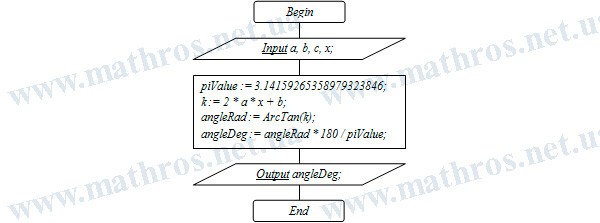
If you enjoy programming, try taking one more step: implement the algorithm from the given flowchart in your favorite programming language. It can be Pascal, Python, C++, JavaScript, or any other language.
The main idea is simple and interesting: the program should find the derivative of a quadratic function at a given point, determine the slope of the tangent line, and calculate the angle of its inclination to the \( OX \)-axis in degrees.
In this way, you will not just review the theory. You will also see how the geometric interpretation of the derivative turns into a real algorithm that works with numbers and gives a specific result.