Arc length of a curve is a practical topic in calculus that often appears in physics, engineering, and geometry. How much “distance” does a point travel along a graph between x=a and x=b? How can we turn this question into a clear, computation-ready formula? The answer comes from the definite integral. Below, we’ll briefly and consistently see how a geometric idea turns into a working formula you can use in practice.
Arc Length of a Curve: From an Inscribed Polyline to the Limit
Let y=f(x) be a continuous function on the interval [a,b]. We want the length of the arc between the points whose x-coordinates are x=a and x=b. Where do we start? First, “split” the arc with points A=M0, M1, M2, M3,…, Mn=B so that x0=a and xn=b.

Next, connect neighboring points with segments Mi-1Mi. This gives a polyline inscribed in the arc. Its total length equals the sum of the segment lengths:

What happens as we make the partition finer and finer? The polyline follows the arc more and more closely. So it’s natural to define the length of the arc itself as the limit of the lengths of these inscribed polylines, as the largest partition segment tends to zero and the number of segments grows without bound:
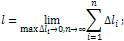
This definition turns the geometric idea into a rigorous mathematical statement. But how do we actually compute it in practice? Let’s move to the formula.
From the Definition to the Integral: A Working Formula
Consider a single segment of the polyline Mi-1Mi. By the distance formula between two points in the plane, we have:

Since y=f(x), it follows that yi-yi-1=f(xi)-f(xi-1). By the Mean Value Theorem, there exists ξi∈(xi-1, xi) such that f(xi)-f(xi-1)=f'(ξi)⋅(xi-xi-1). Substituting into the segment-length formula gives:

Now return to the limit of the sum. We have:

Doesn’t this look like a Riemann sum? Exactly. If f'(x) is continuous on [a,b], the limit exists and equals the definite integral:
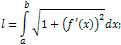
Therefore, we have a convenient and universal formula. It connects the geometric idea of arc length with the analytic tool—the definite integral. In short, when f'(x) is continuous on [a,b], the arc length exists, is finite, and is computed by this formula.
Arc Length of a Curve: Practical Example with a Step-by-Step Solution
The theory is ready, so it’s time to test it in action. Seeing how the formula works on a specific function is always more convincing. Let’s choose a simple graph and move from the problem statement to a numerical result, step by step.
Example 1: Find the arc length of the curve f(x)=x2 that lies between the points with x=-1 and x=1
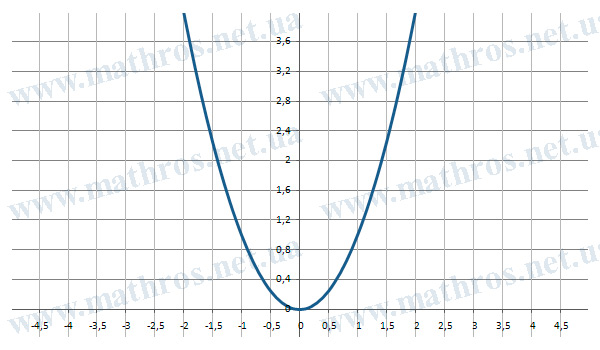
First, compute the derivative: f'(x)=2⋅x. Then the integrand becomes √(1+(f'(x))2)=√(1+4⋅x2). Hence,
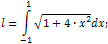
Notice that √(1+4⋅x2) is an even function. So it’s convenient to double the integral on [0,1]:
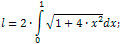
Use the known antiderivative:

Now substitute the integration limits [0,1]:

Therefore,

The numerical value of this length is l=2.957886.
For verification, you can compute it numerically, for example, by Simpson’s method with n=10 equal subintervals. To save time on hand calculations, use an online calculator—it’s quick and convenient.

After entering the integrand and the integration limits, we get:

This value agrees well with the analytical result. So, the formula works accurately, and approximate methods confidently confirm the solution.
Where to Go Next: Three Topics to Deepen Your Knowledge
Ready to cement what you’ve learned and go deeper? Choose the path that fits your goals. Do you want more accuracy or new dimensions of problems? Let’s start small—but confidently.
- Romberg Method: Formulas, Explanations, Examples – See how Richardson extrapolation built on the trapezoidal rule quickly boosts the accuracy of definite integrals with moderate computation.
- Area of a Plane Figure: When Curves Become Boundaries – Understand how to use the integral to find areas between curves, and apply it to real, graph-based problems.
- Double Integrals with the Grid Method: A Step Toward Multidimensionality – Get familiar with partitioning a region into cells to integrate functions of two variables and see the logic of 2D integration.
From Theory to Code: Build Your Mini-Tool
And finally, if you already feel confident with the concept of arc length, why not turn that knowledge into a handy tool for everyday practice? When the computer handles the routine calculations, you can focus on what really matters: the meaning of the problem, checking correctness, and analyzing results. Choose the programming language you like, and make the process transparent and engaging—the flowchart below clearly shows the logic, and you can adapt it to your needs to get a reliable helper for quick and accurate calculations.
