The derivative of tangent squared shows up a lot in problems with trigonometric transformations, function analysis, and finding extreme values. And yes, it’s easy to mix up similar-looking expressions. After all, \( \tan^2(x) \) means the square of tangent, that is \( (\tan(x))^2 \), not \( \tan(x^2) \). So let’s fix the structure right away: we have a composite function where the outer part is “squaring”, and the inner part is “tangent”. This is the simplest way to organize differentiation correctly.
Derivative of Tangent Squared: Main Formula and Graphs
Let’s start with the formula that’s most often needed in practice. Suppose
\[
y=\tan^2(x).
\]
Then the derivative is
\[
\frac{d}{dx}\bigl(\tan^2(x)\bigr)=\bigl(\tan^2(x)\bigr)’=\frac{2 \cdot \sin(x)}{\cos^3(x)}.
\]
Here’s an important detail: both the function \( \tan^2(x) \) and its derivative are not defined where \( \cos(x)=0 \). That is, at points of the form
\[
x=\frac{\pi}{2}+\pi \cdot k,
\]
where tangent has discontinuities. It may seem like a small thing, but it’s exactly the kind of detail that helps you avoid mistakes when working with the domain.
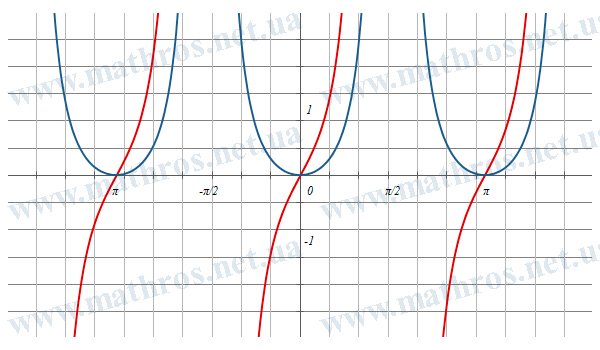
Now let’s look at what the graphs tell us. The function \( \tan^2(x) \) is always non-negative, because a square can’t be negative. Near the points where \( \cos(x)=0 \), it grows extremely fast and tends toward infinity. The derivative changes its sign depending on the interval, so it shows where \( \tan^2(x) \) is increasing and where it is decreasing. And if, on some interval, the derivative becomes zero, that’s a signal of possible local extrema at those points where the function is defined.
Step by Step: Deriving the Formula Using the Chain Rule
Now let’s derive the derivative of tangent squared step by step. First, rewrite the function so its structure is as clear as possible:
\[
y=\tan^2(x)=\bigl(\tan(x)\bigr)^2.
\]
Here you can clearly see the order of operations: first we compute \( \tan(x) \), and then we square the result. So we apply the chain rule.
Let’s make a substitution:
\[
u=\tan(x), \qquad y=u^2.
\]
Then, by the chain rule, we have:
\[
\frac{dy}{dx}=\frac{dy}{du} \cdot \frac{du}{dx}.
\]
Now we find each derivative separately. For the outer function \( y=u^2 \):
\[
\frac{dy}{du}=2 \cdot u.
\]
For the inner function \( u=\tan(x) \), we use the known derivative:
\[
\frac{du}{dx}=\bigl(\tan(x)\bigr)’=\sec^2(x).
\]
Now multiply them:
\[
\frac{dy}{dx}=2 \cdot u \cdot \sec^2(x).
\]
Replace \( u \) back with \( \tan(x) \):
\[
\frac{dy}{dx}=2 \cdot \tan(x) \cdot \sec^2(x).
\]
At this point, the derivative is already found, and this form is completely correct. Next, we’ll rewrite it using sine and cosine, because that’s often more convenient in practice.
Recall the relationships:
\[
\tan(x)=\frac{\sin(x)}{\cos(x)}, \qquad \sec^2(x)=\frac{1}{\cos^2(x)}.
\]
Substitute them into \( 2 \cdot \tan(x) \cdot \sec^2(x) \):
\[
2 \cdot \tan(x) \cdot \sec^2(x) = 2 \cdot \frac{\sin(x)}{\cos(x)} \cdot \frac{1}{\cos^2(x)}.
\]
Now multiply the fractions. In the denominator we get \( \cos(x) \cdot \cos^2(x) = \cos^3(x) \), and in the numerator we get \( 2 \cdot \sin(x) \). So:
\[
\frac{d}{dx}\bigl(\tan^2(x)\bigr) = \frac{2 \cdot \sin(x)}{\cos^3(x)}.
\]
Notice why the denominator is exactly \( \cos^3(x) \): one factor \( \cos(x) \) comes from the tangent, and the other two come from \( \sec^2(x) \). And again, it’s important to remember the condition \( \cos(x)\neq 0 \), otherwise the expression is not defined.
Derivative of Tangent Squared: Solved Examples
Now let’s move on to practice and lock the formula in with some typical problems. In most exercises, the derivative of tangent squared appears as part of a bigger expression, so it’s important to clearly see where the tangent is being squared and which differentiation rule you should use. In each example below, we’ll follow the same approach: first we identify the composite part, and then we apply the needed rules step by step.
Example 1. Find the derivative of \( y=\tan^2(2 \cdot x+3) \cdot x \)
Here we have a product of two functions: \( x \) and the square of the tangent of \( 2 \cdot x+3 \). So we use the product rule:
\[
y’=\bigl(\tan^2(2 \cdot x+3)\bigr)’ \cdot x+\tan^2(2 \cdot x+3) \cdot (x)’.
\]
The second term is easy because \( (x)’=1 \), so it equals \( \tan^2(2 \cdot x+3) \).
Now let’s find \( \bigl(\tan^2(2 \cdot x+3)\bigr)’ \). Set
\[
u=2 \cdot x+3,\quad z=\tan^2(u).
\]
Then
\[
\frac{dz}{dx}=\frac{dz}{du}\cdot\frac{du}{dx}.
\]
For the outer derivative \( z=\tan^2(u) \), using the known formula:
\[
\frac{dz}{du}=\frac{2 \cdot \sin(u)}{\cos^3(u)}.
\]
And for the inner argument:
\[
\frac{du}{dx}=2.
\]
So
\[
\bigl(\tan^2(2 \cdot x+3)\bigr)’=2 \cdot \frac{2 \cdot \sin(2 \cdot x+3)}{\cos^3(2 \cdot x+3)}=\frac{4 \cdot \sin(2 \cdot x+3)}{\cos^3(2 \cdot x+3)}.
\]
Now return to the product rule:
\[
y’=\frac{4 \cdot \sin(2 \cdot x+3)}{\cos^3(2 \cdot x+3)}\cdot x+\tan^2(2 \cdot x+3).
\]
Example 2. Find the derivative of \( y=\dfrac{\tan^2(3 \cdot x-1)}{x^2+1} \)
This is a quotient, so we apply the quotient rule. Let
\[
u=\tan^2(3 \cdot x-1),\quad v=x^2+1.
\]
Then
\[
y’=\frac{u’\cdot v-u\cdot v’}{v^2}.
\]
First find \( v’ \):
\[
v’=(x^2+1)’=2 \cdot x.
\]
Now compute \( u’=\bigl(\tan^2(3 \cdot x-1)\bigr)’ \). Let
\[
t=3 \cdot x-1,\quad u=\tan^2(t).
\]
Then
\[
u’=\frac{du}{dt}\cdot \frac{dt}{dx}.
\]
We have
\[
\frac{du}{dt}=\frac{2 \cdot \sin(t)}{\cos^3(t)},\qquad \frac{dt}{dx}=3.
\]
So
\[
u’=3\cdot \frac{2 \cdot \sin(3 \cdot x-1)}{\cos^3(3 \cdot x-1)}=\frac{6 \cdot \sin(3 \cdot x-1)}{\cos^3(3 \cdot x-1)}.
\]
Substitute everything into the quotient rule:
\[
y’=\frac{\frac{6 \cdot \sin(3 \cdot x-1)}{\cos^3(3 \cdot x-1)}\cdot (x^2+1)-\tan^2(3 \cdot x-1)\cdot 2 \cdot x}{(x^2+1)^2}.
\]
Example 3. Find the derivative of \( y=\tan^2(x^2-4 \cdot x) \)
This is a composite function: the outer part is tangent squared, and the inner part is the polynomial \( x^2-4 \cdot x \). Let
\[
t=x^2-4 \cdot x,\quad y=\tan^2(t).
\]
Then by the chain rule,
\[
\frac{dy}{dx}=\frac{dy}{dt}\cdot\frac{dt}{dx}.
\]
Outer derivative:
\[
\frac{dy}{dt}=\frac{2 \cdot \sin(t)}{\cos^3(t)}.
\]
Inner derivative:
\[
\frac{dt}{dx}=(x^2-4 \cdot x)’=2 \cdot x-4.
\]
So
\[
y’=\frac{2 \cdot \sin(x^2-4 \cdot x)}{\cos^3(x^2-4 \cdot x)}\cdot(2 \cdot x-4).
\]
If you want, you can factor out \( 2 \):
\[
y’=\frac{4 \cdot (x-2) \cdot \sin(x^2-4 \cdot x)}{\cos^3(x^2-4 \cdot x)}.
\]
Example 4. Find the derivative of \( y=\tan^2(x)\cdot \sin(x) \)
Again, this is a product, so we use the product rule. Let
\[
u=\tan^2(x),\quad v=\sin(x).
\]
Then
\[
y’=u’\cdot v+u\cdot v’.
\]
The derivative of \( v \) is known:
\[
v’=\cos(x).
\]
Now find \( u’=\bigl(\tan^2(x)\bigr)’ \). Using the main formula:
\[
u’=\frac{2 \cdot \sin(x)}{\cos^3(x)}.
\]
Substitute into the product rule:
\[
y’=\frac{2 \cdot \sin(x)}{\cos^3(x)}\cdot \sin(x)+\tan^2(x) \cdot \cos(x).
\]
The first term can be written as
\[
\frac{2 \cdot \sin^2(x)}{\cos^3(x)},
\]
so the final result is:
\[
y’=\frac{2 \cdot \sin^2(x)}{\cos^3(x)}+\tan^2(x) \cdot \cos(x).
\]
Example 5. Find the derivative of \( y=\tan^2(2 \cdot x)\cdot \cos(3 \cdot x) \)
This is also a product, but now both factors are composite. Let
\[
u=\tan^2(2 \cdot x),\quad v=\cos(3 \cdot x).
\]
Then
\[
y’=u’\cdot v+u\cdot v’.
\]
Start with \( v’ \). For \( v=\cos(3 \cdot x) \), we get:
\[
v’=-\sin(3 \cdot x)\cdot 3=-3 \cdot \sin(3 \cdot x).
\]
Now find \( u’=\bigl(\tan^2(2 \cdot x)\bigr)’ \). Let
\[
t=2 \cdot x,\quad u=\tan^2(t).
\]
Then
\[
u’=\frac{du}{dt}\cdot \frac{dt}{dx}.
\]
We have
\[
\frac{du}{dt}=\frac{2 \cdot \sin(t)}{\cos^3(t)},\qquad \frac{dt}{dx}=2.
\]
So
\[
u’=2 \cdot \frac{2 \cdot \sin(2 \cdot x)}{\cos^3(2 \cdot x)}=\frac{4 \cdot \sin(2 \cdot x)}{\cos^3(2 \cdot x)}.
\]
Return to the product rule:
\[
y’=\frac{4 \cdot \sin(2 \cdot x)}{\cos^3(2 \cdot x)}\cdot \cos(3 \cdot x)+\tan^2(2 \cdot x)\cdot \bigl(-3 \cdot \sin(3 \cdot x)\bigr).
\]
So,
\[
y’=\frac{4 \cdot \sin(2 \cdot x) \cdot \cos(3 \cdot x)}{\cos^3(2 \cdot x)}-3 \cdot \tan^2(2 \cdot x) \cdot \sin(3 \cdot x).
\]
Next Steps: Where to Go From Here
If the topic already feels clear, it makes sense to take the next step and expand the set of derivatives you can confidently use in practice. After all, in real problems, trigonometry rarely stays limited to just one function, right?
- Derivative of Sine Squared: Formula, Proof, Examples — We’ll go through the differentiation rule, explain the derivation, and practice typical tasks with different kinds of arguments.
- Derivative of Cosine Squared: Formula, Proof, Examples — We’ll compare different equivalent forms of the derivative, show the proof, and learn how to quickly differentiate composite expressions.
- Derivative of Cotangent Squared: Formula, Proof, Examples — We’ll clarify how the chain rule works for cotangent and work through examples involving both products and quotients.
Derivative of Tangent Squared: From the Formula to Your Code
If you enjoy programming, this is a great moment to turn the math into a working algorithm: take a ready-made flowchart, follow it step by step, and implement the search for candidate points for local extrema in your favorite language. You’ll immediately see how the derivative controls the logic of the checks, why it’s important to skip points near discontinuities, and how the step size and accuracy settings influence the list of values you find. And the best part is that you can compare your program’s output with the graph and confirm that everything matches—what could be a better way to check that you truly understand the topic?
