The derivative of cosine squared shows up a lot in derivative problems with trigonometric expressions, in simplifications, and also when you’re finding maximum and minimum values on an interval. And yes, it’s easy to slip up because of one small detail: \( \cos^2(x) \) is the square of cosine, meaning \( \bigl(\cos(x)\bigr)^2 \), not \( \cos(x^2) \). It looks like the difference is just one pair of parentheses, but the results are completely different, right?
So first, let’s clearly fix the structure of the function as a composition: the outer function is a power function, and the inner function is trigonometric. This makes it much easier to organize the steps correctly and get an accurate result quickly.
Derivative of Cosine Squared: Formula and Graph Comparison
First, let’s write the formula and briefly explain why it has this exact form. We have
\[ y=\cos^2(x)=(\cos(x))^2, \]
so this is a composite function: first we compute \( \cos(x) \), and then we square the result. Because of this structure, we use the chain rule.
Main formula:
\[ \frac{d}{dx}\bigl(\cos^2(x)\bigr)=\bigl(\cos^2(x)\bigr)'=-\sin(2 \cdot x). \]
This form is convenient because the derivative is written as a single trigonometric function with a double angle. At the same time, it’s important to remember that the form \( -2 \cdot \cos(x) \cdot \sin(x) \) is also a correct answer, and turning it into \( -\sin(2 \cdot x) \) is simply a simplification using the double-angle identity.
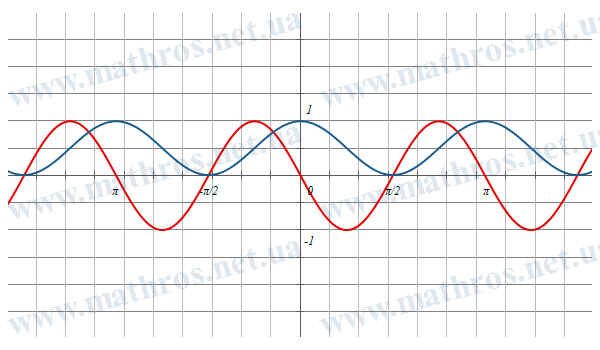
Now let’s look at the graphs. Here it helps not only to see the two curves, but to understand their connection. The function \( \cos^2(x) \) is never negative, because a square can’t produce a “minus”, so its values stay between \( 0 \) and \( 1 \). Meanwhile, the derivative \( -\sin(2 \cdot x) \) changes sign, which means it tells us exactly where \( \cos^2(x) \) is increasing and where it is decreasing. You can clearly see that at the points where the derivative equals zero, the graph of \( \cos^2(x) \) switches from increasing to decreasing, or the other way around. That’s exactly what we use in extremum problems.
Chain Rule: A Detailed Derivation of the Derivative Formula
Now let’s move to the derivation. The first thing we need is to clearly separate the inner and outer functions. The expression
\[ y=\cos^2(x)=\bigl(\cos(x)\bigr)^2 \]
shows it very clearly: the inner part is \( \cos(x) \), and the outer part is “raise to the power of 2”.
Let’s introduce a substitution \( u=\cos(x) \). Then the function becomes \( y=u^2 \). By the chain rule, we get:
\[ \frac{dy}{dx}=\frac{dy}{du}\cdot\frac{du}{dx}. \]
Now we find each derivative separately. For the outer function \( y=u^2 \), using the power rule:
\[ \frac{dy}{du}=2 \cdot u. \]
For the inner function \( u=\cos(x) \):
\[ \frac{du}{dx}=-\sin(x). \]
Multiply them:
\[ \frac{dy}{dx}=2 \cdot u \cdot \bigl(-\sin(x)\bigr)=-2 \cdot u \cdot \sin(x). \]
Now return to \( u=\cos(x) \):
\[ \frac{dy}{dx}=-2 \cdot \cos(x) \cdot \sin(x). \]
At this point, as mentioned earlier, the derivative is already found, and this expression is a correct final answer. Next, we only rewrite it in a more compact form. We use the double-angle identity:
\[ \sin(2 \cdot x)=2 \cdot \sin(x) \cdot \cos(x). \]
So,
\[ -2 \cdot \cos(x) \cdot \sin(x)=-\bigl(2 \cdot \sin(x) \cdot \cos(x)\bigr)=-\sin(2 \cdot x). \]
Therefore, the final result is:
\[ \frac{d}{dx}\bigl(\cos^2(x)\bigr) = -\sin(2 \cdot x). \]
This approach matters far beyond this one example. If you see expressions like \( \bigl(\sin(x)\bigr)^2 \) or \( \bigl(\cos(x)\bigr)^n \), you follow the same sequence of steps: identify the inner function, differentiate the outer function, and then multiply by the derivative of the inner one. That’s exactly how you build confidence when solving problems like these.
Derivative of Cosine Squared: Practice and Worked Examples
Now let’s move to practice and reinforce the formula through problems. In typical exercises, cosine squared is usually part of a more complicated expression, so it’s important to carefully identify what exactly is inside the argument and which differentiation rule you need. In each example below, we’ll follow the same logic: first we spot the composite structure, and then we apply the required rules step by step.
Example 1. Find the derivative of \( y=\cos^2(3 \cdot x-1) \)
Here the outer part is the square, and the argument of cosine is \( 3 \cdot x-1 \). So we have a composite function, and we need the chain rule.
Let:
\[ u=\cos(3 \cdot x-1), \quad y=u^2. \]
Then
\[ \frac{dy}{dx}=\frac{dy}{du}\cdot\frac{du}{dx}. \]
Outer derivative:
\[ \frac{dy}{du}=2 \cdot u. \]
Now find \( \frac{du}{dx} \). Since \( u=\cos(3 \cdot x-1) \), we get
\[ \frac{du}{dx}=-\sin(3 \cdot x-1)\cdot 3. \]
So,
\[ \frac{dy}{dx}=2 \cdot u \cdot \bigl(-3 \cdot \sin(3 \cdot x-1)\bigr)=-6 \cdot u \cdot \sin(3 \cdot x-1). \]
Return to \( u=\cos(3 \cdot x-1) \):
\[ y'=-6 \cdot \cos(3 \cdot x-1) \cdot \sin(3 \cdot x-1). \]
If you want, you can rewrite it in a more compact form:
\[ y'=-3 \cdot \sin(6 \cdot x-2). \]
Example 2. Find the derivative of \( y=\cos^2(x^2+1) \)
Here the argument of cosine is a quadratic function, so differentiation requires applying the chain rule step by step.
Let:
\[ t=x^2+1,\quad u=\cos(t),\quad y=u^2. \]
Then
\[ \frac{dy}{dx}=\frac{dy}{du}\cdot\frac{du}{dt}\cdot\frac{dt}{dx}. \]
Compute:
\[ \frac{dy}{du}=2 \cdot u,\quad \frac{du}{dt}=-\sin(t),\quad \frac{dt}{dx}=2 \cdot x. \]
So,
\[ \frac{dy}{dx}=2 \cdot u \cdot \bigl(-\sin(t)\bigr) \cdot 2 \cdot x=-4 \cdot x \cdot u \cdot \sin(t). \]
Return to \( t=x^2+1 \) and \( u=\cos(t) \):
\[ y'=-4 \cdot x \cdot \cos(x^2+1) \cdot \sin(x^2+1). \]
If needed, you can write it shorter:
\[ y'=-2 \cdot x \cdot \sin\bigl(2 \cdot (x^2+1)\bigr). \]
Example 3. Find the derivative of \( y=x^2 \cdot \cos^2(x) \)
Here we have a product of two functions, so we use the product rule: the derivative of the first factor times the second, plus the first factor times the derivative of the second.
Let \( u=x^2 \), \( v=\cos^2(x) \). Then
\[ y'=u' \cdot v + u \cdot v'. \]
Compute:
\[ u'=2 \cdot x. \]
And for \( v \) we use the known formula:
\[ v'=-\sin(2 \cdot x). \]
Substitute:
\[ y'=2 \cdot x \cdot \cos^2(x)+x^2 \cdot \bigl(-\sin(2 \cdot x)\bigr)=2 \cdot x \cdot \cos^2(x)-x^2 \cdot \sin(2 \cdot x). \]
Example 4. Find the derivative of \( y=\frac{\cos^2(x)}{x} \)
This is a quotient, so we use the quotient rule. Let \( u=\cos^2(x) \), \( v=x \). Then
\[ y'=\frac{u' \cdot v-u \cdot v'}{v^2}. \]
We have
\[ u'=-\sin(2 \cdot x), \quad v'=1. \]
So,
\[ y'=\frac{\bigl(-\sin(2 \cdot x)\bigr)\cdot x-\cos^2(x)}{x^2} =\frac{-x \cdot \sin(2 \cdot x)-\cos^2(x)}{x^2}. \]
Example 5. Find the derivative of \( y=\sqrt{\cos^2(x)} \)
This is an interesting case, because the square root of a square turns the expression into an absolute value:
\[ \sqrt{\cos^2(x)}=|\cos(x)|. \]
Now it’s important to remember that the absolute value leads to different derivative formulas on intervals where the sign of \( \cos(x) \) does not change.
If on some interval \( \cos(x)>0 \), then \( y=\cos(x) \), so
\[ y'=-\sin(x). \]
If on some interval \( \cos(x)<0 \), then \( y=-\cos(x) \), so
\[ y'=\sin(x). \]
At points where \( \cos(x)=0 \), the derivative in the usual sense does not exist, because that’s exactly where the sign inside the absolute value changes. For practice, it’s important to remember: here the key idea is not the derivative of \( \cos^2(x) \), but the fact that the square root turns the square into an absolute value.
What’s Next After the Derivative of Cosine Squared? Recommended Topics to Continue
If this topic already feels clearer, it makes perfect sense to take the next step and expand the set of derivatives you can work with confidently. After all, in real problems, trigonometry rarely stops at cosine alone, right? Below are topics that naturally continue this material and help you feel more comfortable with calculations.
- Derivative of Sine Squared: Formula, Proof, Examples — In this article, we’ll go through the differentiation rule, explain the proof, and show typical examples with different kinds of arguments.
- Derivative of Tangent Squared: Formula, Proof, Examples — We’ll talk about the derivative of tangent squared, recall important domain restrictions for the expression, and solve practical exercises step by step.
- Derivative of Cotangent Squared: Formula, Proof, Examples — We’ll look at how to find the derivative of cotangent squared, what to pay attention to during transformations, and how to avoid common mistakes.
Derivative of Cosine Squared: From the Formula to Your Code
If you enjoy programming, this is a perfect moment to turn the math into a working algorithm. Take the provided flowchart, go through it step by step, and implement the search for critical points on an interval in whatever way feels most comfortable—Python, JavaScript, C#, Java, or any other language. Just imagine how satisfying it will be to see the values your program finds in the output, then compare them with the graph and confirm that everything matches. Isn’t that the best proof that you truly understood the topic?
