So, what is a cube, really? At its core, a cube is a three-dimensional object with six square sides. Each of these sides, or faces, is identical in size, which is why all six sides are equal to each other. The cube, sometimes referred to as a regular hexagon or square prism, is a unique geometric figure. It belongs to the group of five Platonic solids, making it a standout in the world of geometry. You probably encounter cubes daily – whether it’s an ice cube, a Rubik’s cube, or a standard die used in games.
In this article, we’ll explore what a cube is, dive into its key properties, break down the essential formulas, and work through some examples to see how this knowledge applies in practice.
What is a Cube: Exploring Its Shape and Structure
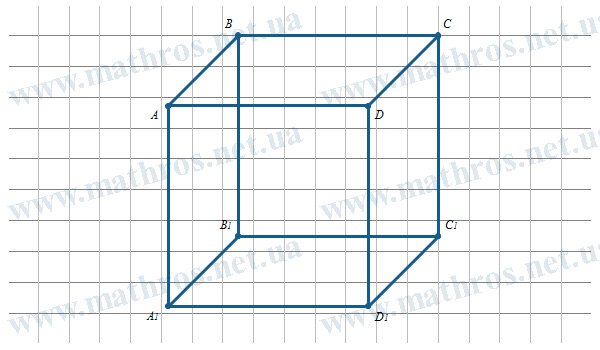
Imagine a block where the length, width, and height are all the same. That’s a cube in its simplest form. A cube is a three-dimensional figure made up of six square faces, with three faces meeting at each vertex. You might hear people call it a hexagon because it has six faces, or even a type of square prism.
The defining characteristics of a cube are its six faces, eight vertices, and twelve edges. These elements work together to form the symmetrical and balanced shape that a cube is known for. Here’s a quick visual: each face is connected by four vertices, and the edges all meet at a point known as the vertex.

But there’s more to a cube than just its shape. Since it’s a three-dimensional figure, two primary measurements are crucial: its volume and surface area.
Properties of a Cube: Key Facts to Remember
What is a cube without its unique set of properties? Let’s break down the essential characteristics that make a cube stand out:
- A cube has 12 edges, 6 faces and 8 vertices;
- All faces of the cube are squares, so the length, width and height of the cube are always the same;
- Angles between any two faces or surfaces of a cube are always equal to 90°;
- Opposite faces of a cube are always parallel to each other;
- Likewise, opposite edges of a cube are also parallel;
- Each face of the cube borders four other faces;
- Each vertex of the cube is the meeting point of three faces and three edges.
These properties highlight why a cube is such a unique and symmetrical figure in the world of geometry.
Cube Formulas: The Essentials of Area and Volume

When discussing what a cube is, it’s essential to touch on the formulas that define its total surface area and volume. Let’s keep it simple:
| Term | Definition | Formula |
|---|---|---|
| Total surface area (TSA) | The total area of all six faces of a cube. To calculate it, multiply the area of one face by six |  |
| Volume (V) | This is the space occupied by a cube in a three-dimensional plane. Since all sides are equal, you find the volume by raising the length of one side to the power of three |  |
Practical Examples: What is a Cube in Action?
Now that we have considered what a cube is, its properties and basic formulas, let’s see how this knowledge is applied in practice.
Example 1: What is a cube in geometry?
In geometric terms, a cube is a three-dimensional figure with six equal square faces. It’s one of the five Platonic solids and is commonly seen in everyday objects like ice cubes or Rubik’s cubes.
Example 2: Can you name two key properties of a cube?
Among all its characteristics, these two are particularly noteworthy:
- A cube is made up of 12 edges, 6 faces, and 8 vertices;
- Each face of the cube is a perfect square.
Example 3: Why is a cube called a regular hexagon?
The term “regular hexagon” is used for a cube because it has six identical square faces, making it a regular figure in geometry.
Example 4: Calculate the surface area of a cube with 5 cm sides
To determine the surface area, we’ll use the formula S=6⋅a2. Given that each side measures 5 cm, the calculation looks like this:

So, the total surface area of this cube is 150 cm2.
Example 5: Determine the volume of a cube with 10cm sides
To calculate the volume, we use the formula V=a3. Substituting the side length of 10 cm into the formula, we get:

Therefore, the volume of this cube is 1000 cm3.
Example 6: How can you determine the distance from the center of a face on a unit cube ABCDA1B1C1D1 to the vertices of the opposite face?
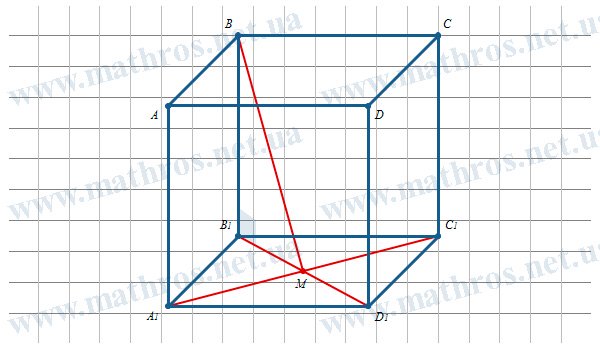
Let’s take a look at the unit cube ABCDA1B1C1D1. Imagine point M is located at the center of the face A1B1C1D1. The task is to determine the distance from point M to the vertices of the opposite face, specifically to points A, B, C, and D.
To solve this, we’ll use the Pythagorean theorem in the right triangle BMB1. The distance MA can be calculated using the formula:
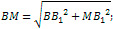
Here, BB1 equals 1 (the length of the edge of the cube), and MB1 is half the diagonal of the square, which is √2/2. Plugging in these values, we get:

Therefore, the distance from the center of face M to the vertices of the opposite face (points A, B, C, and D) is √3/2.
Example 7: In the cube ABCDA1B1C1D1, how do you find the angle between the lines AA1 and BD1?
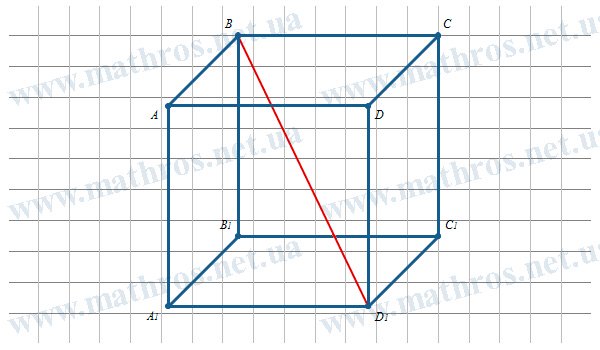
Consider the cube ABCDA1B1C1D1, where each edge has a length of a. Our goal is to find the angle between the lines AA1 and BD1.
Since AA1 is parallel to BB1 (a property of the cube), the angle between AA1 and BD1 is the same as the angle between BB1 and BD1, which is the angle B1BD1.
To determine this angle, we use trigonometry. In the right triangle B1BD1, we apply the cosine formula:

Thus, the angle between the lines AA1 and BD1 – Arccos(1/√3)≈55°.
Diving Deeper into Cube Geometry: Want to Learn More?
Curious to explore more about what is a cube and how to work with it? Here are some topics you might find interesting:
- Diagonal of a Cube – Learn the formula for calculating the diagonal of a cube.
- Surface Area of a Cube – Understand how to compute the surface area with practical examples.
- Volume of a Cube – Get the hang of calculating a cube’s volume using various methods.
And if you’re intrigued by other three-dimensional figures, don’t overlook the rectangular parallelepiped – a geometric shape that’s equally fascinating and worth exploring.