Understanding the volume of a cube is essential in geometry, especially since it’s a shape we encounter frequently in various forms. The volume represents the amount of space a cube occupies. Since all sides of a cube are equal, calculating its volume is straightforward – just raise the length of one side to the power of three.

In this guide, we’ll walk through the formula for finding the volume of a cube and show you how to apply it with practical examples.
The Volume of a Cube: A Must-Know Formula
Calculating the volume of a cube is as easy as pie! If you know the length of one side, you’re all set. A cube has equal sides, making the formula for its volume super simple:

The result will give you the volume in cubic units based on the unit you used to measure the side. For instance, if the side length is in centimeters, the volume will be in cubic centimeters (cm3).
When You Have the Diagonal: Calculating the Volume of a Cube
But what if you only have the diagonal of the cube? No worries! You can still find the volume using a different formula:

Just a quick reminder: Be careful not to confuse the diagonal of the cube with the diagonal of its face. The cube’s diagonal passes through the center, whereas the face diagonal is just across one of the six square faces.

Deriving the Formula Using the Diagonal
Let’s dive a bit deeper into the math behind it. The diagonal of a cube relates to its side length through the equation:

From here, you can express the side length in terms of the diagonal and substitute it back into the volume formula:

And just like that, we’ve proved the formula for calculating the volume of a cube using its diagonal!
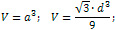
Note: If we represent the side length and the diagonal of the cube with the letters ‘a’ and ‘d,’ respectively, the volume formulas can be expressed in a more familiar form:
Practical Examples: Putting the Volume of a Cube Formula to Use
Let’s solidify this knowledge with a few examples. Each problem comes with a solution, but I encourage you to try solving them on your own first!
Example 1: What’s the volume of a cube with sides measuring 5 cm?
Using the formula:

So, the volume of the cube is 125 cubic centimeters.
Example 2: If a cube has sides of 10 cm, what’s its volume?
Substituting the side length:

Thus, the volume of the cube is 1000 cubic centimeters.
Example 3: If a cube has a volume of 512 cm3, what is the length of its sides?
Reversing the formula to find the side length:

So, the side length of the cube is 8 cm.
Example 4: What’s the volume of a cube with a diagonal of 5 cm?
Applying the diagonal-based formula:

Therefore, the volume of the cube is 24.1 cubic centimeters.
Exploring Cube Geometry: What’s Next?
If you’re eager to dive deeper into the world of cubes, here are some pages that will help you master this fascinating shape:
- What is a Cube: Simple Explanation and Examples – Get to know the cube’s properties with easy-to-understand explanations and visual aids.
- Diagonal of a Cube: Formula and Examples – Learn how to calculate the diagonal of a cube with clear formulas and examples.
- Surface Area of a Cube: Formulas and Examples – Discover the necessary formulas and examples for finding the total surface area of a cube.
Volume of a Cube: Combine Programming and Geometry
If you’re into programming, why not mix your coding skills with geometry? You can create a program to calculate the volume of a cube quickly and accurately using a simple flowchart. It’s a fun and practical way to apply theory and sharpen both your programming and geometry skills!

Try your hand at coding this yourself – you’ll see how easy and enjoyable it is to calculate the space a cube occupies. Plus, it’s a fantastic way to bring your knowledge to life!