The Derivative of Sine Squared shows up a lot in problems involving trigonometric transformations, optimization, and function analysis. And it’s easy to confuse two similar-looking expressions: \( \sin^2(x) \) means the square of sine, that is \( \bigl(\sin(x)\bigr)^2 \), not \( \sin(x^2) \). It may look like the difference is only in the parentheses, but you get a completely different result, right? So let’s lock in the structure of the function right away as a composition: first we compute sine, and then we square the result. That’s exactly what leads us to the correct derivative.
Derivative of Sine Squared: The Main Formula and Graphs
Let’s start with the most important part. If
\[
y=\sin^2(x)=\bigl(\sin(x)\bigr)^2,
\]
then the derivative has a compact form:
\[
\frac{d}{dx}\bigl(\sin^2(x)\bigr)=\bigl(\sin^2(x)\bigr)’=\sin(2 \cdot x).
\]
This is convenient because the answer is immediately written as a single trigonometric function with a double-angle argument. And it also matches the graphs nicely.

Now let’s pay attention to how these functions behave. The function \( \sin^2(x) \) is never negative, because squaring removes any “minus” sign. So its values lie between \( 0 \) and \( 1 \). Meanwhile, the derivative \( \sin(2 \cdot x) \) changes sign, which is why it tells us where \( \sin^2(x) \) is increasing and where it is decreasing. And you can clearly see that where the derivative equals zero, the graph of \( \sin^2(x) \) switches from increasing to decreasing, or the other way around. That’s exactly what you need in extrema and optimization problems.
Chain Rule and the Double-Angle Identity: Deriving the Formula Step by Step
Let’s move on to the derivation. Here it’s important not to rush and to clearly separate the inner and outer parts of the function. The form
\[
y=\sin^2(x)=\bigl(\sin(x)\bigr)^2
\]
immediately shows the structure: the inner function is \( \sin(x) \), and the outer function is “raising to the power of 2”.
Let’s make the standard substitution:
\[
u=\sin(x).
\]
Then the function becomes simpler:
\[
y=u^2.
\]
Now we apply the chain rule:
\[
\frac{dy}{dx}=\frac{dy}{du} \cdot \frac{du}{dx}.
\]
First, differentiate the outer function \( y=u^2 \). By the power rule, we get:
\[
\frac{dy}{du}=2 \cdot u.
\]
Next, take the derivative of the inner function \( u=\sin(x) \):
\[
\frac{du}{dx}=\cos(x).
\]
Multiply these two parts:
\[
\frac{dy}{dx}=2 \cdot u \cdot \cos(x).
\]
Now substitute back \( u=\sin(x) \):
\[
\frac{dy}{dx}=2 \cdot \sin(x) \cdot \cos(x).
\]
At this point, the derivative is already found, and this is a correct answer. But we want the double-angle form, because it’s shorter and often more convenient. So we use the double-angle identity:
\[
\sin(2 \cdot x)=2 \cdot \sin(x) \cdot \cos(x).
\]
So,
\[
2 \cdot \sin(x) \cdot \cos(x) = \sin(2 \cdot x),
\]
and we get the final result:
\[
\frac{d}{dx}\bigl(\sin^2(x)\bigr) = \sin(2 \cdot x).
\]
Notice how logically everything connects: the square pushes us to use the chain rule, and the double-angle identity turns the product into a compact expression. Handy, right?
Derivative of Sine Squared: Practice with Examples and Step-by-Step Explanations
Let’s move on to practice and reinforce the formula with real tasks. In typical exercises, sine squared is almost always part of a more complicated expression, so it helps to follow the same plan every time. First, identify the type of expression: is it a composite function, a product, or a quotient? Then choose the correct differentiation rule. After that, compute derivatives step by step, and only at the very end (if needed) simplify the result.
Example 1. Find the derivative of \( y=\sin^2(3 \cdot x-1) \)
Here the outer part is the square, and the sine’s argument is the linear function \( 3 \cdot x-1 \). So we have a composite function, and we need the chain rule.
Let:
\[
u=\sin(3 \cdot x-1), \quad y=u^2.
\]
Then
\[
\frac{dy}{dx}=\frac{dy}{du}\cdot\frac{du}{dx}.
\]
Outer derivative:
\[
\frac{dy}{du}=2 \cdot u.
\]
Now compute the derivative of the inner part. Since \( u=\sin(3 \cdot x-1) \), we get
\[
\frac{du}{dx}=\cos(3 \cdot x-1) \cdot 3.
\]
Multiply:
\[
\frac{dy}{dx}=2 \cdot u \cdot 3 \cdot \cos(3 \cdot x-1)=6 \cdot u \cdot \cos(3 \cdot x-1).
\]
Substitute back \( u=\sin(3 \cdot x-1) \):
\[
y’=6 \cdot \sin(3 \cdot x-1) \cdot \cos(3 \cdot x-1).
\]
If you want a more compact form, use the double-angle identity:
\[
y’=3 \cdot \sin\bigl(2 \cdot (3 \cdot x-1)\bigr)=3 \cdot \sin(6 \cdot x-2).
\]
Example 2. Find the derivative of \( y=\sin^2(x^2+1) \)
Here the argument of sine is a quadratic function, so the chain rule is applied in a sequence. It’s important to carefully include the derivative of \( x^2+1 \) at the right step.
Let’s do it using intermediate substitutions:
\[
t=x^2+1,\quad u=\sin(t),\quad y=u^2.
\]
Then
\[
\frac{dy}{dx}=\frac{dy}{du}\cdot\frac{du}{dt}\cdot\frac{dt}{dx}.
\]
Compute each part:
\[
\frac{dy}{du}=2 \cdot u,\quad \frac{du}{dt}=\cos(t),\quad \frac{dt}{dx}=2 \cdot x.
\]
Multiply:
\[
\frac{dy}{dx}=2 \cdot u \cdot \cos(t) \cdot 2 \cdot x=4 \cdot x \cdot u \cdot \cos(t).
\]
Substitute back \( u=\sin(t) \) and \( t=x^2+1 \):
\[
y’=4 \cdot x \cdot \sin(x^2+1) \cdot \cos(x^2+1).
\]
If you want a shorter form:
\[
y’=2 \cdot x \cdot \sin\bigl(2(x^2+1)\bigr).
\]
Example 3. Find the derivative of \( y=x^2 \cdot \sin^2(x) \)
Here we have a product of two functions. So we use the product rule: derivative of the first factor times the second, plus the first factor times the derivative of the second. And the formula for \( \sin^2(x) \) appears exactly in the second term.
Let:
\[
u=x^2,\quad v=\sin^2(x).
\]
Then
\[
y’=u’ \cdot v + u \cdot v’.
\]
Derivative of the first factor:
\[
u’=2 \cdot x.
\]
Now the derivative of the second factor. For \( v=\sin^2(x) \), use the main formula:
\[
v’=\sin(2 \cdot x).
\]
Substitute into the product rule:
\[
y’=2 \cdot x \cdot \sin^2(x)+x^2 \cdot \sin(2 \cdot x).
\]
That’s the final answer. If needed, you can simplify further, but often there’s no real point—this form is already convenient for substitutions in problems.
Example 4. Find the derivative of \( y=\dfrac{\sin^2(2 \cdot x+1)}{x} \)
Here we have a composite function in the numerator and division by \( x \), so we use the quotient rule, and for the numerator’s derivative we use the chain rule. Also, it’s important to note the domain right away: we must have \( x\neq 0 \).
Let
\[
u=\sin^2(2 \cdot x+1),\quad v=x.
\]
Then
\[
y’=\frac{u’ \cdot v-u \cdot v’}{v^2}.
\]
First find \( u’ \). Fix the argument \( 2 \cdot x+1 \) and remember its derivative is \( 2 \). Then the derivative of sine squared can be written as
\[
u’=\sin\bigl(2 \cdot (2 \cdot x+1)\bigr) \cdot 2=2 \cdot \sin(4 \cdot x+2).
\]
Now \( v’=1 \). Substitute:
\[
y’=\frac{\bigl(2 \cdot \sin(4 \cdot x+2)\bigr) \cdot x-(\sin(2 \cdot x+1))^2}{x^2}.
\]
So,
\[
y’=\frac{2 \cdot x \cdot \sin(4 \cdot x+2)-\bigl(\sin(2 \cdot x+1)\bigr)^2}{x^2}.
\]
Example 5. Find the derivative of \( y=(\sin(x))^2 \cdot \cos(x) \)
This is also a product. But now one factor is the square of sine, and the other is \( \cos(x) \). So we use the product rule and remember there are two different derivatives involved.
Let:
\[
u=\bigl(\sin(x)\bigr)^2,\quad v=\cos(x).
\]
Then
\[
y’=u’ \cdot v+u \cdot v’.
\]
For the first factor, use the known formula:
\[
u’=\sin(2 \cdot x).
\]
For the second factor:
\[
v’=-\sin(x).
\]
Substitute:
\[
y’=\sin(2 \cdot x) \cdot \cos(x)+\bigl(\sin(x)\bigr)^2 \cdot \bigl(-\sin(x)\bigr).
\]
So,
\[
y’=\sin(2 \cdot x) \cdot \cos(x)-\bigl(\sin(x)\bigr)^3.
\]
This is a correct final answer. If needed, you can transform it using double-angle identities, but for most problems this form is already clear and convenient enough.
Where to Go Next: Topics That Naturally Continue This Material
If this topic already feels clear, the next logical step is to expand the set of trigonometric derivatives you’ll use most often. After all, real problems usually mix different functions, so it’s helpful to switch between them quickly and confidently, right?
- Derivative of Cosine Squared: Formula, Proof, Examples — We’ll break down the differentiation rule and walk through examples with different arguments and useful transformations.
- Derivative of Tangent Squared: Formula, Proof, Examples — We’ll explain how to find the derivative, what to watch for in the domain, and how to handle typical problem types.
- Derivative of Cotangent Squared: Formula, Proof, Examples — We’ll go through the derivation of the formula and practice on examples where cotangent appears inside composite expressions.
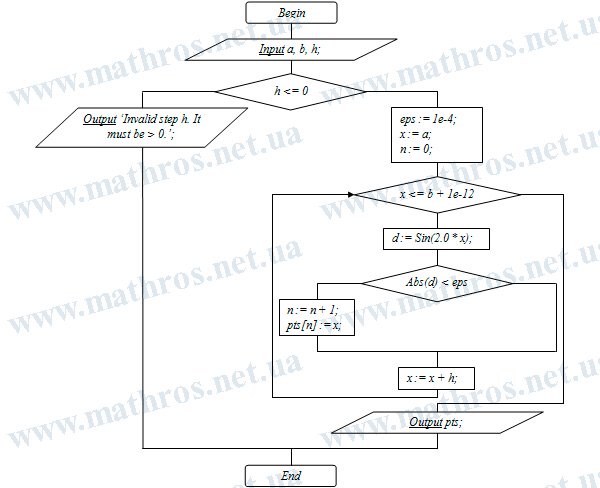
Derivative of Sine Squared: From a Flowchart to Code
If you enjoy programming, this is the perfect moment to turn the math into a working algorithm. Take the ready-made flowchart, go through it step by step, and implement a search for candidate points where the derivative is almost zero in your favorite language—Python, JavaScript, C#, Java, or anything else. Then compare how the result changes when you use a different step size and precision, and check how well your program finds critical points. Isn’t it interesting to see how the theory works in real code?