Derivative of cosine is a key idea in mathematical analysis that appears all the time in physics, engineering, and programming tasks. It describes how quickly the value of cosine changes when the input shifts by a tiny amount. Why do we need this? To determine where a function increases or decreases, draw tangents, find extrema, and compare the graphs of a function and its derivative. Below, we’ll state the formula, unpack its meaning, and step by step derive the result from the definition of a derivative.
Formula and Meaning: Derivative of Cosine – Negative Sine
The main formula is:
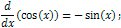
What does this mean for the graph? The derivative is shifted relative to cosine by π/2 and has the opposite sign. Therefore, at the maxima of cos(x) the derivative equals zero and changes sign from “plus” to “minus”, while at the minima the opposite happens.
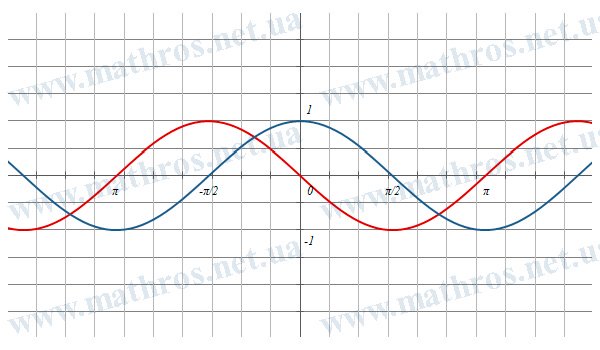
The rate of change in absolute value never exceeds 1, because the amplitude of -sin(x) is 1. Why does the minus sign appear before sine? Because as we move to the right near zero, cosine decreases, so the slope of the tangent is negative. It’s also helpful to remember the chain rule: for cos(a⋅x+b) we have

This is convenient in applied problems where the input is scaled or shifted.
Proof from the Definition: Step by Step to the Result
Let’s start from the definition of the derivative:

Next, use the addition formula cos(x+h)=cos(x)⋅cos(h)-sin(x)⋅sin(h). After substitution, the numerator becomes cos(x)⋅(cos(h)-1)-sin(x)⋅sin(h). Divide by h and split into two terms. Why is this allowed? Because cos(x) and sin(x) do not depend on h, so they act like constants with respect to the limit:

We know the second limit from calculus:

It can be justified using the squeeze theorem via the unit-circle geometry or by Maclaurin series. In either case, the value is 1, so the second term becomes -sin(x).
It remains to compute the first limit. It is convenient to rewrite it using the half-angle identity 1-cos(h)=2⋅sin2(h/2). Then:

Break this expression into a product of two factors:
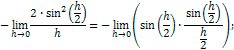
The first factor goes to 0 because sin(h/2)→0. The second factor goes to 1 (again, by the squeeze theorem result). The product is 0. Hence,
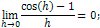
Now substitute both limits back:

For completeness, we can verify the same first limit by rationalizing. Multiply and divide by (cos(h)+1):

Rewrite as a product:

The first bracket tends to 1, the second to 0/2=0. We get 0 again. Both techniques agree, so the conclusion is unambiguous:
This holds for all real x because sine and cosine are continuous and differentiable on the entire real line.
Practical Block: Problems on the Derivative of Cosine
To strengthen your understanding of the formula, let’s move from theory to practice. We’ll work through several problems involving the derivative of cosine. Each problem comes with a solution, but before reading it, try to find the answer on your own. Ready to test your skills?
Example 1: Find the derivative of f(x)=cos(6⋅x)
This is a composite function: the outer part is f(u)=cos(u) and the inner part is u=6⋅x. By the chain rule, first differentiate the outer function (keep the inner unchanged), then multiply by the derivative of the inner:

Final answer: f'(x)=-6⋅sin(6⋅x).
Example 2: Find the derivative of f(x)=x⋅cos(x)
This is a product, so use the product rule. Let u=x and v=cos(x). Then u’=1 and v’=-sin(x). Substitute into (u⋅v)’=u’⋅v+u⋅v’:

Conclusion: f'(x)=cos(x)-x⋅sin(x).
Example 3: Find the derivative of f(x)=(cos(3⋅x-π/4))2
This is a three-layer composite: a square, then cosine, and inside it a linear function. Differentiate layer by layer. The derivative of the square gives the factor 2⋅cos(3⋅x-π/4). Next, the derivative of cosine is -sin(3⋅x-π/4). Finally, the derivative of the inner linear part 3⋅x-π/4 is 3. Thus,

Using sin(2⋅α)=2⋅sin(α)⋅cos(α), we get -6⋅cos(α)⋅sin(α)=-3⋅sin(2⋅α). With α=3⋅x-π/4,

So both forms are equivalent:

Example 4: Find the derivative of f(x)=cos(x)/(1+x2)
Here we have a quotient, so use the quotient rule. Let u=cos(x) and v=1+x2. Then u’=-sin(x) and v’=2⋅x. Substitute into (u/v)’=(u’⋅v-u⋅v’)/v2:

Group the terms in the numerator (without changing the meaning):

This is a correct, finished answer.
Example 5: Find the derivative of f(x)=e2⋅x⋅cos(x)
Again, a product, so apply the product rule. Let u=e2⋅x and v=cos(x). For u, also use the chain rule since the exponent is 2⋅x: then u’=2⋅e2⋅x. For v, v’=-sin(x). Combine the steps:

Therefore, the final result is: e2⋅x⋅(2⋅cos(x)-sin(x)).
Next Steps: Where to Go After the Cosine Derivative
Want to solidify what you’ve learned and see the bigger picture? Let’s go further and explore the derivatives of related trigonometric functions. This will help you solve problems of any difficulty with real confidence. Here’s a quick look at what to study next.
- Derivative of Arcsine: Formula, Proof, Examples – Derive it from the definition, connect it with key identities, and solve problems ranging from straightforward substitutions to more involved expressions.
- Derivative of Tangent: Formula, Proof, Examples – Obtain the result rigorously, discuss the domain and behavior near discontinuities, then practice with a wide range of examples from basic to challenging.
- Derivative of Cotangent: Formula, Proof, Examples – Build the result step by step, analyze restrictions and sign behavior, compare it with tangent, and work through problems that feature more involved expressions.
Derivative of Cosine in Code: Bringing Math and Programming Together
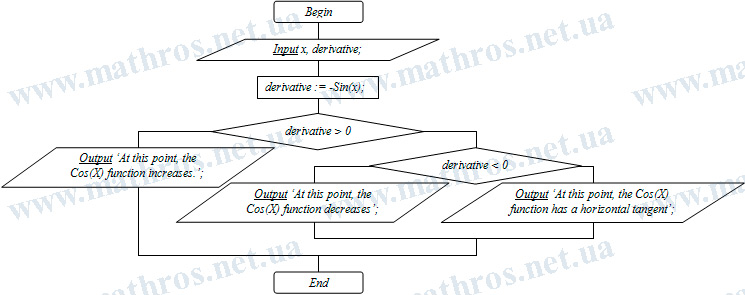
Ready to wrap up and take the final step? Below is a flowchart of an algorithm that computes the derivative of cosine at a given point and determines the function’s behavior there—whether it’s increasing or decreasing. Use it as your guide: carefully follow the steps, transfer the logic into your own code (Pascal, Python, C++, or JavaScript), run tests on several input values, and compare the results with your expectations. This way, you’ll turn the theory you’ve learned into a working tool and strengthen your understanding through your own implementation.