Multiplying fractions is one of the most essential topics encountered at every stage of learning math. Mastering how to multiply fractions correctly allows you to confidently handle even complex algebraic expressions. But what if you need to multiply mixed fractions or whole numbers? The process is actually straightforward! You only need to follow a clear sequence of steps, and any multiplying fractions problem will become simple and manageable.
Multiplying Fractions: What Steps Should You Follow?
How exactly do you multiply fractions? First, it’s important to ensure all fractions are in the proper form before starting. If you encounter a mixed fraction or a whole number, you must convert them into improper fractions. For example, to convert a mixed number, multiply the whole number by the denominator and then add the numerator. Whole numbers can be expressed as fractions by simply giving them a denominator of 1. Simple, right?
Once all fractions are ready, proceed to the actual multiplying fractions step. Start by multiplying the numerators of the fractions together. Then, multiply the denominators. The last and very important step is simplifying the resulting fraction. Check if the numerator and denominator share any common factors — reducing the fraction makes your answer clearer and simpler.
To summarize the main steps for multiplying fractions:
- Convert mixed fractions or whole numbers into improper fractions.
- Multiply the numerators of the fractions.
- Multiply the denominators of the fractions.
- Simplify the resulting fraction, if possible.
By following these steps, you’ll be able to multiply even the most complicated algebraic fractions with ease. Now, let’s practice with some examples!
Reinforcing Knowledge with Practice: Solving Examples Together
Understanding the theory is important, but practice makes your skills stronger. Let’s go through some examples to see how to apply the rules of multiplying fractions in real situations. We’ll analyze each example step-by-step to get the right answer.
Example 1: Multiply Fractions and Simplify the Result

To multiply fractions, multiply the numerators and denominators separately:

This fraction cannot be simplified further, so this is the final answer.
Example 2: Find the Product of the Following Fractions
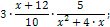
Notice that the number 3 is a whole number and can be written as a fraction with denominator 1. Multiply the numerators: 3⋅(x+12)⋅5, and the denominators: 1⋅10⋅(x2+4⋅x). The result is:

Since numerator and denominator share a common factor 5, divide both by 5:

This is the simplified final result.
Example 3: Perform Multiplication of Fractions
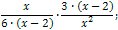
Multiply the numerators: x⋅3⋅(x-2), and the denominators: 6⋅(x-2)⋅x2. This gives:

Since the factor (x-2) appears in both numerator and denominator, cancel it out. Similarly, one x cancels with x2. After simplification:
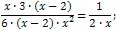
This fraction cannot be simplified further, so this is the final answer.
Want to Learn More? Useful Topics for Further Study
Now that you understand how to multiply fractions confidently, it’s a great time to expand your knowledge further. Mathematics is a vast world where each new topic opens up even more possibilities. To better understand operations with algebraic fractions, explore these related topics—they will help you organize your knowledge and solve problems more confidently:
- Adding Algebraic Fractions: Examples and Solutions – Learn how to find common denominators and correctly add fractions with practical examples.
- Subtracting Algebraic Fractions: Examples and Solutions – Master subtracting fractions with different denominators by following clear and simple rules.
- Dividing Algebraic Fractions: Examples and Solutions – Discover how to convert division into multiplication and simplify expressions in a few steps.
Choose what interests you most and dive deeper. If you’re already practicing problem-solving but want a reliable way to check your answers, try using an online fraction calculator. It’s fast, convenient, and helps you focus on the core of the problem.
Multiplying Fractions in Python or Pascal? Try It Yourself!
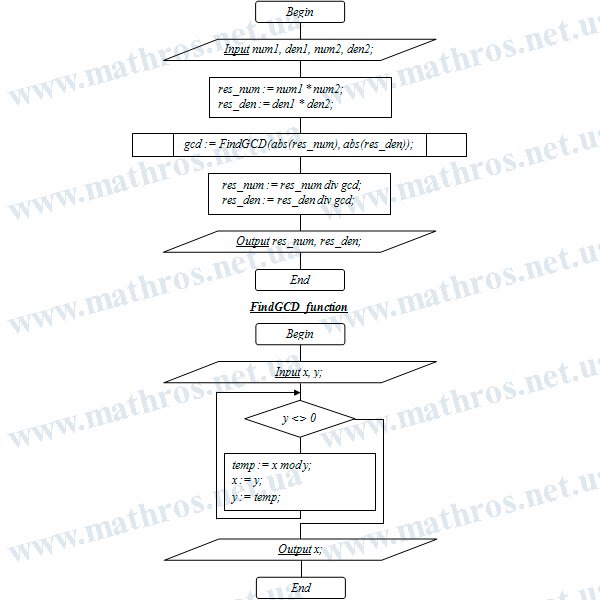
After mastering multiplying fractions and expanding your understanding through related topics, why not try something new? Imagine creating a simple program: you input two fractions, the program multiplies them, simplifies the result, and displays the answer on the screen.
Below is a flowchart outlining the sequence of steps to implement this idea in any programming language. This approach not only reinforces your knowledge but also provides an exciting start to your first math-related projects.