How do you find the perimeter of a trapezoid? This is a key question in geometry, and understanding it is not difficult at all. The main idea is to know which parameters affect the calculation and which formulas you can use. Is there a simple way to find the perimeter? Absolutely! Below, we’ll explore several approaches that will help you do it quickly and without mistakes.
Perimeter of a Trapezoid: A Universal Formula for All Cases
Let’s start with the most straightforward idea: the perimeter of any trapezoid is the sum of the lengths of all its sides. If we label the trapezoid as ABCD, the general formula looks like this:

Here, P is the perimeter, and AB, BC, CD, and AD are the lengths of the four sides. This formula works for all types of trapezoids, no matter their specific properties.
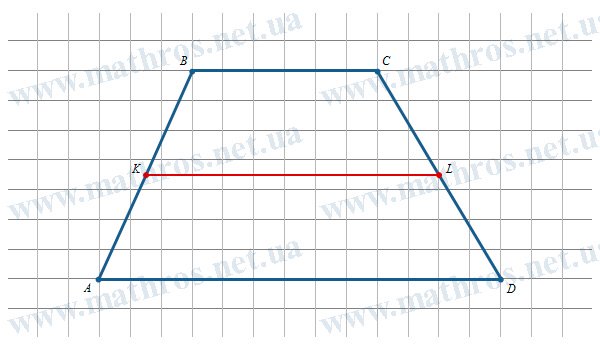
However, if the trapezoid is isosceles (which means its non-parallel sides are equal, AB=CD), you can use a simplified formula:

Or equivalently, using the other equal side: P=2⋅CD+BD+AD.
These shorter versions reduce the number of calculations if you know for sure that the trapezoid is isosceles.
Using the Midsegment: Another Handy Method
There’s another interesting way to find the perimeter of a trapezoid—by using its midsegment (sometimes called the “median” of the trapezoid). The midsegment is the segment that connects the midpoints of the non-parallel sides and is equal to half the sum of the bases (the parallel sides). If we label the midsegment as KL, we can use this formula:

Why is this approach useful? In some geometry problems, the midsegment and the non-parallel sides are given, but the lengths of the bases are not directly known. In such cases, this formula helps you find the perimeter without having to calculate every single side separately.
Geometry Problems: Practice Your Calculation Skills
To help you better grasp this material, let’s look at several practical problems. Each will give you a chance to practice the formulas and boost your confidence.
Example 1: Find the Perimeter of a Trapezoid ABCD With Sides AB=3 cm, BC=4 cm, CD=5 cm, AD=6 cm
Use the main formula P=AB+BC+CD+AD. Plugging in the given values:

So, the perimeter of this trapezoid is 18 cm.
Example 2: Find the Perimeter of a Trapezoid ABCD If its Non-parallel Sides Are Equal, With AB=CD=3 cm, the Base BC=4 cm, and the Other Base AD=5 cm
Since the trapezoid is isosceles, use the simplified formula P=2⋅AB+BC+AD:

Thus, the perimeter of this isosceles trapezoid is 15 cm.
Example 3: The Perimeter of An Isosceles Trapezoid is 30 cm. Its Two Bases Measure 8 cm and 12 cm, Respectively. Find the Length of the Non-parallel Side AB
We know P=30 cm and the bases are 8 cm and 12 cm. Using the same isosceles formula P=2⋅AB+BC+AD (here, let’s say the bases are BC=8 and AD=12):

Hence, each non-parallel side of the trapezoid measures 5 cm.
Example 4: In a Right Trapezoid, the Lengths of the Two Bases are 8 cm and 12 cm, and the Shorter Non-parallel Side is 3 cm. Find the Perimeter of a Trapezoid
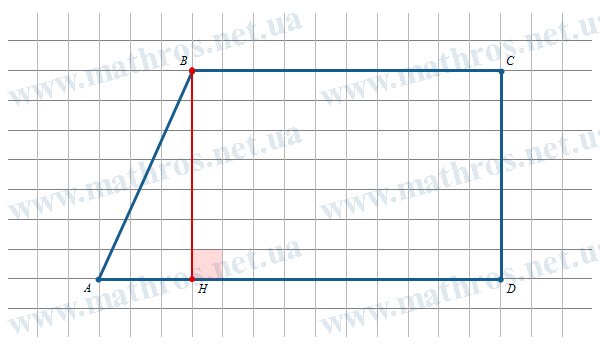
First, drop a perpendicular from vertex B to the longer base AD. This creates a right triangle where BH=3 cm (the given shorter non-parallel side) and HD=8 cm (a segment of the longer base). To find AH, subtract HD from AD:

Now, in the right triangle ABH, the segment AB is the hypotenuse. Using the Pythagorean theorem, we calculate:

Finally, that we have all four side lengths, we can find the perimeter of the trapezoid using the standard formula:

Thus, the perimeter of this right trapezoid is 28 cm.
What’s Next? Useful Resources for Further Learning
You now know several ways to calculate the perimeter of a trapezoid. If you’d like to gain an even deeper understanding, consider exploring other important properties of this geometric figure. Here are a few suggestions:
- What is a Trapezoid – Learn more about different types of trapezoids, their unique features, and how to use these characteristics in your calculations.
- Midsegment of a Trapezoid – Discover why the midsegment is so important, how to find it, and how to use it for solving various geometry problems.
- Area of a Trapezoid – While the perimeter gives the total boundary length, the area measures the size of the region enclosed. This article will show you multiple methods to find the area, complete with practical examples.
Learning more about trapezoids will boost your confidence in solving geometry problems and prepare you for exams, tests, or even math competitions. Keep exploring!
Perimeter of a Trapezoid: Flowchart for Writing Code
Calculating the perimeter of a trapezoid can also be a great project for those interested in combining geometry with programming. If you know any programming language, try creating a small program that automatically calculates the perimeter based on user-input side lengths. This will not only reinforce your geometry knowledge but also enhance your algorithmic thinking.

Use the flowchart above as a guide to structure your code. Give it a try and see how easy it is to translate geometry into programming!