The Gauss-Seidel method is one of the most efficient tools for solving systems of linear equations, widely used in mathematics and engineering. In this article, we’ll delve into the principles of how it works, discuss its advantages and potential limitations. You’ll learn about the algorithm of the method, its theoretical foundations, and see practical examples of its application. This will help you gain a deeper understanding of how to use the Gauss-Seidel method to effectively solve complex systems of linear equations.
Understanding the Gauss-Seidel Method: Let’s Dive In
So, how exactly does the Gauss-Seidel method work, and what makes it so special? It’s an improved version of the Jacobi method but with some clever twists. When we compute a new approximation for an unknown variable xi, we use the already updated values of the previous variables x1, x2,…, xi-1. This means we’re not just repeating the same steps but constantly refining our calculations by incorporating the most recent data.
You might ask: what are the benefits of this approach? Firstly, the Gauss-Seidel method usually converges faster than the Jacobi method. But is this always the case? Interestingly, sometimes it can converge even when the Jacobi method diverges. However, there are also situations where the Gauss-Seidel method converges more slowly or even diverges when the Jacobi method yields a result. Therefore, it’s important to understand how and when to apply it.
Algorithm and Theoretical Foundations of the Gauss-Seidel Method
Let’s dive into the theory. Imagine a system of n linear equations with n unknowns:
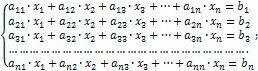
How do we approach solving it using the Gauss-Seidel method? First, we ensure that all the diagonal coefficients aii are not zero. Why is this important? It allows us to express each variable in terms of the others. That is, we rewrite each equation to obtain:
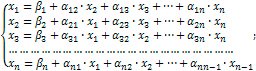
Where do these β and α come from? They are obtained by dividing the coefficients and the constants from the original system:

Now we need initial approximations for the variables x1(0), x2(0), x3(0),…, xn(0). How to choose them? You can pick any values, but it’s better if they’re close to the expected solution—it will speed up convergence.
We then proceed to the iterative process. Suppose we already have the k-th approximation. We compute the new values as follows:

Notice that when computing each xi(k+1), we use the most recently available values of the other variables. This is the “trick” of the Gauss-Seidel method!
Stopping Criterion and Convergence
When should we stop? We continue the iterations until the maximum difference between the new and previous approximations becomes less than a specified accuracy ε:

This makes sense because we want results with a certain accuracy. But does the Gauss-Seidel method always converge? Good question! The convergence conditions for the Gauss-Seidel method are similar to those for the Jacobi method. That is, before starting calculations, it’s worth checking whether the method will be effective for your specific system.
For example, if the system’s matrix is diagonally dominant, the Gauss-Seidel method is likely to converge. But if not, convergence problems may arise. Therefore, it’s always helpful to analyze the system before applying the method. This helps avoid unpleasant surprises and ensures successful problem-solving.
Applying the Gauss-Seidel Method: Let’s Work Through Some Examples Together
To fully grasp how the Gauss-Seidel method works, let’s look at a few examples. We’ll start by answering some interesting questions and then apply the method to a practical problem. Are you ready to dive deeper?
Example 1: Why Does the Gauss-Seidel Method Usually Converge Faster Than the Jacobi Method?
Because the Gauss-Seidel method uses the most up-to-date available values of variables during each iteration. When we compute a new value for variable xi, we already consider the updated values of the previous variables x1, x2,…, xi-1. This accelerates the convergence process since we’re constantly working with the most current data.
Example 2: Does the Gauss-Seidel Method Always Converge to the Solution of a System of Linear Equations?
Not always. The convergence of the Gauss-Seidel method depends on the properties of the system’s coefficient matrix. If the matrix is diagonally dominant or symmetric and positive-definite, the method usually converges. However, in other cases, it may converge more slowly or even diverge. Therefore, it’s important to analyze the system before applying the method.
Example 3: Solve the System of Linear Equations Using the Gauss-Seidel Method with Accuracy ε=0.1

First, we’ll rewrite each equation by expressing one variable in terms of the others. This prepares the system for applying the Gauss-Seidel method:

Next, we’ll arbitrarily choose initial values for the variables. For simplicity, let’s take:

Proceeding to the first iteration, note that when computing x2(1), we already use the newly found valu x1(1). Similarly, when computing x3(1), we use x1(1) and x2(1), and so on:

After this, we check the stopping condition. We find the maximum absolute difference between the corresponding elements of vectors x(1) and x(0):

Since this difference exceeds the specified accuracy ε, we continue the iterations.

So, at the fifth iteration, we achieve the required accuracy, and we accept the obtained values as the solution to the system.
See Also: Additional Resources and Methods for Practice
Want to learn more or test your skills in practice? There are several other methods and tools that might be useful for you. They will not only expand your understanding but also provide opportunities to practice solving systems of linear equations.
- Gauss-Seidel Method Online Calculator – This tool allows you to practice the Gauss-Seidel method online, quickly checking the correctness of your calculations and obtaining immediate results.
- Successive Over-Relaxation (SOR) Method – This iterative method improves convergence by introducing a relaxation parameter, optimizing the process of finding a solution.
- Gradient Method – These use gradient approaches for quick and efficient solving of large systems, especially useful for sparse matrices.
Combining Math with Programming: Coding the Gauss-Seidel Method Algorithm
Why not combine your love for math with programming? Try coding the Gauss-Seidel method algorithm yourself! It’s a great opportunity not only to solidify your understanding of the method but also to improve your programming skills. Check out the provided flowchart and use it as a foundation for your code. You’ll be surprised at how engaging and rewarding it is!
