The continuity of a function is one of the foundational concepts in mathematical analysis, exploring how functions behave at specific points and across intervals. But what does it really mean for a function to be continuous? How can you test for continuity? And why is it so crucial? Let’s break it all down with some theory and practical examples in a way that’s easy to understand!
Continuity of a Function: What Is It and How Do We Check It?
Continuity of a function essentially means that the function changes smoothly, without any abrupt jumps or gaps. In simpler terms, you could draw the graph of a continuous function without lifting your pen from the paper. Let’s dive into the formal definition.
A function f(x) is continuous at a point x=a if three essential conditions are met:
- The Function is Defined at the Point: f(a) exists. This means that the point a is within the domain of the function, and the function has a specific value at this point.
- The Limit of the Function Exists at the Point: limx→af(x) exists. In other words, as x approaches a from both sides, the function values converge to a single number.
- The Limit Equals the Function’s Value: limx→af(x)=f(a). This ensures the function behaves consistently at a, without any jumps or surprises.
Sounds a bit abstract, right? Let’s clarify with a concrete example.
Example of Continuity
Consider the function f(x)=x2. It’s continuous at every point on its domain. Let’s check continuity at x=2:
- f(2)=4: The function is defined, and its value is 4.
- limx→2f(x)=4: The limit exists and equals 4.
- limx→2f(x)=f(2): The limit matches the value of the function, confirming continuity.

On the graph, the curve of f(x)=x2 is smooth, with no breaks or jumps.
What About Discontinuities?

Now, consider a piecewise function:

At x=0, there’s a jump discontinuity. Why?
- As x approaches 0 from the left (x→0–), f(x)→1.
- As x approaches 0 from the right (x→0+), f(x)→2.
The two limits don’t match, so the function has a gap at x=0.
Continuity of a Function in an Interval
What about an entire interval? A function f(x) is continuous on an interval if it is continuous at every single point within that interval. For example, the function f(x)=sin(x) is continuous throughout its entire domain. Its graph is smooth, flowing seamlessly without any interruptions or breaks.

But what happens if there’s even one point of discontinuity within the interval? In such cases, we can no longer call the function continuous over that interval. Consider the function f(x)=1/x. It has a discontinuity at x=0, where the function is undefined. This single point of f(x) is not continuous on intervals that include x=0.
Types of Discontinuities: Breaking Them Down One by One
Now that we understand what continuity is, let’s explore what happens when a function fails to meet this property. In such cases, we encounter discontinuities. Think of these as “glitches” in the behavior of a function. Discontinuities can be categorized into several main types, and we’ll walk through each one in detail.
- Jump Discontinuity: This type of discontinuity occurs when the left-hand and right-hand limits of a function at a point a exist, but they don’t match. In other words: limx→a–f(x)=A, limx→a+f(x)=B, A≠B. As we discussed in the previous section, this is known as a jump discontinuity. To illustrate, we considered the following function:
 In this case, the values “jump” between 1 and 2 at x=0, making it a textbook example of a jump discontinuity.
 - Removable Discontinuity: A removable discontinuity arises when the left-hand and right-hand limits of a function at a point a are equal, but the function’s value at a either doesn’t exist or doesn’t match the limit. For instance, consider the function:
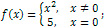 Here:
Here:
- The limit as x→1 exists and equals 1 (limx→1f(x)=1).
- However, the value of the function at x=1 is f(1)=5.
To fix this discontinuity, we simply redefine f(1)=1, aligning the function’s value with its limit. Voilа! The function becomes continuous
- Infinite Discontinuity: An infinite discontinuity occurs when one or both of the limits at a point a do not exist because they approach infinity. Take the function f(x)=1/x as an example. At x=0, the function behaves as follows:
- As x→0+, f(x)→+∞.
- As x→0–, f(x)→-∞.
Because the function “blows up” to infinity at x=0, this is a classic case of infinite discontinuity, often referred to as an “infinite jump”.
How to Remember the Types of Discontinuities
- Jump Discontinuity: The function “jumps” between two finite values.
- Removable Discontinuity: The limit exists, but the function’s value doesn’t align with it.
- Infinite Discontinuity: The function “shoots“ to infinity or doesn’t have a limit.
Such a classification not only helps in understanding the behavior of functions but also aids in identifying ways to eliminate discontinuities whenever possible.
Examples of Continuity of a Function: From Simple to Complex
To fully understand the concept of continuity, theory alone is not enough. Let’s go step by step through several examples with detailed explanations that will help you better understand how different types of functions work. We’ll start with simple problems and gradually move on to more complex ones.
Example 1: Investigating the Continuity of the Function f(x)=sin(x)/x

The function is defined everywhere except at x=0, where the denominator becomes zero. Let’s find the limit at x=0:

Thus, at x=0, the limit exists and equals 1, but the function itself is not defined there. This means that the function has a removable discontinuity at this point. To make the function continuous, it’s enough to “define” it at x=0 by setting f(0)=1.
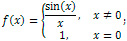
Then, the function will be continuous over its entire domain.
Example 2: Investigating the Continuity of the Function f(x)=arctg(1/x) at x=0

Clearly, the function is not defined at x=0, so it cannot be continuous at that point. Let’s find the one-sided limits:

Since the left-hand and right-hand limits do not match, there is a jump discontinuity at x=0.
Example 3: Investigating the Continuity of the Function f(x)=(x-1)/(x2-3⋅x+2) at points x1=0, x2=1 and x3=2

Let’s consider each of the points:
- Point x1=0: Let’s check if the function is defined at this point. Substitute x=0 into the function:
 Since the function is defined and the value exists at x=0, let’s find the limit at this point:
 There are no zeros in the denominator, so the limit exists and equals the value of the function at this point:
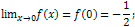 Thus, the function is continuous at x1=0.
 - Point x2=1: At x=1, the denominator of the function equals zero, so the function is not defined here. Let’s check if we can classify x=1 as a point of discontinuity by finding the one-sided limits:
 The left-hand and right-hand limits both approach -1. This means that x=1 is a point of removable discontinuity. To make the function continuous, we can define its value as f(1)=-1.
 - Point x3=2: At x=2, the denominator of the function again equals zero, so the function is not defined here. Let’s check if there is a discontinuity at this point by finding the one-sided limits:
 Since the left-hand limit approaches -∞ and the right-hand limit approaches +∞, x=2 is a point of an infinite discontinuity.
Thus, at point x1=0 the function is continuous; at point x2=1, the function has a removable discontinuity; and at point x3=2, the function has an infinite discontinuity.
Related Topics: What Else You Need to Know About Functions
Studying the properties of functions isn’t just about their continuity. To gain a deeper understanding of a function’s behavior, it’s important to be aware of other aspects that will help you analyze and apply them to problems. Here are a few key topics that deserve your attention:
- Increasing and Decreasing Functions – How can you determine on which intervals a function is increasing or decreasing? This is crucial for understanding its overall behavior.
- Monotonicity of Functions – What does it mean for a function to be monotonic? This property helps predict the direction of change without needing additional calculations.
- Even and Odd Functions – Why are some functions symmetrical with respect to the coordinate axes? Understanding whether a function is even or odd simplifies working with graphs and solving problems.