Monotonicity of a function is one of the key properties that helps us understand how a function behaves over a given interval. Does its value increase, decrease, or stay constant? Answering these questions allows us to analyze functions more deeply, plot their graphs, and apply our knowledge in various fields like physics, economics, and computer science.
Monotonicity of a Function: The Basics You Should Know
So, what is monotonicity? It’s the ability of a function to maintain a certain “trend” over a given interval. If the function’s values are consistently increasing, it’s called an increasing function. If they are consistently decreasing, it’s a decreasing function. If the values remain constant, the function is called constant.
Why is this property so important? Imagine a function that is constantly increasing. It doesn’t have any local maxima or minima in the middle of its interval, making it much easier to study. Similarly, a decreasing function is always moving towards a smaller value, allowing us to make precise predictions. Therefore, understanding monotonicity helps us solve problems faster and better understand how functions behave.
How to Determine the Monotonicity of a Function: Derivative and Graph
There are different ways to determine the monotonicity of a function, but the most effective methods are derivative analysis and examining the function’s graph. Why these methods? The derivative shows the rate of change of a function, while the graph provides a visual representation of its behavior.
The Derivative as a Key Tool
- Increasing Function: If the derivative of the function f'(x)>0 over an interval, the function is increasing. This means that each successive point has a greater value than the previous one.
- Decreasing Function: If f'(x)<0, the function is decreasing, meaning its values are constantly getting smaller.
- Constant Function: If f'(x)=0, the function is constant, meaning its values stay the same.
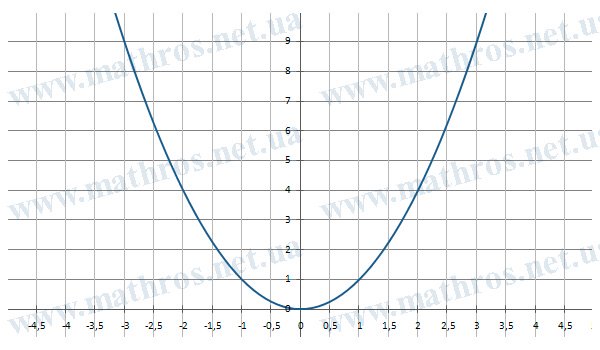
For example, consider the function f(x)=x2. Its derivative is f'(x)=2⋅x:
- On the interval (-∞; 0), f'(x)<0, so the function is decreasing;
- On the interval (0; +∞), f'(x)>0, so the function is increasing.
The Graph as a Visual Helper
Can the graph reveal the behavior of a function without using the derivative? Absolutely! The graph is a great tool for visual analysis. If the curve of the function rises from left to right, it’s increasing; if it drops, it’s decreasing. For example, the graph of f(x)=x3 shows that it increases over the entire domain.
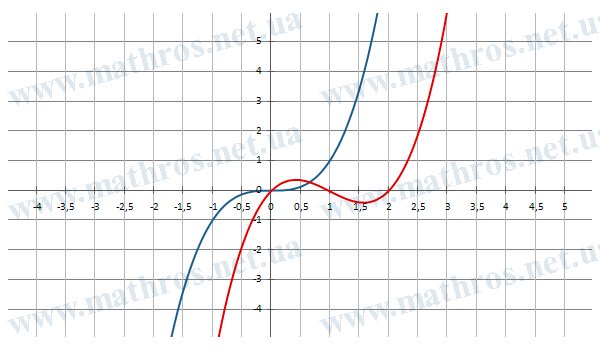
But sometimes, graphs aren’t that straightforward. Consider a complex function with several maxima and minima, like f(x)=x3-3⋅x2+2⋅x. How can we understand its behavior? This is where the derivative comes in again, allowing us to find the critical points (where f'(x)=0) and determine the monotonicity on each interval.
Thus, combining derivative analysis and graph examination gives us the most complete understanding of a function’s behavior.
Types of Monotonicity: Strict, Non-Strict, Local, and Global
Monotonicity can appear in different forms depending on the nature of the function’s changes.
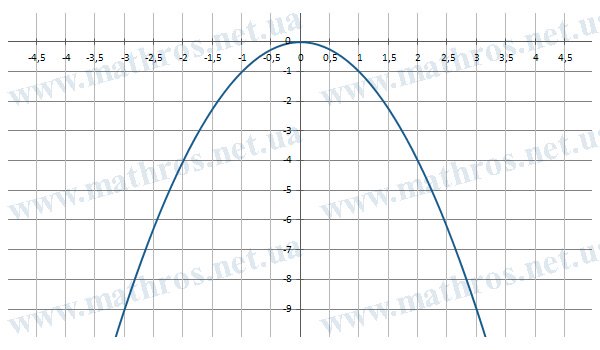
- Strict Monotonicity: A function is strictly increasing (f'(x)>0) or strictly decreasing (f'(x)<0). For example, f(x)=-x2 strictly decreases for x>0.
- Non-Strict Monotonicity: The function may be constant over certain intervals, but its overall trend remains increasing or decreasing.
It’s also important to remember that monotonicity can be local or global. Local monotonicity refers to specific parts of the function’s domain, while global monotonicity considers the entire domain.
Monotonicity of a Function: Practical Examples with Solutions
Theory becomes clearer when we apply it in practice. Isn’t it interesting to see how to determine the monotonicity of functions through concrete examples? Let’s look at three problems to help solidify your understanding. We’ll start with simpler examples and gradually move to more complex ones.
Example 1: Investigate the Monotonicity of f(x)=x+2
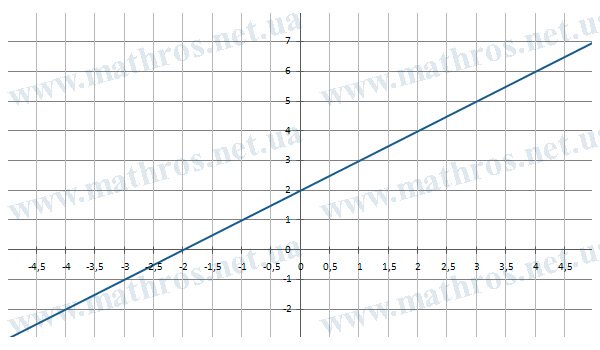
First, find the derivative:

Since the derivative is always positive (f'(x)>0), the function is strictly increasing over the entire domain (-∞; +∞).
Example 2: Investigate the Monotonicity of f(x)=ln(x)-x

Find the derivative and set it equal to zero:

Now, analyze the signs of the derivative:
- On (0; 1): f'(x)>0, so the function is increasing;
- On (1; +∞): f'(x)<0, so the function is decreasing.
Thus, the function is increasing on (0; 1) and decreasing on (1; +∞).
Example 3: Investigate the Monotonicity of f(x)=x3-3⋅x2+2⋅x
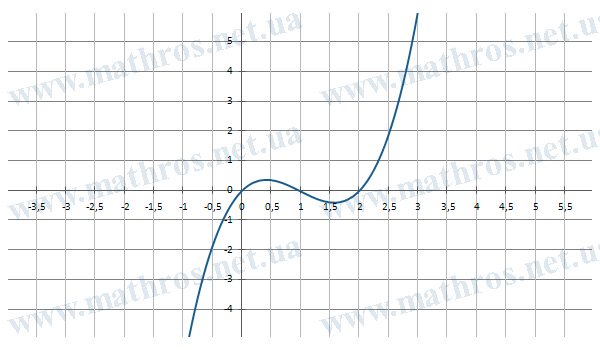
First, find the derivative:

Solve the quadratic equation 3⋅x2-6⋅x+2=0 to find the critical points:

Now, analyze the sign of the derivative on the intervals:
- On (-∞; 1-√3/3): f'(x)>0, so the function is increasing;
- On (1-√3/3; 1+√3/3): f'(x)<0, so the function is decreasing;
- On (1+√3/3; +∞): f'(x)>0, so the function is increasing.
Thus, the function is increasing on (-∞; 1-√3/3)∪(1+√3/3; +∞) and decreasing on (1-√3/3; 1+√3/3).
Deepening Your Knowledge: Other Important Topics in Function Analysis
Studying the monotonicity of a function is just one piece of the larger picture of function analysis. To better understand a function’s behavior, it’s important to explore other related topics. Here are a few key concepts that will deepen your understanding:
- Increasing and Decreasing Functions – This topic explains in more detail how functions change depending on the sign of the derivative and how this affects their graphs.
- Continuity of a Function – Continuity describes whether a function has any breaks in its graph, and it’s a fundamental concept for analyzing a function’s behavior.
- Discontinuities of Functions – Functions can have different types of discontinuities, and understanding these helps analyze the behavior of the function, identify where it might be undefined, and predict how it behaves near those points.