The derivative of cotangent squared often appears in problems involving trigonometric transformations, function analysis, and finding extrema. It is also a place where mistakes can happen very easily if the expression is read too quickly. After all, cotangent squared means the square of the function value, not the cotangent of a squared argument. So let us fix the structure of the expression right away: we are dealing with a composite function in which the outer operation is squaring and the inner function is cotangent. Looking at it this way makes it much easier to apply the rules of differentiation correctly and avoid confusion.
Derivative of Cotangent Squared: Main Formula and Graphs
Let us start with the formula that is used most often in practice. Suppose
\[
y=\cot^2(x).
\]
Then the derivative is
\[
\frac{d}{dx}\bigl(\cot^2(x)\bigr)=\bigl(\cot^2(x)\bigr)’=-\frac{2\cdot \cos(x)}{\sin^3(x)}.
\]
This formula is worth remembering, but it is even more important to understand where it comes from. You also need to keep the domain in mind. Both the function \( \cot^2(x) \) and its derivative are undefined at the points where \( \sin(x)=0 \). In other words, these are points of the form \( x=\pi \cdot k \), where \( k \in \mathbb{Z} \). These are exactly the points where the cotangent function is discontinuous, so they cannot be ignored when analyzing the function.
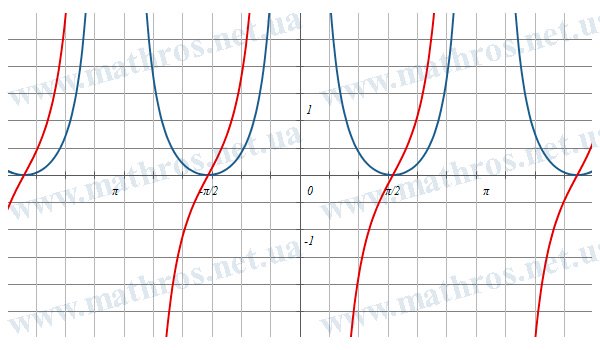
Now let us look at the graph above. What do these graphs show in practice? First, we can see that the function \( \cot^2(x) \) is never negative, because a square cannot produce a negative value. Next, it becomes clear that near the points of discontinuity, the values of the function grow very sharply. The derivative, in turn, shows the intervals on which the function is decreasing and the intervals on which it is increasing. It is the sign of the derivative that allows us to determine this behavior on specific intervals. So the graph of the derivative does not simply repeat the same information. Instead, it helps us understand the behavior of the original function more clearly.
Step by Step: How to Derive the Formula
Now let us move on to the full derivation. First, write the function in a more explicit form:
\[
y=\cot^2(x)=\bigl(\cot(x)\bigr)^2.
\]
This form immediately shows the order of operations. First, we compute \( \cot(x) \), and only then do we square the result. That is exactly why the chain rule is the natural method to use here.
Let us make an intermediate substitution:
\[
u=\cot(x), \qquad y=u^2.
\]
Then, by the chain rule, we have
\[
\frac{dy}{dx}=\frac{dy}{du}\cdot\frac{du}{dx}.
\]
Let us begin with the outer function. If \( y=u^2 \), then its derivative with respect to \( u \) is
\[
\frac{dy}{du}=2\cdot u.
\]
Now let us move to the inner function. For \( u=\cot(x) \), we know that
\[
\frac{du}{dx}=\bigl(\cot(x)\bigr)’=-\csc^2(x).
\]
The minus sign here is especially important, because it is very easy to lose it accidentally during the calculation.
Now substitute both results into the chain rule:
\[
\frac{dy}{dx}=2\cdot u \cdot \bigl(-\csc^2(x)\bigr).
\]
So,
\[
\frac{dy}{dx}=-2\cdot u \cdot \csc^2(x).
\]
Next, replace \( u \) with the original function:
\[
\frac{dy}{dx}=-2\cdot \cot(x)\cdot \csc^2(x).
\]
At this stage, the derivative has already been found, and this form is correct. In fact, this is already a complete answer in one of the standard forms. However, in many problems it is more convenient to work with sine and cosine rather than cotangent and cosecant. Why? Because this form makes it easier to simplify expressions, combine fractions, and study the sign of the derivative.
Let us recall the identities
\[
\cot(x)=\frac{\cos(x)}{\sin(x)}, \qquad \csc^2(x)=\frac{1}{\sin^2(x)}.
\]
Substitute them into the expression \( -2\cdot \cot(x)\cdot \csc^2(x) \):
\[
-2\cdot \cot(x)\cdot \csc^2(x) = -2\cdot \frac{\cos(x)}{\sin(x)}\cdot \frac{1}{\sin^2(x)}.
\]
Now multiply the fractions. In the numerator, we get \( -2\cdot \cos(x) \), and in the denominator, we get \( \sin(x)\cdot \sin^2(x)=\sin^3(x) \). Therefore,
\[
\frac{d}{dx}\bigl(\cot^2(x)\bigr)=-\frac{2\cdot \cos(x)}{\sin^3(x)}.
\]
And that is exactly the formula we were looking for. Notice one important detail: the power in the denominator is three for a reason. One factor of \( \sin(x) \) comes from cotangent, and two more come from \( \csc^2(x) \). That is why the final result contains \( \sin^3(x) \).
So the derivation follows a very clear pattern. First, we applied the chain rule. Then we used the derivative of cotangent. After that, we rewrote the result in terms of sine and cosine. This exact sequence of steps is what allows us to get the correct formula without mistakes.
Derivative of Cotangent Squared: Solving Examples
After understanding the formula, the next logical step is to work through specific expressions. Practice is where you can see most clearly how cotangent squared combines with other functions and when you need to use the product rule, quotient rule, or chain rule. So now let us look at several typical situations and follow each solution step by step.
Example 1. Find the derivative of the function \( y=\cot^2(2 \cdot x+1)\cdot x \)
Here we have a product of two functions: \( x \) and cotangent squared of \( 2 \cdot x+1 \). So we apply the product rule:
\[
y’=\bigl(\cot^2(2 \cdot x+1)\bigr)’\cdot x+\cot^2(2 \cdot x+1)\cdot (x)’.
\]
The second term is immediate, because \( (x)’=1 \). So it is simply \( \cot^2(2 \cdot x+1) \).
Now let us find \( \bigl(\cot^2(2 \cdot x+1)\bigr)’ \). Denote
\[
u=2 \cdot x+1,\quad z=\cot^2(u).
\]
Then
\[
\frac{dz}{dx}=\frac{dz}{du}\cdot\frac{du}{dx}.
\]
For the outer part \( z=\cot^2(u) \), we use the formula we already know:
\[
\frac{dz}{du}=-\frac{2 \cdot \cos(u)}{\sin^3(u)}.
\]
The derivative of the inner argument is
\[
\frac{du}{dx}=2.
\]
Now multiply:
\[
\bigl(\cot^2(2 \cdot x+1)\bigr)’=2\cdot \left(-\frac{2 \cdot \cos(2 \cdot x+1)}{\sin^3(2 \cdot x+1)}\right)=-\frac{4 \cdot \cos(2 \cdot x+1)}{\sin^3(2 \cdot x+1)}.
\]
Now return to the product rule:
\[
y’=-\frac{4 \cdot \cos(2 \cdot x+1)}{\sin^3(2 \cdot x+1)}\cdot x+\cot^2(2 \cdot x+1).
\]
So,
\[
y’=-\frac{4x\cdot \cos(2 \cdot x+1)}{\sin^3(2 \cdot x+1)}+\cot^2(2 \cdot x+1).
\]
Example 2. Find the derivative of the function \( y=\dfrac{\cot^2(3 \cdot x-2)}{x^2+4} \)
Here we have a quotient, so we apply the quotient rule. Let
\[
u=\cot^2(3 \cdot x-2),\quad v=x^2+4.
\]
Then
\[
y’=\frac{u’\cdot v-u\cdot v’}{v^2}.
\]
First, let us find the derivative of the denominator:
\[
v’=(x^2+4)’=2 \cdot x.
\]
Now move to the numerator. We need to find \( u’=\bigl(\cot^2(3 \cdot x-2)\bigr)’ \). Denote
\[
t=3 \cdot x-2,\quad u=\cot^2(t).
\]
Then
\[
u’=\frac{du}{dt}\cdot\frac{dt}{dx}.
\]
For the derivative of the outer part, we have
\[
\frac{du}{dt}=-\frac{2 \cdot \cos(t)}{\sin^3(t)}.
\]
And the derivative of the inner argument is
\[
\frac{dt}{dx}=3.
\]
Therefore,
\[
u’=3\cdot \left(-\frac{2 \cdot \cos(3 \cdot x-2)}{\sin^3(3 \cdot x-2)}\right)=-\frac{6 \cdot \cos(3 \cdot x-2)}{\sin^3(3 \cdot x-2)}.
\]
Now substitute everything into the formula for the derivative of a quotient:
\[
y’=\frac{-\frac{6 \cdot \cos(3 \cdot x-2)}{\sin^3(3 \cdot x-2)}\cdot (x^2+4)-\cot^2(3 \cdot x-2)\cdot 2 \cdot x}{(x^2+4)^2}.
\]
So,
\[
y’=\frac{-\frac{6 \cdot \cos(3 \cdot x-2)}{\sin^3(3 \cdot x-2)}(x^2+4)-2x\cot^2(3 \cdot x-2)}{(x^2+4)^2}.
\]
Example 3. Find the derivative of the function \( y=\cot^2(x^2-5 \cdot x) \)
This is a composite function in which the outer part is cotangent squared and the inner part is the polynomial \( x^2-5 \cdot x \). So the chain rule is the right tool here.
Denote
\[
t=x^2-5 \cdot x,\quad y=\cot^2(t).
\]
Then
\[
\frac{dy}{dx}=\frac{dy}{dt}\cdot\frac{dt}{dx}.
\]
The derivative of the outer part is
\[
\frac{dy}{dt}=-\frac{2 \cdot \cos(t)}{\sin^3(t)}.
\]
The derivative of the inner part is
\[
\frac{dt}{dx}=(x^2-5 \cdot x)’=2 \cdot x-5.
\]
Now multiply:
\[
y’=-\frac{2 \cdot \cos(x^2-5 \cdot x)}{\sin^3(x^2-5 \cdot x)}\cdot (2 \cdot x-5).
\]
So,
\[
y’=-\frac{(4 \cdot x-10)\cdot \cos(x^2-5 \cdot x)}{\sin^3(x^2-5 \cdot x)}.
\]
Example 4. Find the derivative of the function \( y=\cot^2(x)\cdot \sin(x) \)
Once again, we have a product, so we use the product rule. Let
\[
u=\cot^2(x),\quad v=\sin(x).
\]
Then
\[
y’=u’\cdot v+u\cdot v’.
\]
The derivative of \( v=\sin(x) \) is well known:
\[
v’=\cos(x).
\]
Now let us find \( u’=\bigl(\cot^2(x)\bigr)’ \). From the main formula, we get
\[
u’=-\frac{2 \cdot \cos(x)}{\sin^3(x)}.
\]
Substitute everything into the product rule:
\[
y’=-\frac{2 \cdot \cos(x)}{\sin^3(x)}\cdot \sin(x)+\cot^2(x)\cdot \cos(x).
\]
In the first term, we can cancel one factor of \( \sin(x) \) in the numerator and denominator:
\[
-\frac{2 \cdot \cos(x)}{\sin^3(x)}\cdot \sin(x)=-\frac{2 \cdot \cos(x)}{\sin^2(x)}.
\]
So the final result is
\[
y’=-\frac{2 \cdot \cos(x)}{\sin^2(x)}+\cot^2(x)\cdot \cos(x).
\]
Example 5. Find the derivative of the function \( y=\cot^2(2 \cdot x)\cdot \cos(3 \cdot x) \)
Here we also have a product, but now both factors are composite functions. In examples like this, it is especially important not to miss any factor when applying the chain rule.
Denote
\[
u=\cot^2(2 \cdot x),\quad v=\cos(3 \cdot x).
\]
Then
\[
y’=u’\cdot v+u\cdot v’.
\]
Let us start with the second factor. For \( v=\cos(3 \cdot x) \), we have
\[
v’=-\sin(3 \cdot x)\cdot 3=-3 \cdot \sin(3 \cdot x).
\]
Now let us find \( u’=\bigl(\cot^2(2 \cdot x)\bigr)’ \). Denote
\[
t=2 \cdot x,\quad u=\cot^2(t).
\]
Then
\[
u’=\frac{du}{dt}\cdot\frac{dt}{dx}.
\]
The derivative of the outer part is
\[
\frac{du}{dt}=-\frac{2 \cdot \cos(t)}{\sin^3(t)}.
\]
The derivative of the inner part is
\[
\frac{dt}{dx}=2.
\]
Therefore,
\[
u’=2\cdot \left(-\frac{2\cdot \cos(2 \cdot x)}{\sin^3(2 \cdot x)}\right)=-\frac{4 \cdot \cos(2 \cdot x)}{\sin^3(2 \cdot x)}.
\]
Now return to the product rule:
\[
y’=-\frac{4 \cdot \cos(2 \cdot x)}{\sin^3(2 \cdot x)}\cdot \cos(3 \cdot x)+\cot^2(2 \cdot x)\cdot \bigl(-3 \cdot \sin(3 \cdot x)\bigr).
\]
So,
\[
y’=-\frac{4 \cdot \cos(2 \cdot x)\cdot \cos(3 \cdot x)}{\sin^3(2 \cdot x)}-3 \cdot \cot^2(2 \cdot x)\cdot \sin(3 \cdot x).
\]
Next Step: Recommended Topics to Continue With
After the topic of cotangent squared, it is quite natural to move on to related trigonometric functions. In this way, step by step, you will be able to see the common rules more clearly, notice the differences in the formulas, and understand the typical approaches used to solve these problems.
- Derivative of Sine Squared: Formula, Proof, Examples — This article will cover the derivative formula, its derivation, and typical problems involving sine squared.
- Derivative of Cosine Squared: Formula, Proof, Examples — Here we will look at the derivative of cosine squared, explain the formula, and go through examples with detailed solutions.
- Derivative of Tangent Squared: Formula, Proof, and Examples — In this article, you will see how to find the derivative of tangent squared and how to apply it in practice.
Derivative of Cotangent Squared: Practice for Those Who Program
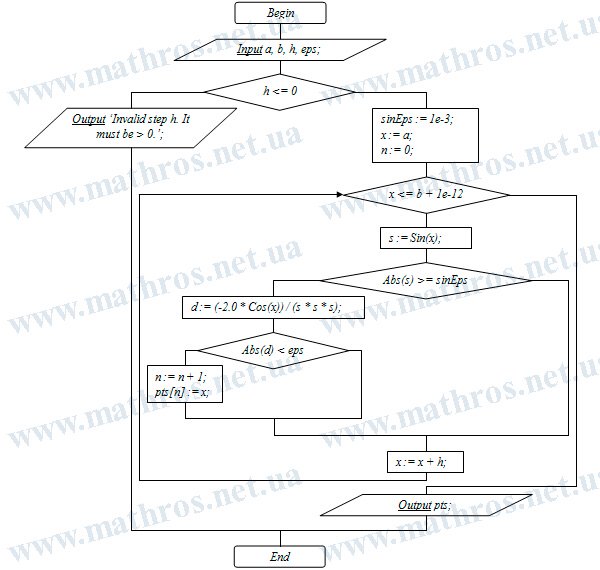
If you enjoy programming, this is a great moment to move from the mathematical formula to its program implementation: take a ready-made flowchart, go through its steps carefully, and implement the search for candidate points for a maximum or minimum in your favorite programming language. Here, you are not just computing a derivative. You are building a small tool for studying the behavior of a function on an interval. You learn how to work with the step size of iteration, condition checks, and skipping points of discontinuity. After that, you can compare your program’s result with the graph and clearly see how knowledge of mathematics helps solve practical problems.