The chord of a circle is an essential part of geometry that opens the door to fascinating properties and applications. In simple terms, it is just a line segment that connects any two points on a circle. But did you know that the diameter is not only a chord, but also the longest one, passing right through the center of the circle?
Let’s step into the world of chords, where we will explore not only their definition but also their key properties, methods of calculation, and practical uses. You’ll discover how these geometric elements become the key to solving complex problems and understanding some of the most interesting aspects of a circle.
Chord of a Circle: Definition and Properties
A chord of a circle is defined as a line segment connecting any two points on its circumference. Simply put, it’s the “line” between two points on a circle.
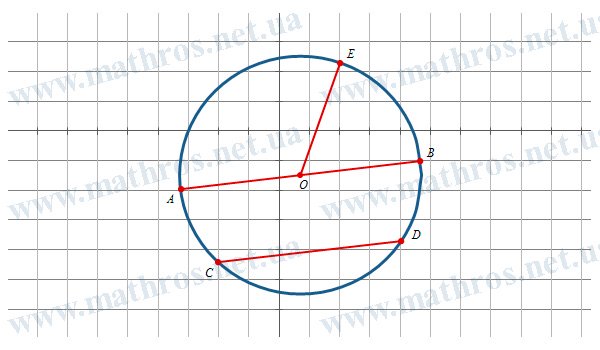
For better understanding, take a look at the diagram above, where point O is the center of the circle, OE is its radius, and AB and CD are chords. Notice that the line AB in this case can represent both a diameter and a chord. This means it is the largest chord that passes through the center of the circle.
Properties of a Chord of a Circle
There are several key properties of a chord of a circle that reveal its unique geometric characteristics:
- A perpendicular drawn from the center of the circle to a chord bisects it into two equal parts.
- Two chords are equal in length if they are at the same distance from the circle’s center.
- Two radii connecting the endpoints of a chord to the center form an isosceles triangle.
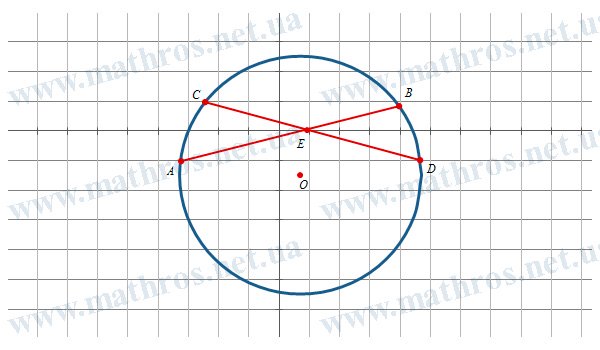
- When two chords intersect inside the circle, the point of intersection divides each chord into two segments such that the product of the lengths of one chord’s segments equals the product of the other’s: AE·EB=CE·ED;
- When a chord is drawn, it divides the circle into two regions called segments: the major segment and the minor segment.
- A chord, when extended infinitely in both directions, becomes a secant.
How to Find the Length of a Chord of a Circle: Two Key Formulas
There are two main formulas for determining the length of a chord of a circle. Note that both formulas are effective tools depending on the known parameters. Therefore, when using these formulas, it is important to consider the context of the problem and choose the optimal method for the specific case.
Formula Using the Perpendicular Distance from the Center
The length of a chord using the perpendicular distance from the center is given by:

Let’s consider the proof of this formula. In the circle shown below, the radius AO is the hypotenuse of a right triangle AOC, and the perpendicular bisector OC is one of its legs. It is important to note that a perpendicular drawn from the center of the circle to the chord bisects the chord.
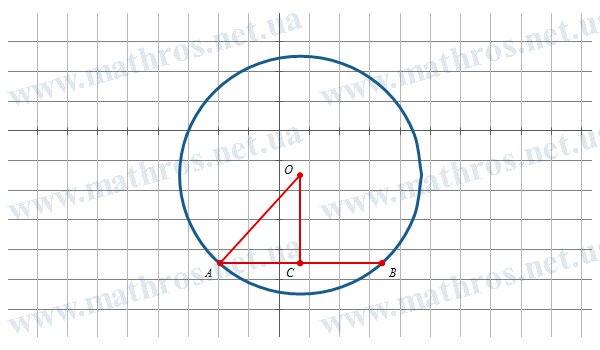
Thus, half of the chord forms the second leg of the right triangle. Applying the Pythagorean theorem to this triangle, we obtain:

Therefore, the length of the chord AB equals 2·√(AO2-OC2).
Formula Using Trigonometry
The length of a chord using trigonometry is determined by the formula:
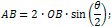
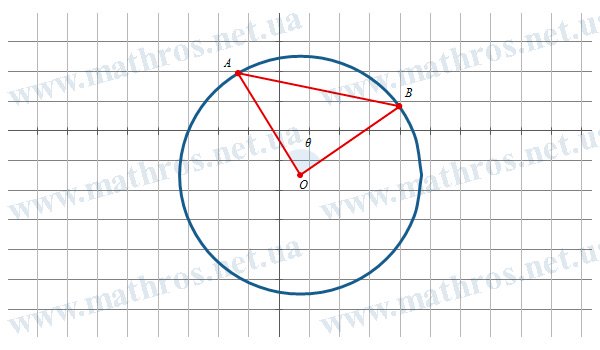
Here, OB is a radius of the circle, and θ is the central angle. This mathematical relationship can be illustrated with the circle shown below, where the central angle θ is formed by the chord AB and the radius OB.
Using Geometric Knowledge: Chord of a Circle Through Examples
To solve the following problems, you will need the knowledge gained from the previous sections. Each exercise has its own solution, but it is recommended to try solving the tasks on your own before checking the answers. This helps reinforce what you’ve learned and strengthens your problem-solving skills in mathematics.
Example 1: What are the radius, diameter, and chord of a circle?
The radius of a circle is the distance from the center to any point on the circle. The diameter is a line segment that passes through the center of the circle and touches two points on the circumference. A chord is a segment that connects any two points on the circumference of a circle.
Example 2: What is the relationship between a chord of a circle and the perpendicular dropped to it from the center?
A perpendicular drawn from the center of a circle to a chord bisects the chord. In other words, a line through the center that is perpendicular to the chord divides it into two equal parts.
Example 3: How do you find a chord of a circle?
Any line segment whose endpoints lie on the circumference of a circle is a chord of that circle. There are two methods to find the length of a chord depending on the known parameters:
- When the radius and the distance from the center of the circle to the chord are known, use the formula: AB=2·√(AO2-OC2);
- When the radius and the central angle are known, use the formula : AB=2·OB·sin(θ/2).
Example 4: In the given circle, the chord AB is 16 cm. Find the length AD if OC is the radius of the circle
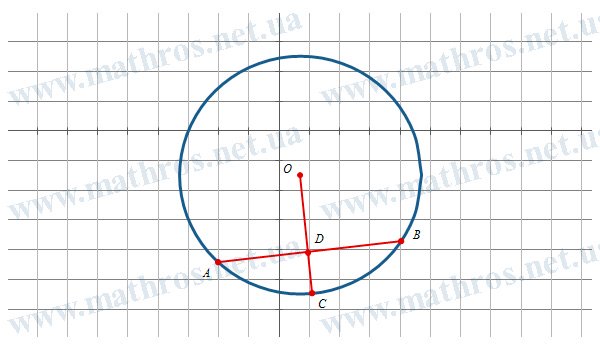
As is known, a perpendicular drawn from the center of a circle to a chord divides it into two equal parts, i.e., AD=AB/2=16/2=8. Thus, AD=8 cm.
Example 5: In the given circle, the radius is 5 cm. Find the length of the chord AB if the length of the perpendicular dropped from the center is 4 cm
So, according to the conditions, the radius of the circle AO is 5 cm, and the perpendicular OC dropped from the center to the chord is 4 cm. Substituting these values into the formula that uses the perpendicular distance, we get:

Thus, the chord of the circle is 6 cm.
Keep Exploring: Circle Geometry Topics
Curious to go a bit further? Here are a few closely related ideas that build on what you’ve learned and make problem-solving with circles even more intuitive.
- Circle in Detail: From Definition to Core Properties – Review the circle’s parts (radius, diameter, arc) and the key properties that tie them together in real problems.
- Center of a Circle: From Theory to Practice – Learn practical ways to locate the center and see why this point simplifies constructions and solutions.
- Circumference Formula: From Theory to Us – Understand what the circle’s perimeter means and how to apply it in everyday-style tasks.
- Area of a Circle: From Definition to Practical Problem – Explore what area represents and practice using it in short, meaningful examples.
Programming Challenge: Build Your Chord of a Circle Solver
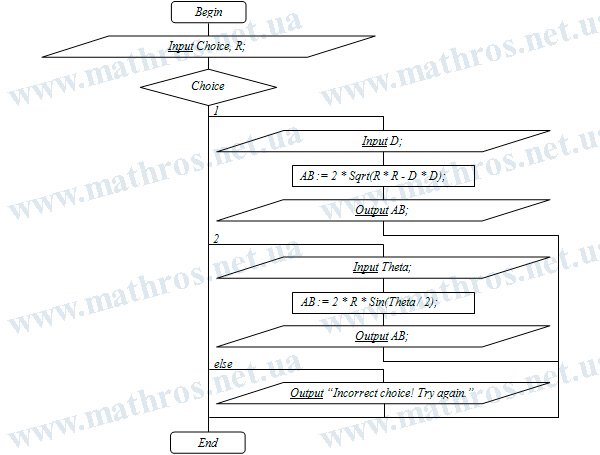
If you enjoy coding, here’s a fun mini-project: below is a flowchart that outlines the algorithm for determining the chord of a circle under different conditions. Your task is to turn this flowchart into a working program in any language you like—Python, Java, C#, JavaScript, or whatever you’re learning. Focus on translating each step from the diagram into clear, readable code, and add helpful prompts or messages so others can use your tool with ease. It’s a great way to connect geometry with real-world programming and sharpen your problem-solving skills.