Geometry is a fascinating branch of mathematics that reveals the structure of the space around us. One engaging topic in geometry is the tangent to the circle. This concept opens up wide possibilities for solving challenging problems and exploring the properties of circles.
In this article, we will look at what a tangent to a circle is, which properties it has, how to find its equation, and the main theorems related to this idea. Get ready to discover a world of geometric insights!
Tangent to the Circle: Definition and Properties
A tangent to a circle is a line that touches it at exactly one point. We can draw infinitely many tangents to a circle because there are infinitely many points on its boundary. However, if we are given a fixed point outside the circle, only two tangents to the circle can be drawn through that external point.
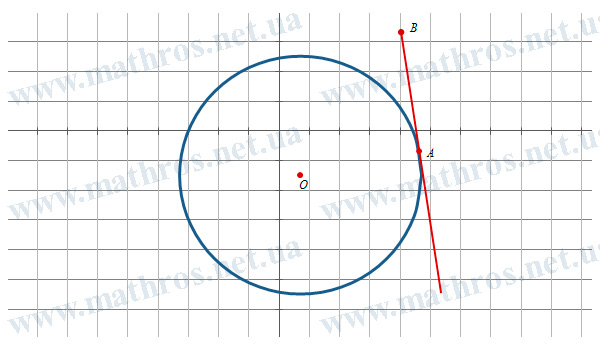
As we can see, in the circle above with center O, the straight line AB is a tangent that touches the circle at point A. It touches the circle at only one point and looks like a line lying outside the circle. There are several important facts connected with a tangent to a circle:
- There is exactly one tangent at a given point of a circle.
- A tangent to the circle is a special case of a secant when the two endpoints of the corresponding chord coincide.
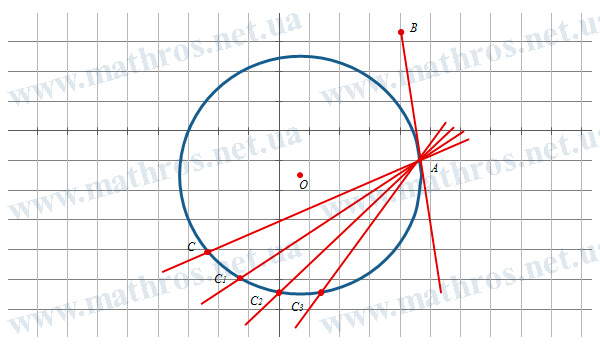
From the drawing above, we notice that the secant line AC becomes a tangent as C moves toward A along the circle, or when points A and C coincide.
Properties of the Tangent to the Circle
Now that we know what a tangent is, it’s time to consider its key properties. These characteristics describe how the tangent interacts with the circle and help us understand their relationship.
- A tangent is a straight line that touches the circle but does not cut across it.
- A tangent is perpendicular to the radius at the point of contact.
- A tangent can never meet the circle at two points; it touches the circle at only one point.
- The lengths of the tangents drawn from a single external point to the circle are always equal.
Beyond the properties listed above, the tangent to the circle comes with several important theorems, and these theorems are used in many standard geometric calculations. Next, we will look more closely at a few of these theorems to understand their applications in geometry.
Going Deeper: Theorems and Proofs
There are two most important theorems about the tangent to a circle: the theorem on the tangent to a radius and the two-tangent theorem. Let’s discuss their statements and proofs in detail.
Theorem on the Tangent to a Radius
Statement of the theorem: The tangent at any point of a circle is perpendicular to the radius drawn to the point of tangency.

Proof: Consider a circle with center O and radius OA. Suppose point B lies outside the circle, and connect it with the center O.
If BO>OA (the radius of the circle), this condition will hold for every point on the line BC, except point A. From this we conclude that OA – is the shortest distance from point O to any other point on BC. Hence, we have shown that OA is perpendicular to BC.
Theorem on Two Tangents
Statement of the theorem: Suppose two tangents are drawn to a circle from an external point C. Let the points of tangency be A and B, as shown in the figure below.
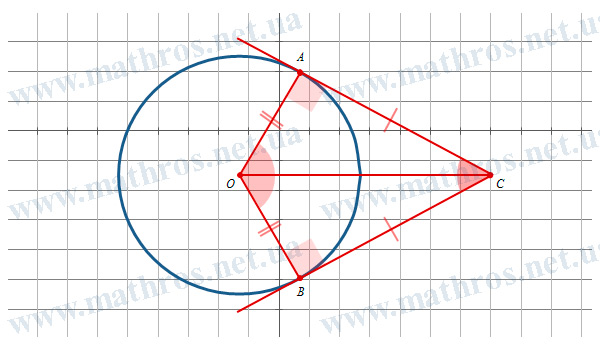
In this case, the theorem states the following:
- The lengths of the two tangents are equal, i.e., CA=CB.
- The two tangents subtend equal angles at the center, i.e., ∠COA=∠COB.
- The angle between the tangents is bisected by the line joining the external point with the center, i.e., ∠ACO=∠BCO.
Proof: Note that all three statements will be proved if we show that △CAO is congruent to △CBO. Comparing the two triangles, we see that:
- OA=OB (radii of the same circle).
- OC is a common side.
- ∠OAC=∠OBC=90° (a tangent to a circle is perpendicular to the radius at the point of contact).
Thus, by the RHS (Right angle–Hypotenuse–Side) congruence criterion, △CAO≅△CBO, and it follows that all three statements are true.
Step by Step: How to Write the Equation of the Tangent to the Circle at a Point
Consider a circle with center O(a,b) and radius R, as shown in the figure, where A(x1,y1) is a point on the circle. Note that the equation of this circle has the form: (x-a)2+(y-b)2=R2.
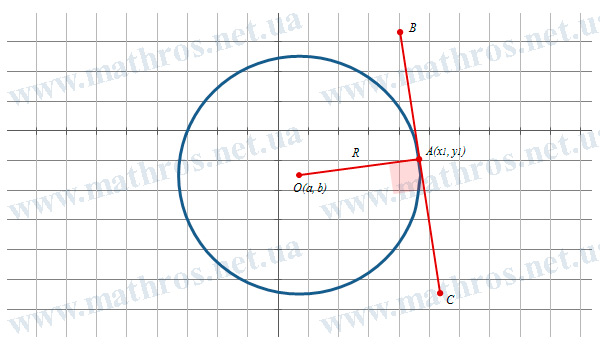
From the figure we also see that the tangent BC touches the circle at point A. Since the tangent to a circle is a straight line, we look for its equation in the form y=k⋅x+c, where k is the slope of the tangent and c is a constant.
To find the slope k, we can use the fact that the tangent to the circle at point A is perpendicular to the radius at that point. Thus, we can compute the slope of the radius as the ratio of the change in y to the change in x between the center O(a,b) and the point A(x1,y1):

Having obtained kOA, we can use the fact that the product of the slopes of perpendicular lines is -1, and therefore find the slope of the tangent kBC:

Now, knowing the slope kBC and the point of tangency A(x1, y1), we can write the equation of the tangent in the form:

Substitute the known values of the point of tangency A and the slope kBC to obtain the equation of the tangent to the circle at the given point.
Applying Geometric Knowledge: Tangent to the Circle Through Examples
Let’s strengthen our understanding in practice. Together, we’ll solve a few interesting problems so you can feel how effective tangents to the circle are in action.
Example 1: What is a tangent to a circle?
A tangent to a circle can be defined as a straight line that passes through a point of the circle and is perpendicular to the radius. A tangent interacts with the circle by touching it at exactly one point while remaining outside the circle.
Example 2: How many tangents can be drawn to a circle?
Knowing that a tangent can be drawn at any point of a circle, we understand that the number of possible tangents to a circle is infinite. Every point on the circle can serve as a point of tangency, which defines countless straight lines that touch the circle.
Example 3: How many parallel tangents can be drawn to a circle?
The number of parallel tangents that can be drawn to a circle is limited to two. The first parallel tangent can be drawn at any point on the circle, while the second will pass through the point diametrically opposite the first. Therefore, a circle can have no more than two parallel tangents, which sets the maximum number of such lines in circle geometry.
Example 4: Lines CA and CB are two tangents to a circle with center О, such that ∠AOB=130°. Find the value of angle ACB

Using the theorem on the tangent to a radius, we can state that ОA and ОB are perpendicular to CA and CB respectively. Hence, ∠ОAC=∠OBC=90°.
We know that the sum of the interior angles of a quadrilateral is 360°. Therefore, we have: ∠AOB+∠ACB+∠OAC+∠OBC=360°. Solving for ∠ACB, we get:

Thus, ∠ACB equals 50°.
Example 5: Let there be two concentric circles with radii 5 cm and 7 cm. The chord AB of the larger circle is tangent to the smaller circle at point C. What is the length of AB?
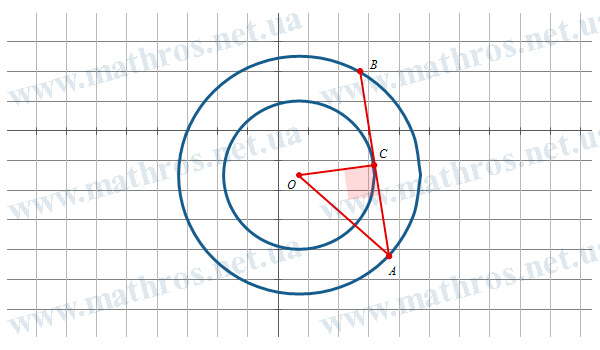
Note that since AB is tangent to the smaller circle at point C, the segment OC must be perpendicular to AB. Thus, triangle OAC is right-angled at C. Since C is the midpoint of AB, we have AC=BC=AB/2. Using the Pythagorean theorem:

Therefore, the length of the tangent AB is approximately 9.8 cm.
Example 6: Find the equation of the tangent to the circle x2+y2-4·x+2·y-8=0 at the point A(0,2)
To determine the equation of the tangent to the given circle at the point (0,2), start by finding the center of the circle. First, write x2+y2-4·x+2·y-8=0 in standard (canonical) form.
So, in the first step, collect the terms that contain only x and the terms that contain only y, and complete the square for them:

Taking these results into account, rewrite the equation in terms of perfect squares:

Thus, the center of the circle is at O(a,b)=(2,-1).
Now choose the point of tangency A(x1, y1)=(0, 2) and find the slope of the radius that joins the center of the circle and the point of tangency. The slope kOA is computed by the formula:
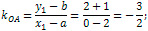
Since the tangent and the radius of the circle are perpendicular, the slope of the tangent kBC can be found as the negative reciprocal of kOA, that is, kBC=-2/3. Knowing the slope of the tangent and the point of tangency, we can write the equation of the tangent:

See Also: Topics Related to Tangent to the Circle
Studying tangents to the circle is an exciting and important step in geometry. As you continue your exploration, you may find it helpful to learn more about:
- Circle in Detail: From Definition to Key Properties – Discover and understand the fundamental aspects of a circle—its definition and essential properties.
- Center of a Circle: From Geometric Theory to Practical Uses – Explore the meaning and properties of the circle’s center and gain practical skills for using them.
- Circumference Formula: From Theory to Application – Review the formulas and methods for calculating a circle’s circumference and see how to apply them in practice.
- Area of a Circle: From Definition to Practical Problems – Learn the theory and methods for finding the area of a circle, and solve engaging problems related to area.
Programming Challenge: Code the Tangent to the Circle Flowchart
If you enjoy programming, here’s a neat task to try: use the flowchart below as your roadmap and implement the algorithm for finding the equation of the tangent to a circle at a point in any language you like—Python, JavaScript, Java, C++, or another favorite. Translate each block step by step into clear, readable code, and focus on making your solution easy to follow. It’s a great way to connect geometry with real-world coding practice and sharpen your problem-solving skills.
