A table of integrals is a convenient collection of ready-to-use formulas that helps you quickly find antiderivatives of common functions. Why perform complicated transformations every time when the required formula is already known? That is why a table of integrals is one of the main tools used when studying integral calculus. It simplifies calculations, helps you check solutions, and allows you to focus on choosing the right integration method.
Table of Integrals: Formulas for Elementary Functions
Let us begin with the most commonly used formulas. They cover power, exponential, trigonometric, and inverse trigonometric functions. In each formula, \( C \) represents an arbitrary constant. Why do we need to add it? The derivative of any constant is zero. Therefore, a single function has infinitely many antiderivatives that differ only by a constant term.
| Function | Integral |
|---|---|
| \( k \) | \( \int k\,dx=k\cdot x+C \) |
| \( x^n \) | \( \int x^n\,dx=\frac{x^{n+1}}{n+1}+C \) |
| \( \frac{1}{x} \) | \( \int \frac{1}{x}\,dx=\ln\left(\lvert x\rvert\right)+C \) |
| \( e^x \) | \( \int e^x\,dx=e^x+C \) |
| \( a^x \) | \( \int a^x\,dx=\frac{a^x}{\ln(a)}+C \) |
| \( \sin(x) \) | \( \int \sin(x)\,dx=-\cos(x)+C \) |
| \( \cos(x) \) | \( \int \cos(x)\,dx=\sin(x)+C \) |
| \( \frac{1}{\sin^2(x)} \) | \( \int \frac{1}{\sin^2(x)}\,dx=-\cot(x)+C \) |
| \( \frac{1}{\cos^2(x)} \) | \(\int \frac{1}{\cos^2(x)}\,dx=\tan(x)+C \) |
| \( \frac{\sin(x)}{\cos^2(x)} \) | \( \int \frac{\sin(x)}{\cos^2(x)}\,dx=\frac{1}{\cos(x)}+C \) |
| \( \frac{\cos(x)}{\sin^2(x)} \) | \( \int \frac{\cos(x)}{\sin^2(x)}\,dx=-\frac{1}{\sin(x)}+C \) |
| \( \tan(x) \) | \( \int \tan(x)\,dx=-\ln\left(\lvert\cos(x)\rvert\right)+C \) |
| \( \cot(x) \) | \( \int \cot(x)\,dx=\ln\left(\lvert\sin(x)\rvert\right)+C \) |
| \( \frac{1}{1+x^2} \) | \( \int \frac{1}{1+x^2}\,dx=\arctan(x)+C \) |
| \( \frac{1}{\sqrt{1-x^2}} \) | \( \int \frac{1}{\sqrt{1-x^2}}\,dx=\arcsin(x)+C \) |
| \( \frac{1}{a^2+x^2} \) | \( \int \frac{1}{a^2+x^2}\,dx=\frac{1}{a}\cdot\arctan\left(\frac{x}{a}\right)+C \) |
| \( \frac{1}{\sqrt{a^2-x^2}} \) | \( \int \frac{1}{\sqrt{a^2-x^2}}\,dx=\arcsin\left(\frac{x}{a}\right)+C \) |
| \( \frac{1}{x^2-a^2} \) | \( \int \frac{1}{x^2-a^2}\,dx=\frac{1}{2\cdot a}\cdot\ln\left(\left\lvert\frac{x-a}{x+a}\right\rvert\right)+C \) |
| \( \frac{1}{a^2-x^2} \) | \( \int \frac{1}{a^2-x^2}\,dx=\frac{1}{2\cdot a}\cdot\ln\left(\left\lvert\frac{a+x}{a-x}\right\rvert\right)+C \) |
| \( \frac{1}{\sqrt{x^2+a^2}} \) | \( \int \frac{1}{\sqrt{x^2+a^2}}\,dx=\ln\left(\left\lvert x+\sqrt{x^2+a^2}\right\rvert\right)+C \) |
| \( \frac{1}{\sqrt{x^2-a^2}} \) | \( \int \frac{1}{\sqrt{x^2-a^2}}\,dx=\ln\left(\left\lvert x+\sqrt{x^2-a^2}\right\rvert\right)+C \) |
Thus, the table provides a ready-made answer whenever the integrand matches one of the forms shown above. However, in practice, an expression may contain constant factors or several terms. What should you do in this case? You need to use the properties of the indefinite integral and then apply the appropriate formulas from the table.
Practical Part: Applying the Table of Integrals
Now let us move on to calculations. In each example, we will first identify the type of the integrand and then choose the appropriate formula from the table. This approach helps you not only find the integral but also understand each step of the solution.
Example 1. Find the indefinite integral
\[
\int x^5\,dx.
\]
The integrand \( x^5 \) is a power function. Therefore, we use the formula:
\[
\int x^n\,dx=\frac{x^{n+1}}{n+1}+C.
\]
In this case, \( n=5 \). We increase the exponent by one and then divide by the resulting number:
\[
\int x^5\,dx
=
\frac{x^{5+1}}{5+1}+C
=
\frac{x^6}{6}+C.
\]
Let us check the antiderivative by finding its derivative:
\[
\left(\frac{x^6}{6}\right)’
=
\frac{1}{6}\cdot 6\cdot x^5
=
x^5.
\]
Therefore, the calculation is correct.
Example 2. Find the indefinite integral
\[
\int \left(e^x+\cos(x)\right)\,dx.
\]
Under the integral sign, we have the sum of two functions. Therefore, the integral of the sum can be written as the sum of the corresponding integrals:
\[
\int \left(e^x+\cos(x)\right)\,dx
=
\int e^x\,dx+\int \cos(x)\,dx.
\]
Now we use two formulas from the table:
\[
\int e^x\,dx=e^x+C,
\qquad
\int \cos(x)\,dx=\sin(x)+C.
\]
After substitution, we get:
\[
\int \left(e^x+\cos(x)\right)\,dx
=
e^x+\sin(x)+C.
\]
Why do we write only one constant \( C \)? The sum of several arbitrary constants is also an arbitrary constant, so it is represented by a single letter.
Example 3. Find the indefinite integral
\[
\int \left(\frac{3}{x}-2\cdot\sin(x)\right)\,dx.
\]
First, we write the integral of the difference as the difference of two integrals. We also take the constant factors outside the integral signs:
\[
\int \left(\frac{3}{x}-2\cdot\sin(x)\right)\,dx
=
3\cdot\int \frac{1}{x}\,dx
–
2\cdot\int \sin(x)\,dx.
\]
For the first integral, we use the formula:
\[
\int \frac{1}{x}\,dx=\ln\left(\lvert x\rvert\right)+C.
\]
For the second integral, we have:
\[
\int \sin(x)\,dx=-\cos(x)+C.
\]
After substitution, we obtain:
\[
3\cdot\int \frac{1}{x}\,dx
–
2\cdot\int \sin(x)\,dx
=
3\cdot\ln\left(\lvert x\rvert\right)
–
2\cdot\left(-\cos(x)\right)+C.
\]
There is a minus sign before the second integral, and the antiderivative of sine also contains a minus sign. Therefore, after simplification, we get a plus sign:
\[
\int \left(\frac{3}{x}-2\cdot\sin(x)\right)\,dx
=
3\cdot\ln\left(\lvert x\rvert\right)+2\cdot\cos(x)+C.
\]
Example 4. Find the indefinite integral
\[
\int \left(\frac{1}{1+x^2}
+
\frac{1}{\sqrt{1-x^2}}\right)\,dx.
\]
Both integrands match formulas from the table of integrals. Therefore, we write the integral of the sum as the sum of two integrals:
\[
\int \left(
\frac{1}{1+x^2}
+
\frac{1}{\sqrt{1-x^2}}
\right)\,dx
=
\int \frac{1}{1+x^2}\,dx
+
\int \frac{1}{\sqrt{1-x^2}}\,dx.
\]
For the first function, we use the formula:
\[
\int \frac{1}{1+x^2}\,dx=\arctan(x)+C.
\]
For the second function, we use the formula:
\[
\int \frac{1}{\sqrt{1-x^2}}\,dx=\arcsin(x)+C.
\]
After substitution, we get:
\[
\int \left(
\frac{1}{1+x^2}
+
\frac{1}{\sqrt{1-x^2}}
\right)\,dx
=
\arctan(x)+\arcsin(x)+C.
\]
In this example, the formulas can be applied without any additional transformations because the integrands exactly match the expressions in the table.
Example 5. Find the indefinite integral
\[
\int \left(\frac{4}{\cos^2(x)}+2\cdot\tan(x)\right)\,dx.
\]
The integrand contains two trigonometric functions. We write the integral of the sum as the sum of two integrals and take the constant factors outside the integral signs:
\[
\int \left(
\frac{4}{\cos^2(x)}
+
2\cdot\tan(x)
\right)\,dx
=
4\cdot\int \frac{1}{\cos^2(x)}\,dx
+
2\cdot\int \tan(x)\,dx.
\]
From the table of integrals, we know that:
\[
\int \frac{1}{\cos^2(x)}\,dx=\tan(x)+C,
\qquad
\int \tan(x)\,dx=-\ln\left(\lvert\cos(x)\rvert\right)+C.
\]
Let us substitute these formulas:
\[
4\cdot\int \frac{1}{\cos^2(x)}\,dx
+
2\cdot\int \tan(x)\,dx
=
4\cdot\tan(x)
+
2\cdot\left(-\ln\left(\lvert\cos(x)\rvert\right)\right)+C.
\]
After simplification, we obtain:
\[
\int \left(
\frac{4}{\cos^2(x)}
+
2\cdot\tan(x)
\right)\,dx
=
4\cdot\tan(x)-2\cdot\ln\left(\lvert\cos(x)\rvert\right)+C.
\]
Thus, the table of integrals allows you to find antiderivatives quickly when you correctly identify the type of each function. However, it is important not only to remember the formulas. You must also carefully consider signs, constant factors, and the properties of the indefinite integral.
What to Study Next: Further Topics in Integration
The table of integrals helps you recognize basic formulas, but not every expression can be integrated without additional steps. So, where should you go next? The following topics will show you how to work with more complex indefinite integrals.
- Substitution Method in Integrals: How Substitution Works — This article will explain how to choose a new variable correctly, perform the substitution, and transform a complex integral into a standard form from the table.
- Integration by Parts: Formula and Step-by-Step Examples — You will learn how to choose the parts of an integrand and calculate integrals involving products of different functions step by step.
- Integration of Rational Functions: Partial Fraction Decomposition — This material will explain how to decompose a rational function into simpler fractions and evaluate the resulting integrals using known rules.
Table of Integrals: From a Flowchart to Your Own Program
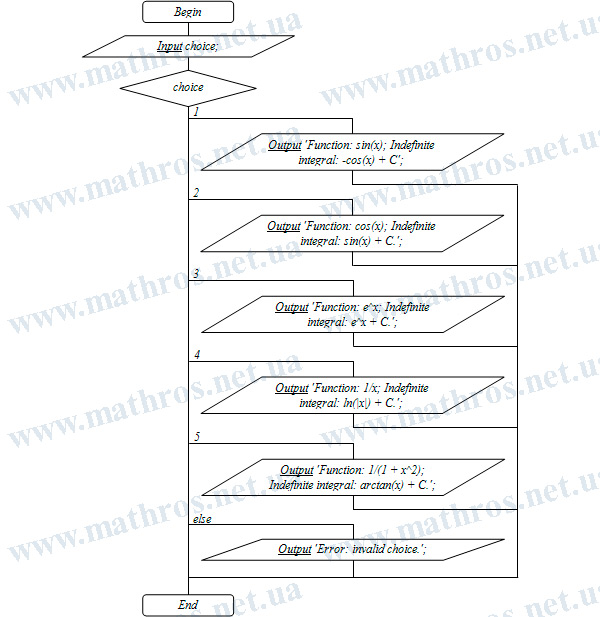
Interested in programming? Then try applying your knowledge of the table of integrals in practice. Study the flowchart carefully and implement the given algorithm in your preferred programming language.
The program should accept a function number, select the corresponding formula, and display the indefinite integral of the chosen function. If the input is incorrect, it should display an error message. Pascal, Python, C++, JavaScript, or another language—the choice is yours.
Once the basic version works, try expanding it by adding new functions from the table.