Wondering about the surface area of a triangular prism? It’s actually pretty straightforward! The surface area of a triangular prism is simply the total area of all its faces. We measure it in square units like mm2, cm2, or m2. To figure out the surface area of any 3D shape, you just add up the areas of all its faces. In the case of a triangular prism, this includes two identical triangular faces and three rectangular faces.
In this guide, we’ll dive into the formula you can use to calculate the surface area of a triangular prism. Plus, we’ll show you how to put this formula into practice. Ready to get started?
Formula for Surface Area of a Triangular Prism : Let’s Break It Down
So, how do you find the surface area of a triangular prism? It’s actually quite simple! All you need to do is add up the areas of all its faces. Remember we said that a triangular prism has two identical triangular faces and three rectangular faces? Let’s dig a bit deeper.
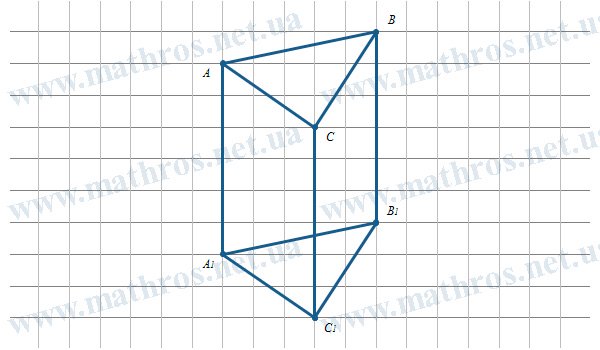
Imagine we have a triangular prism named ABCA1B1C1. To find the area of one of its triangular faces, say ABC, we use this formula: SABC=(AС∙BH)/2, where BH is the height of the triangular base, and AC is the base length.

Pretty straightforward, right? And since the prism has two identical triangular faces, the combined area of these faces will be AС∙BH.
Next up, the rectangular faces. The area of each rectangular face is found by multiplying the height of the prism by the length of the sides of the triangle’s base. So, for our prism ABCA1B1C1, the areas of the rectangular faces are:
- SA1ABB1=A1A∙AB;
- SB1BCC1=B1B1∙BC;
- SA1ACC1=C1C∙AC.
Adding up all these areas, we get the total surface area:

Or in a simpler form:

What If You Don’t Know the Height of the Base?
But what if you don’t have the height of the base? No worries! We can still find the surface area of a triangular prism using Heron’s formula to calculate the area of the triangular faces.
Heron’s formula is:

where s is the semi-perimeter of the triangle s=(AB+BC+AC)/2.
Using this, the total surface area becomes:

Or more simply:

And there you have it! With these formulas in hand, you can easily calculate the surface area of a triangular prism, even if you don’t know the height of the base. Cool, right?
Surface Area of a Triangular Prism: Practical Problems and Solutions
Ready to put those formulas into practice? Here are some examples to help you get the hang of calculating the surface area of a triangular prism. Try to solve each problem on your own before peeking at the answers!
Example 1: A triangular prism has a height of 6 cm, and its triangular base has sides of 5 cm, 6 cm, and 5 cm, with a height of 4 cm. How do we find its surface area?
Alright, using our trusty formula and the given values (l=6, a=5, b=6, c=5, h=4), we get:

So, the surface area of the triangular prism is 116 cm2.
Example 2: A triangular prism has a height of 10 cm, and its triangular base has sides of 13 cm, 10 cm, and 13 cm, with a height of 12 cm. What’s its surface area?
Using our formula again with these values, we have:

Thus, the surface area of this triangular prism is 516 cm2.
Example 3: A triangular prism has an equilateral base with sides of 6 cm and a height of 5 cm. What’s its surface area if the height of the prism is 5 cm?
Here, we use our formula with l=5, a=b=c=6, and h=5:

So, the surface area of this triangular prism is 120 cm2.
Example 4: What’s the height of a triangular prism with a surface area of 171 cm2, if its base is an equilateral triangle with sides of 9 cm and a height of 7 cm?
Using our formula to solve for the height l:

So, the height of the triangular prism is 4 cm.
Example 5: The surface area of a triangular prism is 340 cm2, and its base is an equilateral triangle with sides of 10 cm and a height of 7 cm. What’s the length of the height of the triangular prism?
Again, using the formula and solving for l:

So, the height of the triangular prism is 9 cm.
Want to Dive Deeper? Here Are Some Helpful Links!
Looking to expand your knowledge on triangular prisms? Check out these pages:
- What is a Triangular Prism? – All you need to know about triangular prisms!
- Volume of a Triangular Prism – Learn about calculating the volume of a triangular prism here.
Fast and Efficient Calculation: A Flowchart for You
Are you a coding enthusiast? Why not combine your programming skills with geometry? Use this flowchart to create a program that calculates the surface area of a triangular prism quickly and accurately. Exciting, right? Ready to give it a shot? Dive in and have fun!

We hope you enjoy this hands-on approach to learning geometry!