When it comes to solving quadratic equations, the method of graphing is one of the most visual and interesting ways to find the roots. In this article, we’ll dive into various approaches to solving a quadratic equation by graphing, explain how to plot function graphs, and work through several examples step by step. Does this method work in all cases? Is it possible to solve any quadratic equation graphically? Let’s explore!
What is a Quadratic Equation?
First, let’s recall what a quadratic equation is. It’s a type of equation that takes the following general form:

where a, b, and c are real numbers, and a≠0. Why is it important that a is not zero? If a=0, the equation stops being quadratic and becomes linear, which requires a completely different solution approach.
Solving a Quadratic Equation by Graphing: Basic Approaches
Graphing is a great way to visually understand the solution to a quadratic equation. But how does it work exactly? Here are several approaches, each with its own advantages:
- Plotting the Function: The most common method is plotting the function y=a⋅x2+b⋅x+c. The points where the graph intersects the x-axis represent the solutions to the equation.
- Constructing a Parabola and a Line: Another method involves transforming the equation into the form a⋅x2=-b⋅x-c. Then, we plot the parabola y=a⋅x2 and the line y=-b⋅x-c, and their intersection points give the roots of the equation.
- Parabola and a Line Through the Origin: You can also transform the equation into the form a⋅x2+c=-b⋅x, and then plot the parabola y=a⋅x2+c and the line y=b⋅x, which passes through the origin. The points of intersection indicate the roots.
- Completing the Square: Another method is to complete the square by converting the equation into the form a⋅(x+l)2=-m. Then, plot the parabola y=a⋅(x+l)2 and the line y=-m. Their intersections show the solutions.
- Hyperbola and Straight Line Method: This approach is applicable when c≠0. First, the equation is transformed into the form (a⋅x2)/x+(b⋅x)/x+c/x=0, which simplifies to a⋅x+b+c/x=0 or c/x=-a⋅x-b. Next, you graph the hyperbola y=c/x and the straight line y=-a*x-b. The points where these two graphs intersect represent the roots of the equation.
Choosing the Right Method
The choice of method depends on the equation you’re working with. The first four methods apply to most equations in the form a⋅x2+b⋅x+c=0, while the fifth method is useful for cases where c≠0. Select the approach that feels the most intuitive to you!
Solving a Quadratic Equation by Graphing: Practical Examples
Theory is important, but how do you apply this knowledge? Let’s go through some practical examples to see how to solve quadratic equations by graphing.
Example 1: Solve x2-2⋅x-3=0
Let’s start with the second method. We’ll rearrange the equation to x2=2⋅x+3 and plot the graphs of the functions y=x2 and y=2⋅x+3.

The intersection points give us the solutions. In this case, the graphs intersect at two points: (-1, 1) and (3, 9), so the roots are x1=-1 and x2=3.
Example 2: Solve x2+x-6=0
Using the third method, we transform the equation into x2-6=-x and plot the functions y=x2-6 and y=-x.
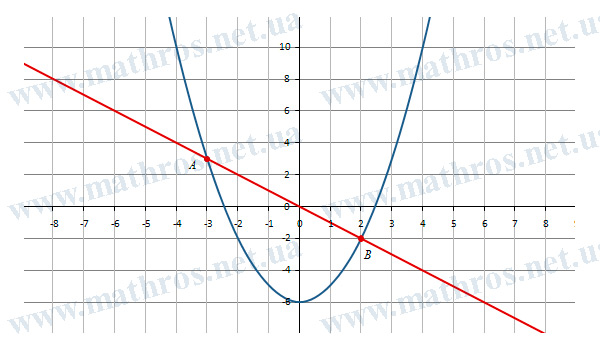
The intersection points (-3, 3) and (2, -2) show that the roots are x1=-3 and x2=2.
Example 3: Solve x2+8⋅x+15=0
For this equation, we’ll use the method of completing the square. First, we rewrite the equation as (x+4)2=1. We then plot the parabola y=(x+4)2 and the line y=1.
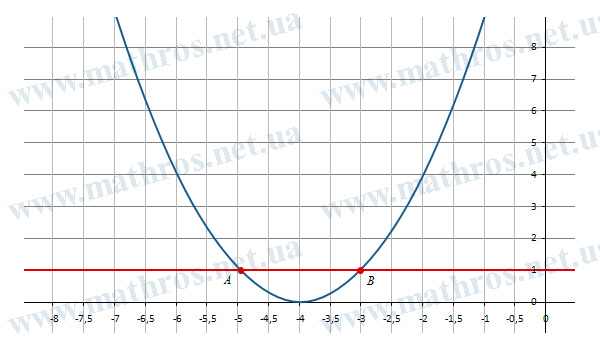
The intersection points are (-5, 1) and (-3,1), so the roots are x1=-5 and x2=-3.
Does the Graphical Method Work in All Cases?
Although graphing is a great method, it doesn’t always work perfectly.

For instance, the equation x2-x-3=0 can be solved graphically, but its roots do not have precise coordinates. Additionally, solving the equation x2-16⋅x-95=0 graphically can be challenging due to the large scale of the graph.

Therefore, this method does not guarantee exact solutions for all equations.
Additional Materials: Other Ways of Solving Quadratic Equations
Want to explore more ways to solve quadratic equations? Here are some interesting topics that can help deepen your understanding:
- Vieta’s Theorem – Learn how to use Vieta’s theorem to quickly find the roots of a quadratic equation.
- The Discriminant – Discover how calculating the discriminant can help find the roots of an equation.
- Completing the Square – A detailed explanation of how completing the square can simplify solving quadratic equations.
By mastering the graphical method and understanding these additional approaches, you’ll be well-equipped to solve any quadratic equation!