Ever heard of a triangular prism? No? Well, let’s dive in! Imagine a geometric shape that’s three-dimensional with two identical triangles and three rectangular side faces. Yep, that’s a triangular prism for you! It’s got five faces, six vertices, and nine edges. All the edges and vertices are connected, forming a solid structure.
In this article, we’ll explore the ins and outs of a triangular prism, using diagrams to make it all crystal clear.
Triangular Prism: How Many Faces, Edges, and Vertices?
So, what exactly makes up a triangular prism? Picture two triangles as the bases and three rectangles connecting these bases. That’s five faces in total – two triangular and three rectangular. Count the vertices, and you’ll find six. And those edges? There are nine of them! Pretty neat, right?
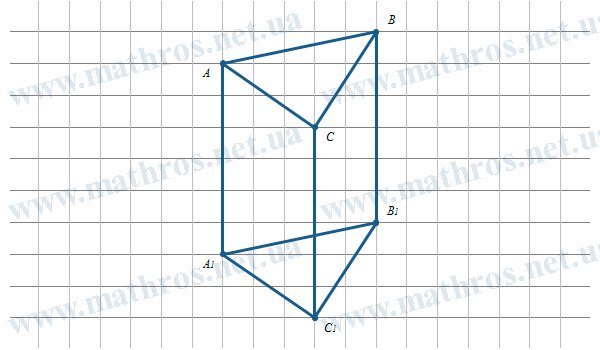
The side faces of a triangular prism are always rectangular, while the bases are, of course, triangular. Depending on the triangles’ shape, the size of these faces can vary. If the bases are equilateral triangles, the side faces will be identical and congruent. Cool, huh?
Types of Triangular Prism: Regular, Irregular, Right, and Oblique
Not all triangular prisms are created equal. They can differ based on their cross-sections and the alignment of their bases. Here’s a quick rundown:
- Regular Triangular Prism: Has two equilateral triangle bases;
- Irregular Triangular Prism: The bases are not equilateral triangles;
- Right Triangular Prism: The side faces are perpendicular to the bases, making all side faces rectangles;
- Oblique Triangular Prism: The side faces are not perpendicular to the bases, and these faces are parallelograms.
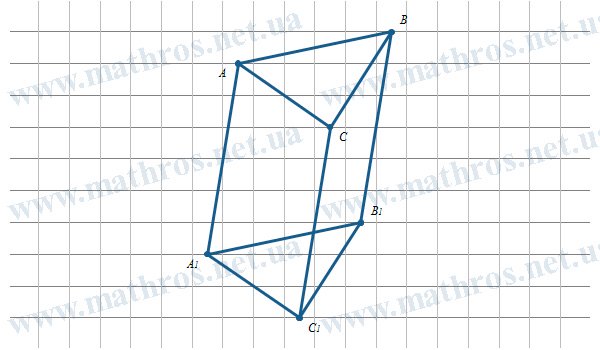
Usually, when we mention a triangular prism without any extra details, we’re talking about the right triangular prism.
Properties of a Triangular Prism: The Essentials
What makes a triangular prism so special? Let’s list some key properties:
- It has 5 faces, 9 edges, and 6 vertices;
- It’s a polyhedron with 3 rectangular faces and 2 triangular bases;
- The two triangular bases are identical;
- If the bases are equilateral triangles, all side faces are equal;
- Any cross-section parallel to the bases is a triangle.
Triangular Prism Formulas: Surface Area and Volume
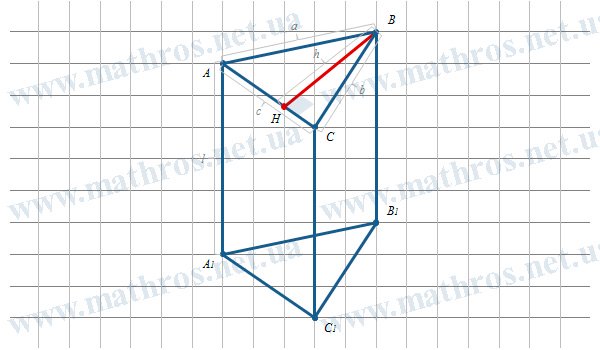
When it comes to math, there are two big formulas you need to know: surface area and volume. Here’s a quick look:
| Term | Definition | Formula |
|---|---|---|
| Surface Area of a Triangular Prism | This is the total area covered by the prism surface. You sum up the areas of all the faces |  |
| Volume of a Triangular Prism | This is the space the prism occupies in three dimensions. Multiply the area of the base by the height |  |
Practical Problems with Triangular Prisms: Theory in Action
Now that we’ve covered the basics, let’s see how this knowledge plays out in real-world problems.
Example 1: What is a triangular prism?
A triangular prism is a 3D shape with two triangular bases and three rectangular faces. You can spot it in everyday objects like tents, chocolate bars, and roofs.
Example 2: How many vertices and edges does a triangular prism have?
A triangular prism has 6 vertices and 9 edges. These edges are also called sides, and the vertices are the corners of the prism. It has 5 faces, of which 2 are triangular and 3 are rectangular.
Example 3: Triangular prism vs. rectangular rrism
The main difference? The bases. A triangular prism has triangle bases, while a rectangular prism has rectangle bases. Plus, a rectangular prism has 6 faces and 12 edges, compared to the triangular prism’s 5 faces and 9 edges.
Example 4: A triangular prism has an equilateral base with each side measuring 6 cm and the height of the triangle being 5 cm. If the height of the prism itself is also 5 cm, what is its surface area?
Alright, let’s break it down. We know:
- The sides of the triangular base (a, b, c) are each 6 cm;
- The height of the triangle (h) is 5 cm;
- The height of the prism (l) is 5 cm.
Using the surface area formula for a triangular prism, we get:

So, the surface area of the triangular prism is 120 cm2.
Example 5: A Triangular prism has a height of 5 cm, a base with a side length of 3 cm, and the height of the triangle is 4 cm. What is the volume of this triangular prism?
So, let’s break it down step by step. We know:
- The height of the prism (h) is 5 cm;
- The side of the triangular base (c) is 3 cm;
- The height of the triangle (l) is 4 cm.
Using the formula for the volume of a triangular prism, we get:

So, the volume of the triangular prism is 30 cm3.
Example 6: Find the distance between the midpoints of the non-parallel sides of different bases of a regular triangular prism, where all edges are 4 cm long
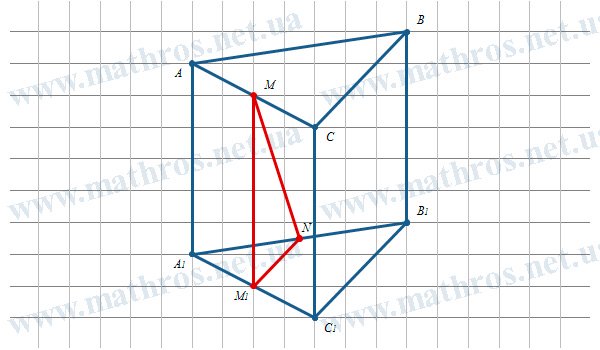
Let’s break it down step by step. Imagine a regular triangular prism ABCA1B1C1 with bases ABC and A1B1C1, where every edge measures 4 cm.
- Identify midpoints: Let M and N be the midpoints of the edges AC and A1B1, respectively;
- Projection: Consider M1 to be the orthogonal projection of point M onto the plane A1B1C1. M1 lies in the middle of A1C1, making M1N the middle line of the triangle A1B1C1.
To find the distance MN, we use the Pythagorean theorem in the right triangle MM1N:
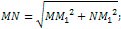
Given that MM1=4 cm (half the edge length since M1 is the midpoint) and NM1=2 cm (half the edge length again), we calculate:

Therefore, the distance between the midpoints of any other non-parallel sides of the bases is also 4.5 cm.
Example 7: Find the height A1H of the oblique triangular prism ABCA1B1C1, if the angle between its height and the side AA1 is 60 degrees, and the length of the side is 26 cm
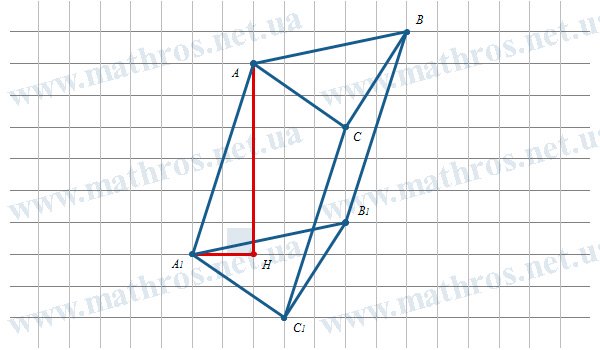
Let’s break it down. The height of an oblique prism is the perpendicular distance between its bases. From point A1, we drop a perpendicular A1H to the plane ABC. The segment AH is the projection of the side edge AA1 onto the plane ABC, making the angle AHA1 90 degrees.
In the right triangle AA1H, we know:
- The angle AA1H is 60 degrees;
- The sum of the acute angles in a right triangle is 90 degrees, so the angle A1AH is 90 – 60 = 30 degrees;
- The length A1H lies opposite the 30-degree angle, making it half the length of the hypotenuse AA1.
Using these facts, we find:

So, the height of the oblique triangular prism is 13 cm.
Diving Deeper: More About Triangular Prisms
Want to get even more into the nitty-gritty of triangular prisms? Check out these topics:
- Surface Area of a Triangular Prism – Detailed formulas and examples.
- Volume of a Triangular Prism – In-depth explanations and practical examples.
There you go! Triangular prisms might seem complex, but with a bit of exploration, they become much easier to understand. Happy learning!