Solving quadratic equations by completing the square is a key technique you’ll often encounter in math, whether you’re studying at school or university. This method is especially useful because it helps simplify equations, making them easier to solve and analyze. In this article, we’ll break down how completing the square works and guide you through practical examples to ensure you can confidently apply this technique in your own problem-solving.
What Is a Quadratic Equation?
Before diving into solving quadratic equations by completing the square, let’s start with the basics. A quadratic equation is a second-degree equation that looks like this:

Here, a, b, and c are real numbers, with a≠0. But why is it so important that a isn’t zero? It’s simple: if a=0, the equation becomes linear, which is a completely different type of equation with its own methods of solving.
Solving Quadratic Equations by Completing the Square: The Basics
Now, let’s get to the heart of solving quadratic equations by completing the square. The main idea is to rewrite the quadratic equation in a form that makes it easier to solve by turning it into a perfect square trinomial. But how does that work? It starts with using these formulas:

How to Apply the Method
To complete the square, you need to add and subtract the right terms within the equation. You might wonder, “How do I know what to add and subtract?”. It’s easier than it sounds! You simply divide the coefficient of the x-term by 2, square the result, and then add and subtract that value to the equation. This transforms the equation into a form that’s much more convenient to solve.
Why Does It Work?
It’s one thing to understand the theory, but seeing it in action is where things really click. Let’s go through a few examples of solving quadratic equations by completing the square.
Solving Quadratic Equations by Completing the Square: Step-by-Step Examples
It’s one thing to understand the theory, but seeing it in action is where things really click. Let’s go through a few examples of solving quadratic equations by completing the square.
Example 1: Solve 2⋅x2+8⋅x-10=0
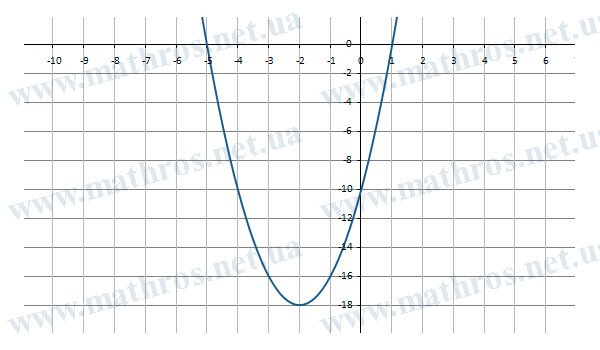
First, notice that the coefficient in front of x2 is 2, not 1. Let’s divide the entire equation by 2:

Now we have a “simpler” equation. The next step is to take half of the coefficient in front of x, which is 4. Dividing it by 2 and squaring the result gives: (4/2)2=4.
Now, add and subtract 4 within the equation:

Rewriting this, we get:

From here, apply the difference of squares formula:

So the solutions are: x1=-5 and x2=1.
Example 2: Solve x2+14⋅x+45=0

In this case, the coefficient of x2 is already 1, so we can skip that first step. Take half of 14 and square it: (14/2)2=49.
Now, add and subtract 49 inside the equation and simplify:

Apply the difference of squares:

So the solutions are: x1=-9 and x2=-5.
Example 3: Solve x2-6⋅x-7=0

Here, half of the coefficient of x is: (-6/2)2=9. Now, add and subtract 9 in the equation and simplify:

Apply the difference of squares:

Thus, the solutions are: x1=-1 and x2=7.
What’s Next After Completing the Square? Uncover More Ways to Solve Quadratics!
Are you interested in learning other methods to solve quadratic equations or exploring more advanced topics? Here are a few recommendations to further deepen your understanding of this fascinating subject:
- Vieta’s Theorem – Learn how to quickly find the roots of quadratic equations using Vieta’s formulas.
- Discriminant and Roots – Dive into the role of the discriminant in determining the nature of quadratic equation solutions.
- Graphical Method – Understand how graphing a function can visually reveal the roots of an equation.
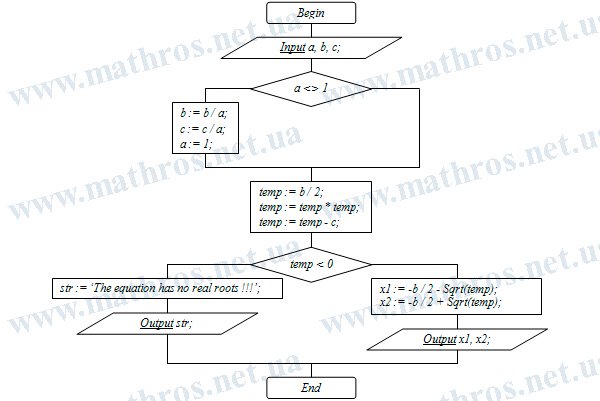
Solving Quadratic Equations by Completing the Square: Could It Be Your Next Coding Project?
If you’re passionate about both math and coding, why not combine them? Solving quadratic equations by completing the square is not only a useful skill for math, but it’s also a great exercise for learning to program. You can create a program that automatically computes the roots of quadratic equations using this method. It’s an excellent way to practice both math and programming skills!