Integration of irrational functions often comes down to one main task: correctly transforming the integrand. Radicals and fractional powers make it difficult to apply standard integration formulas directly, but a well-chosen substitution can overcome this difficulty. That is why it is important to first recognize the structure of the integrand and only then proceed with the calculations.
Integration of Irrational Functions: The Main Idea of Rationalization
In integral calculus, the term irrational functions usually refers to algebraic functions in which the variable appears under a radical sign or is raised to a fractional power. For example, the integrand may contain
\[
\sqrt[n]{a\cdot x+b},
\qquad
x^{\frac{m}{n}},
\]
or a square root of a quadratic expression
\[
\sqrt{a\cdot x^2+b\cdot x+c}.
\]
Why do such expressions create difficulties? The reason is that simply applying standard integration formulas usually does not make the radical disappear. So, the first step is to transform the variable in such a way that fractional exponents become integers or the radical takes a simpler form.
This process is called rationalization of the integrand. In the most convenient case, the substitution transforms the integrand into a rational function of the new variable. Then standard integration rules can be applied.
However, no single substitution works for every case. If there is a linear expression under the radical, one approach is used. If the expression involves a sum or difference of squares, another approach is needed. That is why, before choosing a substitution, you first need to determine the structure of the integrand.
Integration of Irrational Functions: Roots of Linear Expressions
Let us start with the simplest case. Suppose the integrand contains a radical of the form
\[
\sqrt[n]{a\cdot x+b}.
\]
Here, it is convenient to make the radical itself the new variable:
\[
t=\sqrt[n]{a\cdot x+b}.
\]
Then
\[
t^n=a\cdot x+b.
\]
From this equation, we can easily express the original variable:
\[
x=\frac{t^n-b}{a}.
\]
After differentiation, we get
\[
dx=\frac{n\cdot t^{n-1}}{a}\,dt.
\]
What is the advantage of this substitution? The radical disappears and becomes an ordinary power of \( t \). If the rest of the integrand can also be expressed in terms of \( t \), the resulting integral becomes much simpler.
For example, if we have the expression
\[
\sqrt[3]{2\cdot x+1},
\]
a natural choice is
\[
t=\sqrt[3]{2\cdot x+1}.
\]
Then the linear expression \( 2\cdot x+1 \) becomes equal to \( t^3 \). At this stage, we can already see how the radical is transformed into an integer power.
So, when there is a single root of a linear expression, the main idea is quite simple: choose the new variable so that the irrational expression becomes a power with an integer exponent.
Fractional Powers: One Substitution for Several Exponents
Now let us consider a slightly more complicated situation. What should we do if the integrand contains several fractional powers of the same variable at the same time? For example,
\[
x^{\frac12},
\qquad
x^{\frac13},
\qquad
x^{\frac14}.
\]
Using a separate substitution for each power would be inconvenient. A much better approach is to choose one new variable so that all fractional exponents become integers at the same time.
To do this, we use the least common multiple of the denominators of the fractional exponents. If the integrand contains powers
\[
x^{\frac{m_1}{n_1}},
\qquad
x^{\frac{m_2}{n_2}},
\qquad
\dots,
\qquad
x^{\frac{m_k}{n_k}},
\]
let \( N \) denote the least common multiple of
\[
n_1,n_2,\ldots,n_k.
\]
Then we introduce the substitution
\[
x=t^N.
\]
Hence,
\[
dx=N\cdot t^{N-1}\,dt.
\]
Each fractional power then takes the form
\[
x^{\frac{m_i}{n_i}}
=
t^{\frac{N\cdot m_i}{n_i}}.
\]
Since \( N \) is divisible by \( n_i \), the exponent
\[
\frac{N\cdot m_i}{n_i}
\]
is an integer.
For example, for the powers \( x^{\frac12} \) and \( x^{\frac13} \), the denominators are \( 2 \) and \( 3 \), and their least common multiple is \( 6 \). Therefore, it is convenient to set
\[
x=t^6.
\]
Then \( x^{\frac12}=t^3 \), while \( x^{\frac13}=t^2 \). So, instead of two fractional powers, we obtain powers with integer exponents. This is the main purpose of this type of substitution.
Quadratic Radicals: Trigonometric Substitutions
The next type of irrational expression cannot be handled by simply choosing a convenient power of a new variable. Here we are dealing with square roots that contain a sum or difference of squares.
Consider the form
\[
\sqrt{a^2-x^2}.
\]
A convenient substitution is
\[
x=a\cdot\sin(t).
\]
Why sine? After the substitution, the expression under the radical becomes
\[
a^2-a^2\cdot\sin^2(t)
=
a^2\cdot\left(1-\sin^2(t)\right).
\]
Using the identity
\[
1-\sin^2(t)=\cos^2(t),
\]
we obtain the square of a trigonometric function. As a result, the radical becomes much simpler.
For the expression
\[
\sqrt{x^2+a^2},
\]
it is more convenient to use the substitution
\[
x=a\cdot\tan(t),
\]
because this leads to the identity
\[
1+\tan^2(t)=\frac{1}{\cos^2(t)}.
\]
And if we have
\[
\sqrt{x^2-a^2},
\]
a common substitution is
\[
x=\frac{a}{\cos(t)}.
\]
In this case, we use the relation
\[
\frac{1}{\cos^2(t)}-1=\tan^2(t).
\]
For example, for the radical
\[
\sqrt{9-x^2},
\]
a natural choice is
\[
x=3\cdot\sin(t).
\]
Then the expression under the radical becomes a square involving cosine, so the radical simplifies.
Thus, a trigonometric substitution is not chosen at random. It is selected so that the expression under the radical is transformed into the square of a trigonometric function.
Quadratic Trinomials Under a Radical: Reducing to a Standard Form
But what should we do if the expression under the radical is not already a sum or difference of squares, but a general quadratic trinomial
\[
a\cdot x^2+b\cdot x+c.
\]
In this situation, applying a trigonometric substitution immediately is usually inconvenient. First, we need to transform the quadratic trinomial itself.
For \( a\neq0 \), we complete the square:
\[
a\cdot x^2+b\cdot x+c
=
a\left(x+\frac{b}{2\cdot a}\right)^2
+
c-\frac{b^2}{4\cdot a}.
\]
Now the structure becomes much clearer. After a suitable linear substitution, the expression under the radical can be reduced to one of the standard forms:
\[
\begin{gathered}
A^2-u^2,\\[4pt]
u^2+A^2,
\end{gathered}
\]
or
\[
u^2-A^2.
\]
So, this case naturally reduces to the previous one. First, we transform the quadratic trinomial, and then we apply the appropriate trigonometric substitution.
For example, if the expression under the radical is
\[
x^2+4\cdot x+8,
\]
we first write
\[
x^2+4\cdot x+8
=
(x+2)^2+4.
\]
After the substitution
\[
u=x+2,
\]
the radical takes the form
\[
\sqrt{u^2+4}.
\]
At this point, it is easy to determine which trigonometric substitution is appropriate for this type of expression.
So, completing the square is not a separate integration method here. It is a preparatory step that transforms a more complicated radical into a familiar standard form.
Integration of Irrational Functions: Euler Substitutions
Trigonometric substitutions work well with quadratic radicals, but there is another approach. For expressions of the form
\[
\sqrt{a\cdot x^2+b\cdot x+c},
\]
we can use Euler substitutions. Their main purpose is to rationalize both the variable \( x \) and the square root itself.
If \( a>0 \), we can use the relation
\[
\sqrt{a\cdot x^2+b\cdot x+c}
=
\sqrt{a}\cdot x+t.
\]
After squaring both sides, we get
\[
a\cdot x^2+b\cdot x+c
=
a\cdot x^2+2\cdot\sqrt{a}\cdot x\cdot t+t^2.
\]
The terms \( a\cdot x^2 \) cancel. As a result, we obtain an equation from which \( x \) can be expressed in terms of \( t \) as a rational function.
If \( c>0 \), we can use another substitution:
\[
\sqrt{a\cdot x^2+b\cdot x+c}
=
t\cdot x+\sqrt{c}.
\]
After squaring both sides, we again obtain an equation that allows us to express \( x \) rationally in terms of the new variable.
The third option applies when the quadratic trinomial has real roots. If
\[
a\cdot x^2+b\cdot x+c
=
a\cdot(x-x_1)\cdot(x-x_2),
\]
we can use the substitution
\[
\sqrt{a\cdot x^2+b\cdot x+c}
=
t\cdot(x-x_1).
\]
After squaring both sides, the common factor \( x-x_1 \) cancels, and once again \( x \) can be expressed as a rational function of \( t \).
What is the main difference between this method and a trigonometric substitution? With a trigonometric substitution, the radical is transformed into an expression involving trigonometric functions. Here, the goal is different: we want to obtain rational functions of the new variable. This is why Euler substitutions are especially useful when we need to reduce an integral to the integration of a rational function.
Validity of a Substitution: Domain and Returning to the Original Variable
Once a substitution has been chosen, one more important question remains: can all subsequent transformations be performed without any additional restrictions?
Not always. We need to be especially careful with square roots. For example,
\[
\sqrt{\cos^2(t)}
=
|\cos(t)|,
\]
not simply \( \cos(t) \).
Therefore, when using the substitution
\[
x=a\cdot\sin(t),
\]
we usually choose an interval for \( t \) on which the sign of \( \cos(t) \) is known. For example, we can take
\[
-\frac{\pi}{2}\leq t\leq\frac{\pi}{2}.
\]
On this interval,
\[
\cos(t)\geq0,
\]
so
\[
|\cos(t)|=\cos(t).
\]
Similar considerations are needed for other trigonometric substitutions. Otherwise, when simplifying the radical, we may accidentally change the sign of an expression.
It is also important to take the domain of the original function into account. If the expression under the square root is
\[
a^2-x^2,
\]
then for real values we need the condition
\[
a^2-x^2\geq0.
\]
Therefore,
\[
|x|\leq|a|.
\]
For the radical
\[
\sqrt{x^2-a^2},
\]
the condition is different:
\[
x^2-a^2\geq0.
\]
So,
\[
|x|\geq|a|.
\]
Finally, after integration, we need to return from the new variable to the original one. For example, if
\[
x=a\cdot\tan(t),
\]
then
\[
t=\arctan\left(\frac{x}{a}\right).
\]
If \( \sin(t) \), \( \cos(t) \), or other functions appear during subsequent transformations, they must also be correctly expressed in terms of \( x \).
So, a good substitution is not only a way to eliminate the radical. It must also be valid on the chosen interval, respect the domain of the original function, and allow us to return correctly to the original variable. Only then is the transformation of an irrational integral not just convenient, but mathematically correct.
Integration of Irrational Functions: Step-by-Step Application of Common Substitutions
Let us see how integration of irrational functions works in practice using common substitutions. In each case, we will first identify the structure of the integrand, then choose an appropriate substitution, and finally reduce the original integral to a standard one.
Example 1. Find the indefinite integral
\[
\int\frac{x}{\sqrt{2\cdot x+1}}\,dx.
\]
The integrand contains the square root of the linear expression \( 2\cdot x+1 \). Therefore, it is convenient to introduce a new variable so that the radical itself becomes \( t \):
\[
t=\sqrt{2\cdot x+1}.
\]
Square both sides:
\[
t^2=2\cdot x+1.
\]
Now solve for \( x \):
\[
\begin{gathered}
2\cdot x=t^2-1,\\[4pt]
x=\frac{t^2-1}{2}.
\end{gathered}
\]
Next, find the differential \( dx \). Differentiating the last equation, we get
\[
dx=t\,dt.
\]
Also,
\[
\sqrt{2\cdot x+1}=t.
\]
Substitute all these expressions into the original integral:
\[
\int\frac{x}{\sqrt{2\cdot x+1}}\,dx
=
\int\frac{\frac{t^2-1}{2}}{t}\cdot t\,dt.
\]
Cancel \( t \):
\[
\int\frac{x}{\sqrt{2\cdot x+1}}\,dx
=
\frac{1}{2}\int(t^2-1)\,dt.
\]
Now we have an ordinary polynomial integral:
\[
\frac{1}{2}\int(t^2-1)\,dt
=
\frac{1}{2}\cdot\left(\frac{t^3}{3}-t\right)+C.
\]
Therefore,
\[
\frac{1}{2}\cdot\left(\frac{t^3}{3}-t\right)+C
=
\frac{t^3}{6}-\frac{t}{2}+C.
\]
Return to the original variable:
\[
t=\sqrt{2\cdot x+1}.
\]
Thus,
\[
\int\frac{x}{\sqrt{2\cdot x+1}}\,dx
=
\frac{(2\cdot x+1)^{\frac32}}{6}
–
\frac{\sqrt{2\cdot x+1}}{2}
+C.
\]
In this case, the substitution completely eliminated the radical and reduced the problem to integrating a polynomial.
Example 2. Find the indefinite integral
\[
\int\frac{dx}{x^{\frac12}+x^{\frac13}}.
\]
Here, the integrand contains two fractional powers at the same time: \( x^{\frac12} \) and \( x^{\frac13} \). Since we are working with real values, we need \( x\geq0 \) for the square root to be real, and the denominator must not be zero. Therefore, for this integral we consider
\[
x>0.
\]
How can we choose one substitution for both fractional powers? The denominators of the exponents are \( 2 \) and \( 3 \), and their least common multiple is \( 6 \). So we set
\[
x=t^6.
\]
For \( x>0 \), we can take
\[
t=x^{\frac16}>0.
\]
Then
\[
dx=6\cdot t^5\,dt.
\]
Both fractional powers become powers with integer exponents:
\[
\begin{gathered}
x^{\frac12}
=
(t^6)^{\frac12}
=
t^3,\\[4pt]
x^{\frac13}
=
(t^6)^{\frac13}
=
t^2.
\end{gathered}
\]
Substitute these expressions:
\[
\int\frac{dx}{x^{\frac12}+x^{\frac13}}
=
\int\frac{6\cdot t^5}{t^3+t^2}\,dt.
\]
Factor \( t^2 \) from the denominator:
\[
t^3+t^2=t^2\cdot(t+1).
\]
Then
\[
\int\frac{6\cdot t^5}{t^3+t^2}\,dt
=
6\int\frac{t^3}{t+1}\,dt.
\]
We have obtained a rational expression. To integrate it, perform polynomial division:
\[
\frac{t^3}{t+1}
=
t^2-t+1-\frac{1}{t+1}.
\]
Therefore,
\[
6\int\frac{t^3}{t+1}\,dt
=
6\int\left(t^2-t+1-\frac{1}{t+1}\right)dt.
\]
Integrate each term:
\[
6\cdot\left(
\frac{t^3}{3}
–
\frac{t^2}{2}
+
t
–
\ln|t+1|
\right)+C.
\]
After multiplying by \( 6 \), we get
\[
2\cdot t^3
–
3\cdot t^2
+
6\cdot t
–
6\cdot\ln|t+1|
+C.
\]
Now return to \( x \). Since
\[
t=x^{\frac16},
\]
we have
\[
t^2=x^{\frac13},
\qquad
t^3=x^{\frac12}.
\]
Therefore,
\[
\int\frac{dx}{x^{\frac12}+x^{\frac13}}
=
2\cdot x^{\frac12}
–
3\cdot x^{\frac13}
+
6\cdot x^{\frac16}
–
6\cdot\ln\left|x^{\frac16}+1\right|
+C.
\]
Since \( x>0 \), the expression \( x^{\frac16}+1 \) is positive, so the absolute value signs can also be omitted in this case.
Here, one common substitution eliminated both fractional exponents at the same time. This is exactly why we use the least common multiple of their denominators.
Example 3. Find the indefinite integral
\[
\int\sqrt{9-x^2}\,dx.
\]
Under the radical, we have a difference of squares:
\[
9-x^2=3^2-x^2.
\]
This is the standard form
\[
a^2-x^2,
\]
so we use the trigonometric substitution
\[
x=3\cdot\sin(t).
\]
Let us take
\[
-\frac{\pi}{2}\leq t\leq\frac{\pi}{2},
\]
so that
\[
\cos(t)\geq0.
\]
Find the differential:
\[
dx=3\cdot\cos(t)\,dt.
\]
Now transform the radical:
\[
\sqrt{9-x^2}
=
\sqrt{9-9\cdot\sin^2(t)}.
\]
Factor out \( 9 \):
\[
\sqrt{9-9\cdot\sin^2(t)}
=
3\cdot\sqrt{1-\sin^2(t)}.
\]
Use the identity
\[
1-\sin^2(t)=\cos^2(t).
\]
Therefore, on the chosen interval,
\[
\sqrt{9-x^2}
=
3\cdot\cos(t).
\]
Substitute everything into the integral:
\[
\int\sqrt{9-x^2}\,dx
=
\int3\cdot\cos(t)\cdot3\cdot\cos(t)\,dt.
\]
Thus,
\[
\int\sqrt{9-x^2}\,dx
=
9\int\cos^2(t)\,dt.
\]
To integrate, use the power-reduction identity:
\[
\cos^2(t)
=
\frac{1+\cos(2\cdot t)}{2}.
\]
Then
\[
9\int\cos^2(t)\,dt
=
\frac{9}{2}\int\left(1+\cos(2\cdot t)\right)dt.
\]
Integrating gives
\[
\frac{9}{2}\cdot\left(
t+\frac{\sin(2\cdot t)}{2}
\right)+C.
\]
Since
\[
\sin(2\cdot t)
=
2\cdot\sin(t)\cdot\cos(t),
\]
we get
\[
\frac{9}{2}\cdot
\left(
t+\sin(t)\cdot\cos(t)
\right)+C.
\]
Now return to \( x \). From the substitution
\[
x=3\cdot\sin(t),
\]
we have
\[
\sin(t)=\frac{x}{3},
\]
and also
\[
t=\arcsin\left(\frac{x}{3}\right).
\]
Express the cosine in terms of \( x \):
\[
\cos(t)
=
\sqrt{1-\sin^2(t)}
=
\sqrt{1-\frac{x^2}{9}}
=
\frac{\sqrt{9-x^2}}{3}.
\]
Therefore,
\[
\sin(t)\cdot\cos(t)
=
\frac{x}{3}\cdot\frac{\sqrt{9-x^2}}{3}
=
\frac{x\cdot\sqrt{9-x^2}}{9}.
\]
After substitution, we obtain
\[
\int\sqrt{9-x^2}\,dx
=
\frac{x\cdot\sqrt{9-x^2}}{2}
+
\frac{9}{2}\cdot\arcsin\left(\frac{x}{3}\right)
+C.
\]
The trigonometric substitution worked because the difference of squares was transformed into an expression involving \( \cos^2(t) \), allowing us to eliminate the square root.
Example 4. Find the indefinite integral
\[
\int\frac{dx}{\sqrt{x^2+4\cdot x}}.
\]
Under the radical, we have a quadratic trinomial that is not yet in a standard form. So, we first complete the square:
\[
x^2+4\cdot x
=
x^2+4\cdot x+4-4.
\]
Therefore,
\[
x^2+4\cdot x
=
(x+2)^2-4.
\]
The original integral becomes
\[
\int\frac{dx}{\sqrt{(x+2)^2-4}}.
\]
Make the linear substitution
\[
u=x+2.
\]
Then
\[
du=dx.
\]
We obtain
\[
\int\frac{du}{\sqrt{u^2-4}}.
\]
Under the radical, we now have the difference of squares
\[
u^2-2^2.
\]
For the original function to have real values, we need
\[
x^2+4\cdot x>0,
\]
because the radical appears in the denominator. Therefore, we consider the integral on the intervals \( x<-4 \) or \( x>0 \).
First, consider the interval \( x>0 \). Then \( u>2 \), so it is convenient to use the trigonometric substitution
\[
u=\frac{2}{\cos(t)},
\]
where
\[
0<t<\frac{\pi}{2}.
\]
On this interval,
\[
\cos(t)>0,
\qquad
\tan(t)>0.
\]
Differentiate:
\[
du
=
2\cdot\frac{\sin(t)}{\cos^2(t)}\,dt.
\]
Now transform the radical:
\[
\sqrt{u^2-4}
=
\sqrt{\frac{4}{\cos^2(t)}-4}.
\]
Factor out \( 4 \):
\[
\sqrt{u^2-4}
=
2\cdot\sqrt{\frac{1}{\cos^2(t)}-1}.
\]
Use the identity
\[
\frac{1}{\cos^2(t)}-1=\tan^2(t).
\]
Therefore, on the chosen interval,
\[
\sqrt{u^2-4}
=
2\cdot\tan(t).
\]
Substitute the resulting expressions:
\[
\int\frac{du}{\sqrt{u^2-4}}
=
\int
\frac{
2\cdot\frac{\sin(t)}{\cos^2(t)}
}{
2\cdot\tan(t)
}
\,dt.
\]
Since
\[
\tan(t)=\frac{\sin(t)}{\cos(t)},
\]
we get
\[
\int\frac{du}{\sqrt{u^2-4}}
=
\int\frac{1}{\cos(t)}\,dt.
\]
This is a standard integral:
\[
\int\frac{1}{\cos(t)}\,dt
=
\ln\left|
\frac{1}{\cos(t)}+\tan(t)
\right|+C.
\]
Now return to \( u \). From the substitution
\[
u=\frac{2}{\cos(t)},
\]
we obtain
\[
\frac{1}{\cos(t)}=\frac{u}{2}.
\]
Also,
\[
2\cdot\tan(t)=\sqrt{u^2-4},
\]
so
\[
\tan(t)=\frac{\sqrt{u^2-4}}{2}.
\]
Therefore,
\[
\ln\left|
\frac{1}{\cos(t)}+\tan(t)
\right|
=
\ln\left|
\frac{u+\sqrt{u^2-4}}{2}
\right|.
\]
The constant factor \( 1/2 \) inside the logarithm can be absorbed into the arbitrary constant of integration. Thus,
\[
\int\frac{du}{\sqrt{u^2-4}}
=
\ln\left|u+\sqrt{u^2-4}\right|+C.
\]
Return to \( x \):
\[
u=x+2.
\]
Therefore,
\[
\int\frac{dx}{\sqrt{x^2+4\cdot x}}
=
\ln\left|
x+2+\sqrt{x^2+4\cdot x}
\right|
+C.
\]
The same antiderivative, with an appropriate constant of integration, can also be used for \( x<-4 \).
In this case, completing the square transformed the quadratic trinomial into the standard form \( u^2-a^2 \). The trigonometric substitution then eliminated the radical and reduced the problem to a standard integral.
Example 5. Find the indefinite integral
\[
\int\frac{dx}{\sqrt{x^2+x+1}}.
\]
Under the radical, we have a quadratic trinomial, and the coefficient of \( x^2 \) is positive. Therefore, we use one of the Euler substitutions:
\[
\sqrt{x^2+x+1}=x+t.
\]
The purpose of this substitution is to express \( x \), \( dx \), and the square root itself in terms of \( t \) using rational functions.
First, express \( x \) in terms of \( t \). Square both sides:
\[
x^2+x+1
=
(x+t)^2.
\]
Expand the square:
\[
x^2+x+1
=
x^2+2\cdot x\cdot t+t^2.
\]
Cancel \( x^2 \):
\[
x+1
=
2\cdot x\cdot t+t^2.
\]
Move the terms containing \( x \) to one side:
\[
x-2\cdot x\cdot t
=
t^2-1.
\]
Factor out \( x \):
\[
x\cdot(1-2\cdot t)
=
t^2-1.
\]
Hence,
\[
x=
\frac{t^2-1}{1-2\cdot t}.
\]
Now find \( dx \). Differentiate the resulting rational function:
\[
dx
=
\frac{
2\cdot t(1-2\cdot t)+2\cdot(t^2-1)
}{
(1-2\cdot t)^2
}\,dt.
\]
Simplify the numerator:
\[
2\cdot t-4\cdot t^2+2\cdot t^2-2
=
-2\cdot(t^2-t+1).
\]
Therefore,
\[
dx
=
-\frac{2\cdot(t^2-t+1)}{(1-2\cdot t)^2}\,dt.
\]
Now we only need to express the radical in terms of \( t \). From the original substitution,
\[
\sqrt{x^2+x+1}=x+t.
\]
Substitute the expression found for \( x \):
\[
x+t
=
\frac{t^2-1}{1-2\cdot t}+t.
\]
Bring the terms to a common denominator:
\[
x+t
=
\frac{t^2-1+t-2\cdot t^2}{1-2\cdot t}.
\]
Thus,
\[
x+t
=
\frac{-t^2+t-1}{1-2\cdot t}.
\]
Multiplying the numerator and denominator by \( -1 \), we obtain
\[
\sqrt{x^2+x+1}
=
\frac{t^2-t+1}{2\cdot t-1}.
\]
Since
\[
(1-2\cdot t)^2=(2\cdot t-1)^2,
\]
the differential can be written as
\[
dx
=
-\frac{2\cdot(t^2-t+1)}{(2\cdot t-1)^2}\,dt.
\]
Now substitute both expressions into the integral:
\[
\int\frac{dx}{\sqrt{x^2+x+1}}
=
\int
\frac{
-\frac{2\cdot(t^2-t+1)}{(2\cdot t-1)^2}
}{
\frac{t^2-t+1}{2\cdot t-1}
}
\,dt.
\]
Cancel the common factor \( t^2-t+1 \):
\[
\int\frac{dx}{\sqrt{x^2+x+1}}
=
-2\int\frac{dt}{2\cdot t-1}.
\]
So, the original irrational integral has been transformed into an ordinary rational integral.
Make the simple substitution
\[
u=2\cdot t-1.
\]
Then
\[
du=2\,dt.
\]
We get
\[
-2\int\frac{dt}{2\cdot t-1}
=
-\int\frac{du}{u}.
\]
Hence,
\[
-\int\frac{du}{u}
=
-\ln|u|+C.
\]
Return to \( t \):
\[
-\ln|2\cdot t-1|+C.
\]
From the original Euler substitution
\[
\sqrt{x^2+x+1}=x+t,
\]
we have
\[
t=\sqrt{x^2+x+1}-x.
\]
Therefore,
\[
-\ln\left|
2\cdot\sqrt{x^2+x+1}-2\cdot x-1
\right|+C.
\]
This result can be written in a more familiar form. To do this, use the identity
\[
\left(
2\cdot\sqrt{x^2+x+1}-2\cdot x-1
\right)
\cdot
\left(
2\cdot\sqrt{x^2+x+1}+2\cdot x+1
\right)
=
3.
\]
Thus, the difference between the two logarithmic forms of the result reduces to the constant \( \ln(3) \), which can be absorbed into the arbitrary constant of integration. Therefore, the final result is
\[
\int\frac{dx}{\sqrt{x^2+x+1}}
=
\ln\left|
2\cdot\sqrt{x^2+x+1}+2\cdot x+1
\right|
+C.
\]
This example clearly shows the main advantage of an Euler substitution. After the substitution, the original expression containing a square root was transformed into a rational function of the new variable, so the remaining integration no longer required working with the radical.
Next Step in Integral Calculus: Topics to Continue With
Irrational functions are just one of many important topics in integral calculus. A natural next step is to move on to definite integrals, their evaluation, and their practical applications in geometry.
- Definite Integral: Geometric Meaning and Properties — We will explore what a definite integral means geometrically, how it is related to area, and which key properties are useful in calculations.
- Newton–Leibniz Formula: How to Evaluate a Definite Integral — We will learn how to use an antiderivative to find the value of a definite integral and how to substitute the limits of integration correctly.
- Area of a Region Using an Integral: Formulas and Examples — We will look at how definite integrals are used to find the areas of regions bounded by function graphs and given straight lines.
Integration of Irrational Functions: From Antiderivative to Program Code
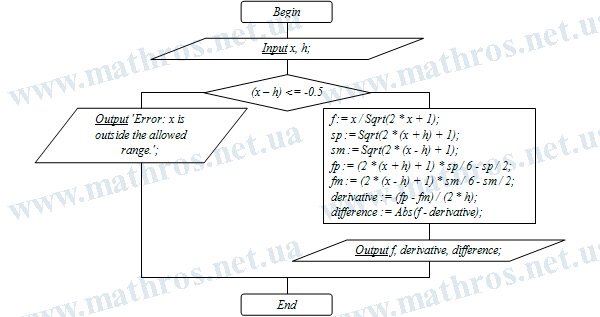
Interested in programming? Then try implementing the algorithm shown in the flowchart using your favorite language — Pascal, Python, JavaScript, or C++. The program checks whether
\[
F(x)=\frac{(2\cdot x+1)^{\frac32}}{6}-\frac{\sqrt{2\cdot x+1}}{2}
\]
is an antiderivative of the integrand
\[
f(x)=\frac{x}{\sqrt{2\cdot x+1}}.
\]
The algorithm calculates the value of \( f(x) \), approximates the derivative \( F'(x) \), and calculates the difference between the two values. This way, you can apply your knowledge of integration of irrational functions in practice and see how mathematical calculations are implemented in code.