Sometimes an integrand seems too complicated to integrate directly. However, after introducing a new variable, its structure can become much simpler. This is exactly why integration by substitution is used. It is one of the main methods for evaluating indefinite integrals. It helps transform the original integral into a familiar form whose antiderivative is easy to find.
Integration by Substitution: Formula and Explanation
The substitution method is based on the connection between integration and the differentiation of a composite function. When finding a derivative, we use the chain rule. When integrating, we do the opposite: we try to recognize the result of applying the chain rule and reverse the process.
Suppose the integrand contains a composite function \( f(\varphi(x)) \) together with the derivative of its inner function, \( \varphi'(x) \). We then introduce a new variable:
\[
u=\varphi(x).
\]
Differentiating this equation gives:
\[
du=\varphi'(x)\,dx.
\]
Therefore, the expression \( \varphi'(x)\,dx \) can be replaced by the differential \( du \). The integral written in terms of \( x \) is then transformed into an integral with the new variable \( u \):
\[
\int f(\varphi(x))\cdot\varphi'(x)\,dx
=
\int f(u)\,du.
\]
Why is this substitution valid? Suppose that \( F(u) \) is an antiderivative of \( f(u) \). Then
\[
F'(u)=f(u).
\]
Since \( u=\varphi(x) \), the chain rule gives:
\[
\frac{d}{dx}F(\varphi(x))
=
F'(\varphi(x))\cdot\varphi'(x).
\]
Since
\[
F'(\varphi(x))=f(\varphi(x)),
\]
we obtain
\[
\frac{d}{dx}F(\varphi(x))
=
f(\varphi(x))\cdot\varphi'(x).
\]
This gives us the main formula for the substitution method:
\[
\int f(\varphi(x))\cdot\varphi'(x)\,dx
=
F(\varphi(x))+C.
\]
Therefore, substitution does not change the meaning of the problem. It simply allows us to find the antiderivative in a more convenient form.
Choosing a Substitution: How to Introduce a New Variable Correctly
The formula explains why the method works. However, this leads to the main question: how can we determine which part of the integrand should be replaced with a new variable?
First, look for a composite function. Its inner part may be a power, radical, exponential, logarithmic, or trigonometric expression. This inner function is often chosen as \( u \).
However, finding a composite function is not enough. You should also examine the other factors in the integrand. If one of them is the derivative of the inner function, the chosen substitution will most likely work well.
The derivative of the inner function does not always appear in the integral exactly as needed. Sometimes it differs by a constant factor. In this case, the constant must be taken into account when transforming the integral.
If
\[
u=\varphi(x),
\]
then
\[
du=\varphi'(x)\,dx.
\]
Therefore, an expression containing a constant factor can be replaced as follows:
\[
k\cdot\varphi'(x)\,dx=k\,du.
\]
If the integrand contains the required derivative up to a constant factor, the missing constant can be placed before the integral. Therefore, a constant does not prevent us from applying the method. We simply need to handle it correctly during the substitution.
In addition, after making the substitution, the entire integrand must be written in terms of the new variable. Expressions involving both \( x \) and \( u \) should not remain in the same integral. Otherwise, the substitution is incomplete.
A suitable substitution does more than shorten one part of the expression. It should completely remove the original variable from the integrand and transform the integral into a simpler standard form. After integrating, we substitute the original expression back in and return to the variable \( x \).
Integration by Substitution: Practical Evaluation of Indefinite Integrals
The theoretical formula becomes easier to understand when we apply it step by step to specific integrals. Let us consider different ways to choose a substitution and see how the original integrand is transformed into a standard integral.
Example 1. Find the indefinite integral
\[
\int 2\cdot x\cdot\cos(x^2)\,dx.
\]
The argument of the cosine function is \( x^2 \). Its derivative is \( 2\cdot x \), and this factor is already present in the integrand. Therefore, we introduce a new variable:
\[
u=x^2.
\]
We find the differential:
\[
du=2\cdot x\,dx.
\]
Thus, the expression \( 2\cdot x\,dx \) can be replaced with the differential \( du \). The original integral then becomes:
\[
\int 2\cdot x\cdot\cos(x^2)\,dx
=
\int \cos(u)\,du.
\]
We use the standard integration formula:
\[
\int \cos(u)\,du=\sin(u)+C.
\]
Now we return to the original variable. Since \( u=x^2 \), we obtain:
\[
\int 2\cdot x\cdot\cos(x^2)\,dx
=
\sin(x^2)+C.
\]
Example 2. Find the indefinite integral
\[
\int e^{3\cdot x-1}\,dx.
\]
The exponent is the linear expression \( 3\cdot x-1 \). It is convenient to choose this expression as the new variable:
\[
u=3\cdot x-1.
\]
We find the differential:
\[
du=3\,dx.
\]
Therefore,
\[
dx=\frac{1}{3}\,du.
\]
Now we rewrite the entire integral in terms of the new variable:
\[
\int e^{3\cdot x-1}\,dx
=
\frac{1}{3}\cdot\int e^u\,du.
\]
Since
\[
\int e^u\,du=e^u+C,
\]
we have
\[
\frac{1}{3}\cdot\int e^u\,du
=
\frac{1}{3}\cdot e^u+C.
\]
We replace \( u \) with the original expression:
\[
\int e^{3\cdot x-1}\,dx
=
\frac{1}{3}\cdot e^{3\cdot x-1}+C.
\]
Example 3. Find the indefinite integral
\[
\int \frac{x}{x^2+4}\,dx.
\]
The denominator contains the expression \( x^2+4 \). Its derivative is \( 2\cdot x \). The numerator contains the factor \( x \), which differs from this derivative only by a constant factor.
We introduce a new variable:
\[
u=x^2+4.
\]
Then
\[
du=2\cdot x\,dx.
\]
Now we express the required part of the integrand:
\[
x\,dx=\frac{1}{2}\,du.
\]
After substitution, we obtain:
\[
\int \frac{x}{x^2+4}\,dx
=
\frac{1}{2}\cdot\int \frac{1}{u}\,du.
\]
We apply the standard integration formula:
\[
\int \frac{1}{u}\,du=\ln|u|+C.
\]
Therefore,
\[
\frac{1}{2}\cdot\int \frac{1}{u}\,du
=
\frac{1}{2}\cdot\ln|u|+C.
\]
We return to the variable \( x \):
\[
\int \frac{x}{x^2+4}\,dx
=
\frac{1}{2}\cdot\ln|x^2+4|+C.
\]
Since \( x^2+4>0 \) for all real values of \( x \), the absolute value signs can be omitted:
\[
\int \frac{x}{x^2+4}\,dx
=
\frac{1}{2}\cdot\ln(x^2+4)+C.
\]
Example 4. Find the indefinite integral
\[
\int \frac{\sin(x)}{\sqrt{1-\cos(x)}}\,dx.
\]
The expression under the square root is \( 1-\cos(x) \). Its derivative is \( \sin(x) \), and this factor appears in the numerator. Therefore, we choose the substitution:
\[
u=1-\cos(x).
\]
We find the differential:
\[
du=\sin(x)\,dx.
\]
After substitution, the original integral becomes:
\[
\int \frac{\sin(x)}{\sqrt{1-\cos(x)}}\,dx
=
\int \frac{1}{\sqrt{u}}\,du.
\]
We rewrite the square root as a power:
\[
\int \frac{1}{\sqrt{u}}\,du
=
\int u^{-\frac{1}{2}}\,du.
\]
We apply the integration formula for a power function:
\[
\int u^{-\frac{1}{2}}\,du
=
\frac{u^{\frac{1}{2}}}{\frac{1}{2}}+C
=
2\cdot\sqrt{u}+C.
\]
We return to the variable \( x \):
\[
\int \frac{\sin(x)}{\sqrt{1-\cos(x)}}\,dx
=
2\cdot\sqrt{1-\cos(x)}+C.
\]
Example 5. Find the indefinite integral
\[
\int \frac{x^3}{(x^4+5)^2}\,dx.
\]
The denominator contains the expression \( x^4+5 \), raised to a power. Its derivative is \( 4\cdot x^3 \). The numerator contains \( x^3 \), so the missing factor \( 4 \) can be taken into account during substitution.
We introduce a new variable:
\[
u=x^4+5.
\]
We find the differential:
\[
du=4\cdot x^3\,dx.
\]
Therefore,
\[
x^3\,dx=\frac{1}{4}\,du.
\]
In addition,
\[
(x^4+5)^2=u^2.
\]
Thus, after substitution, we obtain:
\[
\int \frac{x^3}{(x^4+5)^2}\,dx
=
\frac{1}{4}\cdot\int \frac{1}{u^2}\,du.
\]
We rewrite the fraction as a power:
\[
\frac{1}{4}\cdot\int \frac{1}{u^2}\,du
=
\frac{1}{4}\cdot\int u^{-2}\,du.
\]
We apply the integration formula for a power function:
\[
\int u^{-2}\,du
=
\frac{u^{-1}}{-1}+C
=
-\frac{1}{u}+C.
\]
Therefore,
\[
\frac{1}{4}\cdot\int u^{-2}\,du
=
-\frac{1}{4\cdot u}+C.
\]
We return to the original variable:
\[
\int \frac{x^3}{(x^4+5)^2}\,dx
=
-\frac{1}{4\cdot(x^4+5)}+C.
\]
In each integral considered above, the inner expression of a composite function was chosen as the new variable. At the same time, its derivative appeared in another part of the integrand either exactly or up to a constant factor. This is the key pattern that helps us recognize a suitable substitution.
The antiderivative can be checked by differentiation. Its derivative should be equal to the original integrand.
Where to Go Next: Topics for Further Study
Integration by substitution is only one method for evaluating indefinite integrals. Next, it is worth exploring methods that help you work with products, rational expressions, and trigonometric functions.
- Integration by Parts: Formula and Step-by-Step Examples — This article will explain how to evaluate integrals involving products of functions and how to choose the appropriate parts for further transformations.
- Integration of Rational Functions: Partial Fraction Decomposition — This material will show how to decompose a rational expression into simpler fractions and evaluate the resulting integrals using familiar rules.
- Integrals of Trigonometric Functions: Main Methods — This article will discuss how to transform trigonometric expressions and choose an integration method depending on the powers and types of functions involved.
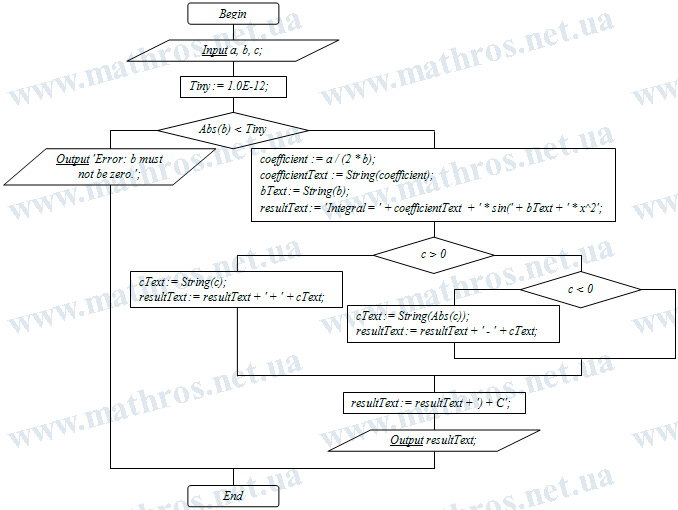
Integration by Substitution: From a Flowchart to Code
Interested in programming? Then try turning this mathematical method into a complete algorithm. Follow the flowchart carefully, implement the algorithm in your preferred programming language, and see how the algorithm can automatically construct an antiderivative for an expression with given coefficients.