Geometry helps us not only study shapes on paper, but also understand the world around us — from ornaments and mosaics to real construction details. Among polygons, the hexagon really stands out: it has six sides and six angles, and its shape often appears in everyday objects. In this article, we’ll learn how to find the perimeter of a hexagon, which formulas work in different cases, and how to apply them in problems. So if you want to calculate confidently and step by step, let’s begin.
How to Find the Perimeter of a Hexagon: Geometric Formulas
The perimeter of a hexagon is the sum of the lengths of all its sides. In other words, it is the total length around the shape (its outline). A hexagon is a polygon with six sides and six angles, so depending on the type of hexagon, the perimeter can be found in different ways.
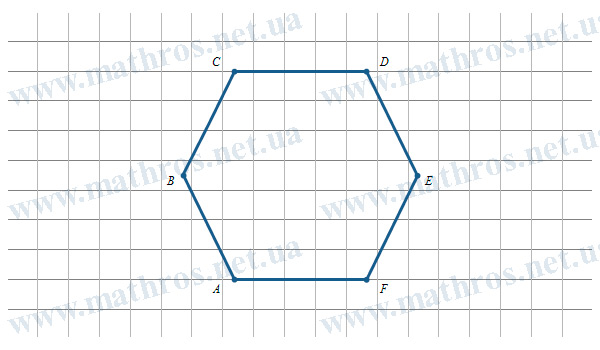
If we have an equilateral (regular) hexagon — meaning all its sides are equal — then finding the perimeter of a hexagon is very straightforward: you only need the length of one side.
The formula is:
\[
P=6 \cdot AB,
\]
where \( P \) is the perimeter of a hexagon.
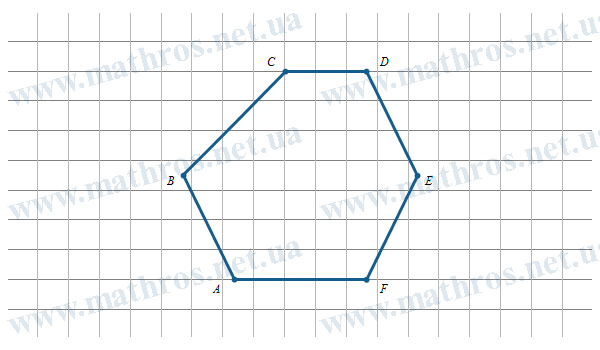
If we have an irregular hexagon, where the sides have different lengths, then to find the perimeter of a hexagon you measure each side and add them all together:
\[
P = AB + BC + CD + DE + EF + AF.
\]
Note. If we label the side lengths of the hexagon with letters \( a \), \( b \), \( c \), \( d \), \( e \), \( f \), then the formulas for the two main cases (a regular hexagon and an irregular hexagon) can be written in a more familiar form:
\[
P = a + b + c + d + e + f,\qquad P = 6 \cdot a.
\]
Problems and Solutions: Perimeter of a Hexagon in Examples
To better understand how to calculate the perimeter of a hexagon, let’s look at a few examples. Even though each example includes a complete (worked) solution, it’s a good idea to try the calculation yourself first — and then compare your result.
Example 1. Find the perimeter of a hexagon with side lengths 5 cm, 4 cm, 7 cm, 3 cm, 6 cm, and 8 cm
As noted above, to find the perimeter of a hexagon for an irregular hexagon, you add the lengths of all six sides:
\[
P = a+b+c+d+e+f = 5+4+7+3+6+8 = 33.
\]
So, the perimeter of a hexagon is \( 33 \) cm.
Example 2. Find the perimeter of a regular hexagon with side length 5 cm
Here, each side of the hexagon is \( 5 \) cm. Using the perimeter formula, we get:
\[
P = 6 \cdot a = 6 \cdot 5 = 30.
\]
Therefore, the perimeter of a hexagon is \( 30 \) cm.
Example 3. Find the perimeter of a regular hexagon with side length 6 cm
Similarly, if \( a = 6 \) cm, then:
\[
P = 6 \cdot a = 6 \cdot 6 = 36.
\]
Therefore, the perimeter of a hexagon is \( 36 \) cm.
Example 4. What is the side length of a regular hexagon with a perimeter of 72 cm?
In this case, we know the perimeter of a hexagon and want to find the side length. Using \( P = 72 \), we solve for \( a \):
\[
P = 6 \cdot a,\qquad 72 = 6 \cdot a,\qquad a = 12.
\]
So, the side length of the hexagon is \( 12 \) cm.
Next Steps: What to Learn Next
If perimeter of a hexagon already feels clear, it’s a great next step to explore how a hexagon relates its sides, diagonals, apothem, and area. These ideas appear very often in geometry problems, and they support each other nicely.
- Diagonals of a Hexagon: Explanation, Properties, and Examples — You’ll learn how many diagonals a hexagon has and how to find their lengths in common problems.
- Apothem of a Hexagon: Formulas and Illustrations — This explains what an apothem is and how to calculate it in a regular hexagon when the side length is known.
- Area of a Hexagon: Formulas and Calculation Examples — This shows different ways to find area and helps you choose the most convenient method for a given task.
Perimeter of a Hexagon in Code: Try Implementing the Algorithm Yourself
If you enjoy not only calculating but also turning formulas into working code, then a flowchart is a nice final touch. It shows the logic of choosing a mode for a regular hexagon versus an irregular hexagon, checking whether the input is valid, and outputting the result without unnecessary complications. So why not write your own version of this flowchart in your favorite programming language — Python, JavaScript, C#, Pascal, or any other?
This is one of those cases where the perimeter of a hexagon stops being an abstract rule from a textbook and becomes a small program you can test with your own examples — and even use as a starting point for a more advanced geometry calculator.
