A hexagon is a polygon that has six sides and six interior angles. The sum of the interior angles of a hexagon is \( 720^\circ \). If we look at different features, we can identify several types of hexagons. For example, depending on the side lengths, a hexagon can be regular or irregular. Depending on its shape (outline), it can be convex or concave.
In this article, we’ll go through the definition of a hexagon and describe the most common types of these geometric shapes. We’ll also explore the fundamental characteristics and properties of hexagons that help us solve a wide range of geometry tasks and problems. Ready to open the door to the world of hexagons? Let’s start learning.
Hexagon: Basic Definition and Types
A hexagon is defined as a polygon with six sides and six interior angles. Let’s quickly remember that a polygon is a closed two-dimensional (2D) shape made of straight line segments. All sides of a hexagon connect to each other, forming the shape.
Taking different characteristics into account, we can identify the following types of hexagons:
- Regular and irregular.
- Convex and concave.
Regular and Irregular Hexagons
A regular hexagon has sides of equal length and all angles equal. On the other hand, irregular hexagons have sides of different lengths and angles with different measures.

Convex and Concave Hexagons
A convex hexagon is a geometric shape where all vertices point outward. In contrast, a concave hexagon is a geometric shape where at least one vertex points inward.

Studying Deeper: Key Properties of a Hexagon
Hexagons are special geometric shapes with a set of clear, useful characteristics. Let’s look at the main properties of these shapes:
- The sum of all interior angles of a hexagon is \( 720^\circ \).
- The sum of all exterior angles of a hexagon is \( 360^\circ \).
- A regular hexagon has all six sides of the same length.
- A regular hexagon has all six angles equal in measure.
- Each interior angle of a regular hexagon is \( 120^\circ \).
- Each exterior angle of a regular hexagon is \( 60^\circ \).
- The total number of diagonals in a regular hexagon is \( 9 \).
- Opposite sides of a regular hexagon are always parallel to each other.
Using Geometry in Practice: Real Problems About Hexagons
Let’s go through a few examples that show how the properties of hexagons work in real problem-solving.
Example 1. What is a 6-sided polygon called?
A 6-sided polygon is called a hexagon. If all six sides are equal, we call it a regular hexagon. If any two sides have different lengths, we call it an irregular hexagon.
Example 2. Is a hexagon a parallelogram?
No, a hexagon is not a parallelogram. A parallelogram has only four sides.
Example 3. What do a quadrilateral and a hexagon have in common?
A quadrilateral and a hexagon are both closed polygons, and the sum of their exterior angles is \( 360^\circ \).
Example 4. Is a regular hexagon convex?
Yes, a regular hexagon is convex, because all its interior angles are less than \( 180^\circ \).
Example 5. What are the properties of a regular hexagon?
A regular hexagon has the following properties:
- It has all six sides equal in length and all six angles equal in measure.
- Each interior and exterior angle of a regular hexagon is \( 120^\circ \) and \( 60^\circ \), respectively.
- The total number of diagonals in a regular hexagon is \( 9 \).
- Opposite sides of a regular hexagon are always parallel to each other.
Example 6. Four angles of a hexagon are 80°, 70°, 100°, and 130°. What are the other two angles: 170° and 170°, or 120° and 180°?
As we know, the sum of the interior angles of a hexagon is \( 720^\circ \). The sum of the known angles is: \( 80^\circ + 70^\circ + 100^\circ + 130^\circ = 380^\circ \). So the sum of the other two angles is: \( 720^\circ – 380^\circ = 340^\circ \).
Now, since \( 170^\circ + 170^\circ = 340^\circ \), while \( 120^\circ + 180^\circ = 300^\circ \), we conclude that the remaining two angles are \( 170^\circ \) and \( 170^\circ \).
Example 7. For the hexagon ABCDEF shown below, find the measure of angle F
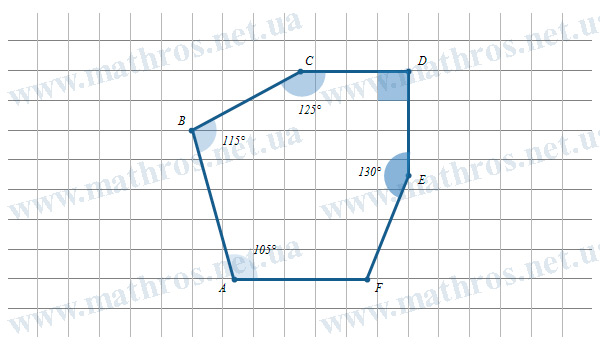
Let \( x \) be the measure of the unknown angle. Since one angle of the hexagon is a right angle, it equals \( 90^\circ \). Using the interior-angle sum rule, we get:
\[ x+90^\circ+115^\circ+125^\circ+105^\circ+130^\circ=720^\circ; \quad x+565^\circ=720^\circ; \quad x=720^\circ-565^\circ=155^\circ. \]
So, angle \( F \) equals \( 155^\circ \).
Keep Exploring: Useful Hexagon Topics to Learn Next
If you’ve already understood the basics, why stop here? These related topics help you go further and solve more geometry tasks with confidence.
- Apothem of a Hexagon: Formulas and Illustrations — A clear guide to the apothem, with visuals that make the idea easier to grasp.
- Perimeter of a Hexagon: Calculation and Practical Uses — Learn how to calculate the perimeter based on the hexagon’s shape, with examples that show real use.
- Area of a Hexagon: Formulas and Worked Examples — See how to find the area using different methods and practice tasks to build skill.
From Flowchart to Code: Build Your Own Hexagon Classifier
If you’re interested in programming, try turning this flowchart into code in the language you love—Python, JavaScript, C#, anything. It’s a neat mini-project: you’ll practice input handling, validation, and clean branching logic while teaching the computer to decide whether the angles form a valid hexagon and, if so, whether it’s regular/irregular and convex/concave. Fun, right? Once it works, test tricky cases and polish the messages even more.
