The area of a circle is a fundamental concept in mathematics that appears across many fields. When you know how to compute it, you can solve problems from basic geometry to real-world applications. But how exactly do you do it? Which formulas should you use? In this article, we’ll explore the answers step by step. Ready to look at the formulas for the area of a circle and see how they work in examples? Join in and learn how to calculate the area of a circle with us!
Area of a Circle Formula: Derivation and Explanation
First, a quick reminder: in this context, a “circle” means the filled region of the plane bounded by a circumference. In other words, a circle of radius R with center O includes the point O and all points whose distance from O is no greater than R.
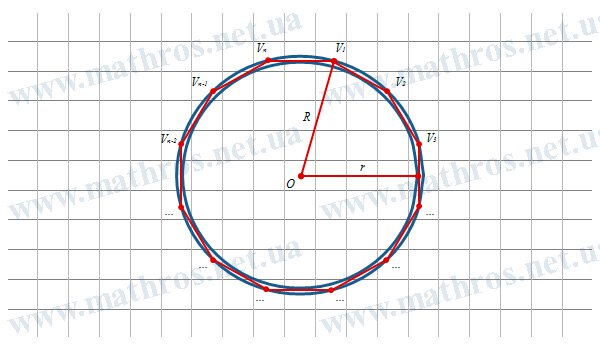
Let’s derive a formula for the area of a circle whose radius is R. Consider a regular n-gon V1, V2, V3,…, Vn-2, Vn-1, Vn inscribed in the circumference that bounds the circle. Clearly, the area A of the circle is larger than the area An of the polygon (because the polygon lies entirely inside the circle). On the other hand, the area a of the circle inscribed in the polygon is smaller than An (because that inner circle lies entirely inside the polygon). Therefore,

Now let the number of sides n grow without bound. In this case, the inradius of the polygon (the radius of the inscribed circle) is r=R⋅cos(180°/n). As n→∞, the angle 180°/n→0°, so cos(180°/n)→1, and therefore r→R. In other words, as the number of sides increases without limit, the inscribed circle approaches the circumscribed circle, so a→A when n→∞. From this and inequality (1), it follows that An→A as n→∞.
Next, use the area formula for a regular n-gon: An=(Pn⋅r)/2, where Pn – is its perimeter and r is the inradius. Taking into account that r→R and Pn→2⋅π⋅R as n→∞, we obtain S=(2⋅π⋅R⋅R)/2=π⋅R2. Therefore, to compute the area A of a circle with radius R, we use the formula

How to Find the Area of a Circle Using Diameter and Circumference
Yes, you’re absolutely right! The area of a circle doesn’t have to be calculated only from its radius. We can also use other parameters of the circle, such as its diameter or even its circumference. Since the radius is closely related to both, a few simple substitutions let us compute the area using either value.
Because the diameter is twice the radius, replacing the radius by D/2 in formula (2) and remembering that it’s squared gives the area via diameter:

The circumference of a circle is C=2⋅π⋅R. Solving for the radius, R=C/(2⋅π). Substituting this into formula (2) (and squaring the expression) gives the area via circumference:

Area of a Circle in Action: Practice Problems with Solutions
To better understand how to find the area of a circle, let’s go through a few practical examples. Each one already includes the final answer — but isn’t it more interesting to try solving them yourself before checking the results?
Example 1: Find the area of a circle with a radius of 7 cm
We have R=7 cm. Using S=π⋅R2, we get:

Therefore, the area of a circle is 153.86 cm2.
Example 2: The length of the largest chord of a circle is 15 cm. Find the area of the circle
The largest chord is the diameter, so D=15 cm. Using S=(π⋅D2)/4, we get:

Thus, the area of a circle is 176.625 cm2.
Example 3: The circumference of a circle is 18 cm. Find the area of the circle enclosed by it
Using S=4⋅π⋅C2 with C=18, we have:

Hence, the area of the circle is approximately 4069.44 cm2.
See Also: Explore Other Important Aspects of Circle Geometry!
Are you curious about exploring new geometric ideas? If so, take a look at a few more engaging circle-related topics:
- What Is a Circle: Definition and Components — Learn the core concepts and elements that define a circle’s structure, and see how they influence its characteristics.
- Properties of a Circle in Action: Problems with Answers — Deepen your understanding of a circle’s geometric properties through practical exercises and their step-by-step solutions.
- Area of a Circle Sector: From Definition to Practical Problems — Discover how to find the area of a sector of a circle and how to apply this knowledge in different situations to solve real-world tasks.
From Flowchart to Code: Build a Circle Area Calculator
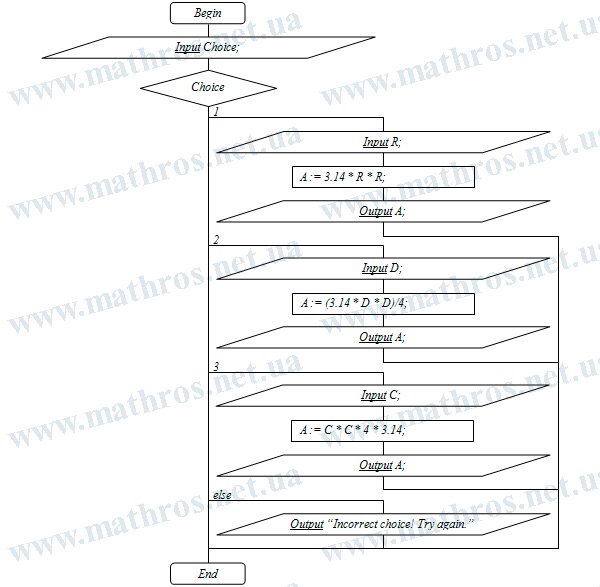
If you’re passionate about programming and love seeing logic come to life, here’s your next exciting challenge! Take the flowchart that illustrates the algorithm for calculating the area of a circle and transform it into real working code. Follow each step carefully — from entering the radius, diameter, or circumference to applying the correct formula automatically. You can choose any programming language you like, such as Pascal, Python, or JavaScript. This task is a great opportunity to connect mathematical thinking with coding creativity — a small project that turns abstract formulas into something dynamic, visual, and truly your own!