Understanding the area of a rhombus is the first step to fully grasping this fascinating shape. Is it difficult to calculate? Actually, it’s not. The key is to know a few handy formulas and understand their origins.
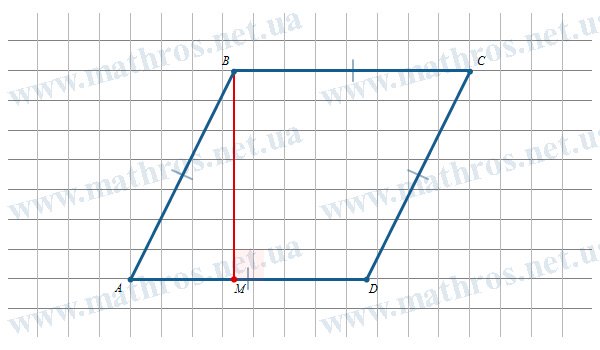
Let’s consider rhombus ABCD and explore three most common methods of calculating its area. Ready to move forward?
How to Find the Area of a Rhombus: Formula Using Side and Height
First, remember that a rhombus is a special type of parallelogram. So, if we know the length of side AD and height BM drawn to this side, the area is found by:

Why does this work? Because the area of any parallelogram equals the base multiplied by the height. This rule remains unchanged for the rhombus. Just don’t forget: the result is always expressed in square units (mm2, cm2, m2, etc.).
Area of a Rhombus Using Diagonals: Another Convenient Method
Now the question arises: what if we don’t know the height but do know the lengths of the diagonals? It turns out this case is even simpler. Just multiply the lengths of the two diagonals, AC and BD, and divide by two:

But why do we divide by two? To answer this, let’s examine diagonal BD—it divides rhombus ABCD into two triangles, ABD and BCD, both sharing base BD.
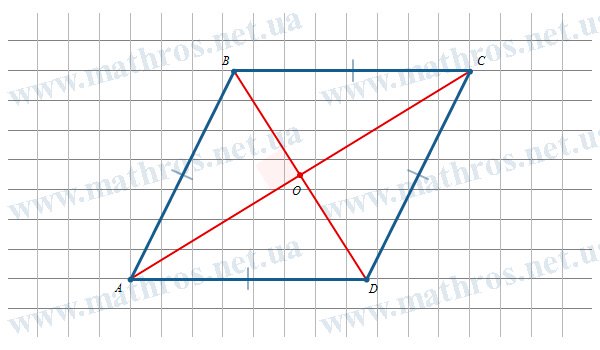
Moreover, the diagonals of a rhombus intersect at a right angle at point O. This means AO and OC act as the heights of these triangles.
Then, areas of triangles ABD and BCD can be calculated using the basic triangle area formula (base multiplied by height, divided by two):

Adding the areas of these two triangles gives the total area of the rhombus:

Factor out common terms:

Thus, it’s clear now why we divide the product of diagonals by two!
Trigonometric Approach: Formula Using Side and Angle
But what if we don’t know the height or diagonals, but we do know side AB and angle α between two adjacent sides? Trigonometry comes to the rescue, specifically the formula involving the sine of the angle:

Where does this formula come from? Let’s draw diagonal BD again.
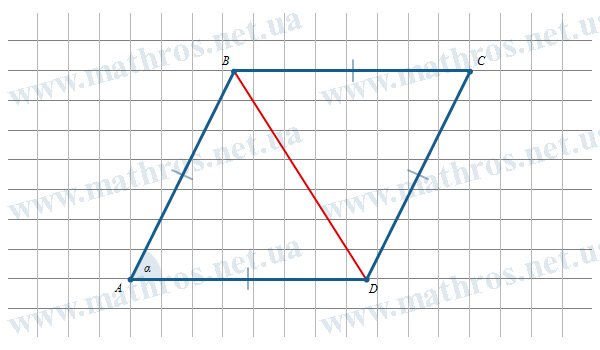
As we already know, it divides the rhombus into two identical triangles, ABD and BCD. The area of triangle ABD is given by the known trigonometric formula: half the product of two sides multiplied by the sine of the angle between them:

But since all sides of a rhombus are equal, AB equals AD, simplifying the formula to:

A rhombus consists of two identical triangles, hence the total area equals:

Interestingly, it doesn’t matter if the chosen angle is acute or obtuse. Since adjacent angles have the same sine value, this formula always gives a correct result.
Note: If we denote side AB as a, height BM as h, and diagonals AC and BD as d1 and d2 respectively, all discussed formulas can be summarized as follows:

Solving Problems: Practical Application of Formulas
To reinforce your understanding of these formulas, let’s move from theory to practice. We’ll now consider several practical examples of calculating the area of a rhombus. Each task has its solution, but before reading it, try finding the answer yourself. Ready to test your knowledge?
Example 1: What Is the Area of a Rhombus with a Side of 8 cm and Height of 6 cm?
Given: a rhombus with side=8 cm, height=6 cm. Use the side-height formula:

Thus, the area of this rhombus is 48 cm2.
Example 2: The Area of a Rhombus Is 70 cm2, and Its Height Is 10 cm. What Is the Length of Its Side?
Here, the area (70 cm2) and height (10 cm) are known. We need the side length. Substitute into the formula and solve:

Therefore, the side length is 7 cm.
Example 3: Find the Area of a Rhombus If Its Diagonals Are 8 cm and 10 cm
Now, we’ll use the diagonal-based formula. Given diagonals of 8 cm and 10 cm, we have:

Hence, the area of this rhombus is 40 cm2.
Example 4: What Is the Area of a Rhombus with Diagonals of 10 cm and 12 cm?
Let’s practice again with diagonals. Substitute into the formula:

Thus, the area of this rhombus is 60 cm2.
Example 5: The Side of a Rhombus Is 10 cm, and the Interior Angle Is 60°. What Is Its Area?
We use the side-angle formula here:

Therefore, the area is approximately 87 cm2.
What’s Next? Additional Resources for Studying the Rhombus
Now you surely understand how to calculate the area of a rhombus in various ways. But is that all you need to know about this shape? Certainly not! Diagonals, angles, perimeter—these are just some of the interesting properties hidden within a rhombus. To explore further, we recommend these resources:
- What is a Rhombus – Explore essential properties and formulas of rhombuses clearly explained with practical examples.
- How to Find the Lengths of Diagonals of a Rhombus – Learn quick methods for calculating diagonals, explained step-by-step.
- Perimeter of a Rhombus – Master perimeter calculations with straightforward explanations and examples.
These articles will help you confidently apply these concepts in practical problems. Keep exploring and enjoy studying geometry!
Area of a Rhombus: Flowchart for Writing Code
Now, let’s shift focus and view the rhombus from a programmer’s perspective! It’s entirely possible to turn all this into code that calculates the area of a rhombus automatically. Below, you’ll find a simple flowchart clearly demonstrating how to build such a program, specifically using the side-height calculation method. Choose your favorite programming language, follow this guide, and soon you’ll have your own tool for automating geometric calculations!