A rectangle is one of the most common geometric shapes, characterized by four sides, four vertices, and four right angles. The diagonal of a rectangle is a line segment connecting two opposite vertices. What makes this segment so special? It not only divides the rectangle into two equal right triangles but also has important properties that can simplify solving many geometric problems. In this article, we’ll dive deep into the concept of the diagonal of a rectangle, its formula, and practical examples.
What is the Diagonal of a Rectangle? Definition and Properties
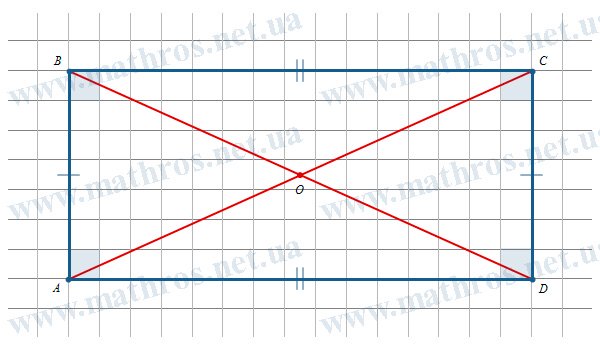
The diagonal of a rectangle is a line segment connecting two opposite vertices of this geometric figure. Imagine a rectangle labeled with vertices A, B, C, and D. The diagonals AC and BD intersect at the center of the rectangle, dividing it into two equal right triangles.
Key Properties of the Diagonal of a Rectangle
- Both diagonals are always of equal length.
- The point where the diagonals intersect divides each diagonal into two equal parts.
- Each diagonal divides the rectangle into two congruent right triangles, with each triangle occupying half of the rectangle’s area.
These properties form the foundation for calculations and problem-solving in geometry. In the next section, we’ll learn how to calculate the length of a diagonal using a straightforward and efficient formula.
How to Calculate the Length of a Rectangle’s Diagonal: The Simple Formula
To find the length of a rectangle’s diagonal, we use a simple and reliable formula based on the Pythagorean theorem:

Where:
- l is the length of the rectangle (the longer side).
- w is the width of the rectangle (the shorter side).
Why does this Formula Work?
The diagonal of a rectangle splits it into two equal right triangles. In these triangles, the diagonal serves as the hypotenuse, while the length and width of the rectangle act as the two legs.
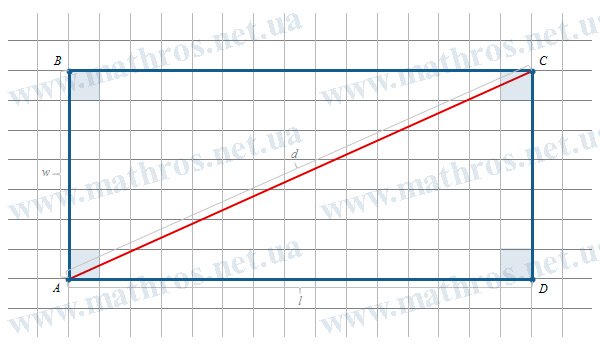
According to the Pythagorean theorem, the square of the hypotenuse equals the sum of the squares of the legs. Thus, to calculate the diagonal’s length, simply substitute the rectangle’s length and width into the formula and compute the square root of the result. This method works for any rectangle, regardless of its size.
Diagonal of a Rectangle: Practical Examples
Now that we know the formula, it’s time to put it into action. Below are several examples with step-by-step explanations. Try solving them yourself before checking the solutions!
Example 1: What is the Diagonal of a Rectangle with Sides 4 cm and 3 cm?
Given l=4 cm and w=3 cm:

The diagonal is 5 cm.
Example 2: A Rectangle Has a Base of 12 cm and a Height of 5 cm. What is its Diagonal?
Given l=12 cm and w=5 cm:

The diagonal is 13 cm.
Example 3: A Rectangle Has a Base of 7 cm and a Height of 9 cm. What is its Diagonal?
Given l=7 cm and w=9 cm:

The diagonal is approximately 11.4 cm.
Example 4: A Rectangle Has a Base of 15 cm and a Height of 10 cm. What is its Diagonal?
Given l=15 cm and w=10 cm:

The diagonal is approximately 18.03 cm.
Example 5: What is the Diagonal of a Rectangle with a Base of 12 cm and a Height of 20 cm?
Given l=12 cm and w=20 cm:

The diagonal is approximately 23.3 cm.
Learn More: Additional Resources to Deepen Your Knowledge
If you found the topic of rectangles intriguing, check out these additional resources to expand your understanding of geometry and enhance your skills:
- Key Properties of Rectangles – Explore the fundamental characteristics of rectangles and their geometric elements.
- Perimeter of a Rectangle – Learn to calculate the perimeter with practical examples.
- Area of a Rectangle – Master the basics of area calculations with clear explanations and exercises.
Exploring these topics will help you confidently solve geometric problems and prepare for exams or competitions.
A Challenge for Programmers: Automating Rectangle Diagonal Calculations
Calculating the diagonal of a rectangle isn’t just a fun geometry problem—it’s also a fantastic way to hone your programming skills. Why not create a program that automatically computes the diagonal length? Start with a basic algorithm, implement it in your favorite programming language, and take your coding and algorithmic thinking to the next level!