Imagine a figure with a triangular base, where all three side faces are also triangular and converge at the top. This is a triangular pyramid! Have you ever wondered what exactly makes it so interesting? Do you know what types of triangular pyramids there are and how they differ? And how to calculate its surface area or volume?
In this article, we will take a detailed look at the triangular pyramid: from the basics to complex formulas, from theory to practical examples. Let’s see what properties are inherent in this geometric shape, and find out how you can apply this knowledge in practice. Stay with us, it will be interesting!
Triangular Pyramid: Basics and Structure
So, what exactly is a triangular pyramid? Also known as a tetrahedron, it’s one of the fundamental three-dimensional shapes in geometry. Picture this: a triangular base, with three more triangles joining at the top. A triangular pyramid has four faces, six edges, and four vertices. Easy to visualize, right?
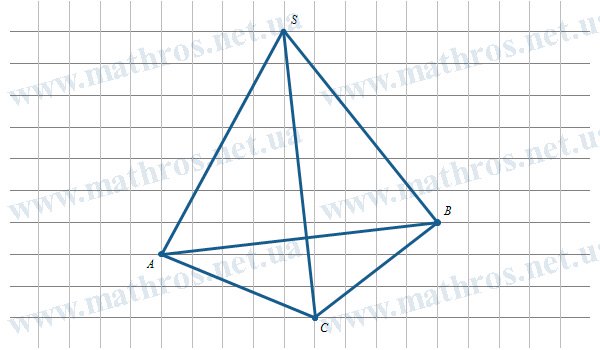
A special type of triangular pyramid is the regular triangular pyramid. In this form, all faces are equilateral triangles, and the angles between the faces are all 60 degrees. This symmetry makes it particularly easy to calculate and work with.
Types of Triangular Pyramids: What’s the Difference?
Did you know there are different types of triangular pyramids? Let’s explore them!
- Regular triangular pyramid: A regular triangular pyramid is one where all the faces are equilateral triangles. Each angle is 60 degrees. So, if all faces are equal, you’re looking at a regular triangular pyramid;
- Irregular triangular pyramid: An irregular triangular pyramid has faces that are not necessarily the same. Each face is still a triangle with angles adding up to 180 degrees, but the side lengths can vary. If the triangles have different edge lengths, it’s an irregular triangular pyramid;
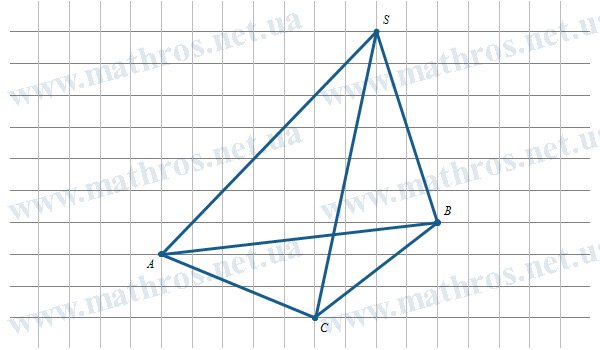
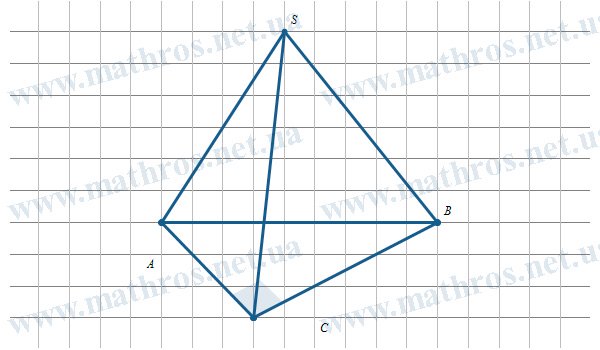
- Right triangular pyramid: This type of triangular pyramid has a base that’s a right triangle, with the other three faces being isosceles triangles. It still has six edges and four vertices, but with a unique twist.
Properties of the Triangular Pyramid: Must-Know Facts
Now that we know what a triangular pyramid is, let’s look at some key properties:
- It has 4 triangular faces, 6 edges, and 4 vertices;
- Three edges meet at each vertex;
- It has no parallel faces;
- All faces of a regular triangular pyramid are equilateral triangles, giving it 6 planes of symmetry;
- Triangular pyramids can be regular, irregular, or right-angled.
Triangular Pyramid in Numbers: Calculating Area and Volume
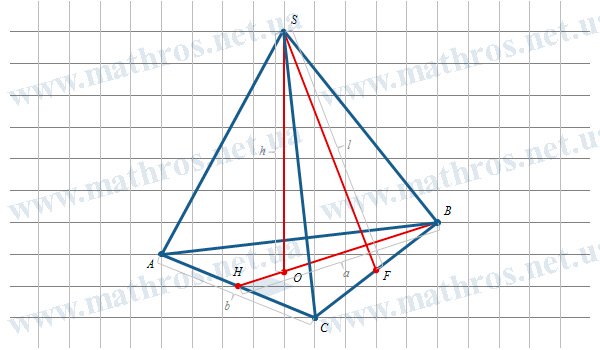
Curious about how to calculate the surface area or volume of a triangular pyramid? Let’s break it down!
| Term | Definition | Formula |
|---|---|---|
| Surface area of a triangular pyramid | The surface area of a triangular pyramid is the total area of all its faces | 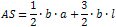 |
| Volume of a triangular pyramid | The volume of a triangular pyramid is the space occupied by a triangular pyramid in three-dimensional space |  |
Practical Applications: Real-Life Examples of a Triangular Pyramid
Let’s put this knowledge to use with some practical examples!
Example 1: What is a triangular pyramid in mathematics?
A triangular pyramid is a 3D shape where all faces are triangles. It has a triangular base and three triangular side faces converging at a point.
Example 2: What is the base of a triangular pyramid?
The base is a triangle, meaning the pyramid consists of four triangular faces in total.
Example 3: If two equal triangular pyramids are glued together along their bases, they form a triangular bipyramid. How many faces, edges and vertices does this bipyramid have?
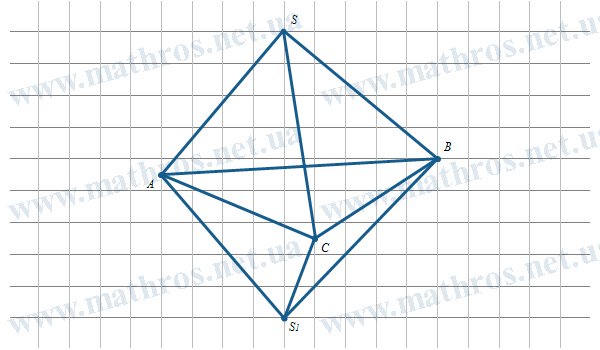
This triangular bipyramid has 6 triangular faces, 9 edges and 5 vertices.
Example 4: Find the volume of a pyramid if its height is 5 cm and the triangular base is 4 cm long and 3 cm high.
First, let’s lay out what we know:
- The height of the pyramid (h) is 5 cm;
- The base length (b) of the triangular base is 4 cm;
- The height (a) of the triangular base is 3 cm.
To find the volume of our triangular pyramid, we use the formula:

Plugging in our values, we get:

Now, let’s do the math:
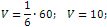
So, the volume of our triangular pyramid is 10 cubic centimeters (cm3). Isn’t it amazing how a few simple numbers can help us find the volume of such a fascinating shape? Now you can impress your friends with your geometric prowess!
Example 5: Find the side of the base of the regular triangular pyramid SABC, if SB=5 cm and SO=3 cm.
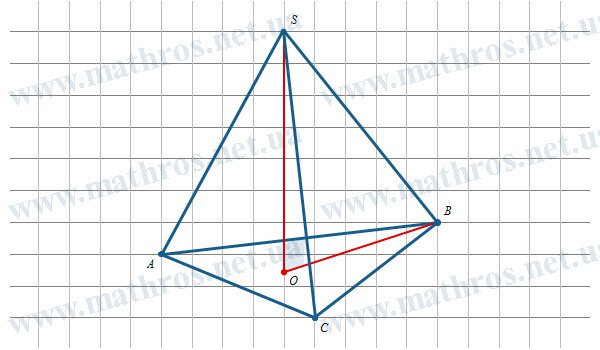
First, let’s take a closer look at triangle SOB. Since SO is the height, we’re dealing with a right-angled triangle here. Remember the Pythagorean theorem from school? It states that in a right-angled triangle, the square of the hypotenuse is equal to the sum of the squares of the other two sides. Let’s use that!
We need to find OB. According to the Pythagorean theorem, we have:

Plugging in the values, it becomes:

So, OB is 4 cm. Easy, right?
Now, here’s the cool part. Because our pyramid is regular, OB is actually the radius of the circle inscribed around the base triangle ABC. We can use this radius to find the side of the base.
Using the formula for the radius R of a circle inscribed around an equilateral triangle:

We substitute R=4:

Solving for AB, the side of the base, we get:

So, the side of the base of our regular triangular pyramid is approximately 6.928 cm. Isn’t it fascinating how we can use a simple theorem to solve this?
Deeper into the Geometry of the Triangular Pyramid: Consider Even More Aspects!
Want to learn more about the tricot pyramid? Check out these pages:
- Height of a Triangular Pyramid – Formulas and examples to better understand the height.
- Surface Area of a Triangular Pyramid – More formulas and examples to master the surface area.
- Volume of a Triangular Pyramid – Detailed formulas and examples for calculating volume.