When it comes to solving quadratic equations, the discriminant method is what most people know. But did you know there’s a quicker way? There’s a fantastic technique that helps you find the roots of an equation without diving into complex discriminant calculations. This approach is known as Vieta’s Theorem, and today, we’ll explore it in detail.
Understanding Vieta’s Theorem: Let’s Begin with the Basics!
So, how can we use Vieta’s Theorem to solve quadratic equations? First, we need to get familiar with a concept called the reduced quadratic equation. This is a quadratic equation where the coefficient in front of the x2 term equals one. In other words, it’s an equation of the form:

But what if x2 is multiplied by a number other than one? In that case, you can make the equation “reduced” by dividing all the terms by that number. This trick works because in quadratic equations, the leading coefficient is never zero, so dividing the equation won’t change its fundamental nature.
Vieta’s Theorem: What’s the Magic Behind These Simple Formulas?
Now that we’ve covered reduced quadratic equations, let’s dive into the core of Vieta’s Theorem. Imagine the roots of your quadratic equation x2+b⋅x+c=0 are x1 and x2. Vieta’s Theorem tells us that these roots are connected by two simple relationships:

These are known as Vieta’s formulas. They’re not just theoretical—they actually work, and we can prove it!
Why Do Vieta’s Formulas Work? Let’s Prove It!
Let’s break down why these formulas hold true. We can calculate the roots of a quadratic equation using the discriminant method and then check if Vieta’s relationships are valid. Assume the quadratic equation is already reduced, meaning a=1. Using the well-known formula for roots, we get:

And there you have it! Vieta’s formulas are not just a trick; they are mathematically solid.
Using Vieta’s Theorem to Check Your Work
Now that we know Vieta’s Theorem works, how can it help in solving problems? One practical use is checking if the roots you found are correct. If either of Vieta’s formulas doesn’t hold, it means one or both of your roots are wrong. This becomes especially handy when working on complex problems where the quadratic equation is just one piece of the puzzle.
Inverse Vieta’s Theorem: Finding Roots From Their Sum and Product
Here’s another cool thing about Vieta’s Theorem—it works in reverse! If you know the sum and product of the roots, you can use Inverse Vieta’s Theorem to find the roots themselves. This inverse theorem says that if the numbers b and c satisfy the relationships:
then x1 and x2 are the roots of the equation x2+b⋅x+c=0.
Proving the Inverse of Vieta’s Theorem
To prove the inverse, let’s express one root in terms of the other and substitute it back into the equation. If we express x2 as:

and substitute this into the second formula, we get:

which simplifies to:

This shows that x1 is a root of the equation, and by symmetry, x2 must also be a root. So, the inverse theorem holds!
Vieta’s Theorem in Action: Examples to Guide You
Now that we’ve covered the theory, let’s apply Vieta’s Theorem to solve some quadratic equations.
Example 1: Solve x2+12⋅x+11=0

Using Vieta’s formulas, the sum of the roots is -12, and the product is 11. This gives us the system:

It’s easy to guess that the roots are x1=-1 and x2=-11.
Example 2: Solve 5⋅x2-40⋅x+60=0
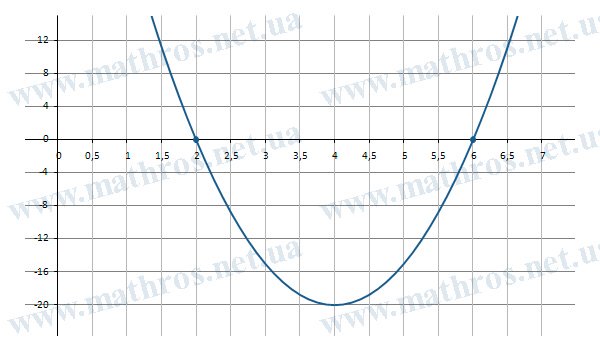
Here, the equation isn’t reduced, so we divide everything by 5:

Now, Vieta’s Theorem tells us the sum of the roots is 8, and the product is 12. The roots are x1=2 and x2=6.
Example 3: Solve 9⋅x2-50⋅x+50=0
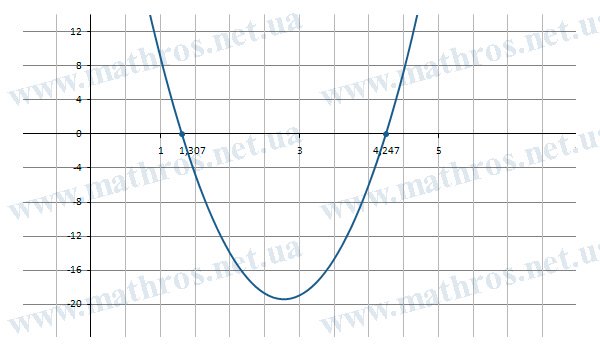
Again, we reduce the equation by dividing by 9:

Since the coefficients are fractional, it’s better to use the discriminant to calculate the roots:

Using the quadratic formula, we find:

By checking with Vieta’s Theorem, we confirm that these roots are correct.

What’s Next? Exploring Vieta’s Theorem for Cubic Equations
Now that you’re comfortable with quadratic equations, why not take it up a notch? Vieta’s Theorem doesn’t stop at quadratic equations—it can also be applied to cubic equations! This opens up even more possibilities for solving challenging problems.
If you’re ready to dive deeper into the world of equations, here’s something worth exploring next:
Boost Your Coding Skills: Implementing Vieta’s Theorem in a Program
Do you enjoy coding? Imagine combining your programming skills with mathematical problem-solving! Vieta’s Theorem is an excellent way to bridge both worlds, allowing you to create a program that can swiftly calculate the roots of quadratic equations. With just a few simple steps, you can transform the theorem into a practical tool.
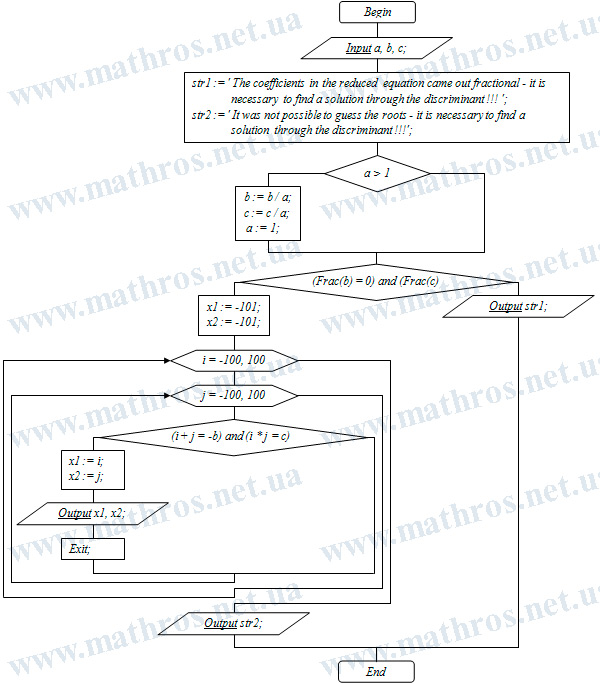
By following a basic flowchart, you can write a program that performs the calculations based on Vieta’s formulas. It’s a great way to not only practice coding but also deepen your understanding of math. So, why not take on this challenge? Create your own program and see just how easy it is to solve quadratic equations using Vieta’s Theorem! This exercise is a fantastic way to improve both your mathematical and programming skills at the same time.