The derivative is one of the key concepts in calculus. However, finding it by using the definition every time is not very convenient. That is why, in practical calculations, we use differentiation rules and a special reference block called the table of derivatives. They help us find derivatives of composite expressions, sums, products, quotients, and basic elementary functions more quickly. How should we work correctly? First, it is useful to determine the structure of the function, and only then choose the right rule or formula.
Differentiation Rules: How to Work with Different Types of Functions
Let’s start with the main idea. If a function consists of several parts, we usually find its derivative by using ready-made rules instead of returning to the definition. This makes the work much easier. After all, why return to limits every time if we already have proven formulas?
Basic Differentiation Rules
The simplest rule concerns a constant value. If \( C \) is a constant, then its derivative is equal to zero:
\[
(C)’=0.
\]
This means that a constant value does not change, so the rate of its change is also equal to zero.
Next, let’s consider the sum and difference of functions. If the functions \( u(x) \), \( v(x) \), and \( z(x) \) are differentiable at some point \( x \), then their algebraic sum is also differentiable. In this case, the derivative of a sum or difference is equal to the sum or difference of the derivatives:
\[
(u(x)\pm v(x)\pm z(x))’=u'(x)\pm v'(x)\pm z'(x).
\]
In other words, each part of the expression can be differentiated separately. This is very convenient when a function has the form of a sum of several simpler functions.
For example, if we need to find the derivative of the function \( f(x)=x^3+\sin(x)-5 \), we differentiate \( x^3 \) separately, \( \sin(x) \) separately, and the constant \( -5 \) gives zero. So, in this case, the sum rule is exactly what we use.
Rules for a Product and a Quotient
The next important rule is the derivative of a product. If the functions \( u(x) \) and \( v(x) \) are differentiable at the point \( x \), then the derivative of their product is calculated as follows:
\[
(u(x)\cdot v(x))’=u'(x)\cdot v(x)+u(x)\cdot v'(x).
\]
Notice that we cannot simply multiply the derivatives. That is, in general,
\[
(u(x)\cdot v(x))’\neq u'(x)\cdot v'(x).
\]
That is why the product formula should be remembered well.
A separate useful case is multiplying a function by a constant. If \( C \) is a constant, then
\[
(C\cdot v(x))’=C\cdot v'(x).
\]
So, a constant factor can be taken outside the derivative sign.
Now let’s move on to the quotient. If the functions \( u(x) \) and \( v(x) \) are differentiable at the point \( x \), and \( v(x)\neq 0 \), then the derivative of the quotient has the following form:
\[
\left(\frac{u(x)}{v(x)}\right)’=
\frac{u'(x)\cdot v(x)-u(x)\cdot v'(x)}{\bigl(v(x)\bigr)^2}.
\]
This formula looks a little longer, but its logic is simple: first, we take the derivative of the numerator and multiply it by the denominator. Then we subtract the numerator multiplied by the derivative of the denominator. The denominator contains the square of the original denominator.
For example, if the numerator is a constant, that is, we have the expression \( \frac{C}{v(x)} \), then the formula becomes simpler:
\[
\left(\frac{C}{v(x)}\right)’=
-\frac{C\cdot v'(x)}{\bigl(v(x)\bigr)^2}.
\]
And if the denominator is a constant, that is, we have \( \frac{u(x)}{C} \), then the derivative is equal to
\[
\frac{u'(x)}{C}.
\]
This once again shows that before differentiating, it is useful to look carefully at the structure of the function.
Derivative of a Composite Function
It is also important to consider a composite function separately. Why is this so important? Because in calculus, we often meet expressions where one function is “inside” another. For example, these may be functions such as \( \ln(x^2+1) \), \( \sin(3\cdot x) \), and \( (2\cdot x+5)^4 \).
In such cases, we use the rule for the derivative of a composite function. If the function \( g(x) \) is differentiable at the point \( x \), and the function \( f \) is differentiable at the point \( g(x) \), then the derivative of the composite function \( f(g(x)) \) is found by the formula:
\[
(f(g(x)))’=f'(g(x))\cdot g'(x).
\]
What does this mean in simple words? First, we take the derivative of the outer function without changing the inner function. Then we must multiply the result by the derivative of the inner function.
For example, in the function \( \ln(x^2+1) \), the outer function is the logarithmic function, and the inner function is \( x^2+1 \). Therefore, it is not enough to find \( (\ln(x^2+1))’ \) as the derivative of an ordinary logarithmic function. We also need to take into account the derivative of the inner function \( x^2+1 \).
Table of Derivatives: Basic Formulas for Elementary Functions
After studying differentiation rules, it is natural to move on to the table of derivatives. Why is it so important? Because the rules show how to differentiate a compound expression, while the table tells us what derivative each elementary function has.
For example, the sum rule allows us to split an expression into parts. But to complete the calculation, we need to know what the derivative of \( x^n \), \( \sin(x) \), \( \ln(x) \), \( e^x \), and other functions is equal to. This is exactly why we use the table.
| Function | Derivative |
|---|---|
| \( C,\ C\in\mathbb{R} \) | \( (C)’=0 \) |
| \( x^n \) | \( (x^n)’=n\cdot x^{n-1} \) |
| \( \sqrt{x} \) | \( (\sqrt{x})’=\frac{1}{2\cdot\sqrt{x}} \) |
| \( \frac{1}{x} \) | \( \left(\frac{1}{x}\right)’=-\frac{1}{x^2} \) |
| \( \sin(x) \) | \( (\sin(x))’=\cos(x) \) |
| \( \cos(x) \) | \( (\cos(x))’=-\sin(x) \) |
| \( \tan(x) \) | \( (\tan(x))’=\frac{1}{\cos^2(x)} \) |
| \( \cot(x) \) | \( (\cot(x))’=-\frac{1}{\sin^2(x)} \) |
| \( a^x \) | \( (a^x)’=a^x\cdot\ln(a) \) |
| \( e^x \) | \( (e^x)’=e^x \) |
| \( \ln(x) \) | \( (\ln(x))’=\frac{1}{x} \) |
| \( \log_a(x) \) | \( (\log_a(x))’=\frac{1}{x\cdot\ln(a)} \) |
| \( \arcsin(x) \) | \( (\arcsin(x))’=\frac{1}{\sqrt{1-x^2}} \) |
| \( \arccos(x) \) | \( (\arccos(x))’=-\frac{1}{\sqrt{1-x^2}} \) |
| \( \arctan(x) \) | \( (\arctan(x))’=\frac{1}{1+x^2} \) |
| \( \operatorname{arccot}(x) \) | \( (\operatorname{arccot}(x))’=-\frac{1}{1+x^2} \) |
So, when differentiating, it is worth working step by step. First, we determine what we have in front of us: a sum, a difference, a product, a quotient, a composite function, or an expression with a constant. Then we apply the appropriate rule. And only after that do we use the necessary formula from the table of derivatives.
Also, let’s not forget about preliminary transformations. Sometimes an expression can be simplified even before differentiation. For example, a fraction can be reduced, powers can be combined, and parentheses can be expanded. Isn’t it easier to make the expression simpler first and only then find the derivative? This approach often helps avoid unnecessary calculations and mistakes.
Differentiation Rules for Functions and the Table of Derivatives: Practical Use of Formulas
Now let’s move on to practice. After all, differentiation eules become truly clear when we apply them to specific examples. We will work step by step: first, we determine the structure of the function, then choose the rule, and after that use the table of derivatives.
Example 1. Find the derivative of the function \( f(x)=x^5-3\cdot x^2+7\cdot x-10 \)
We have an algebraic sum of several terms. So, first, we apply the rule for the derivative of a sum and difference. This means that each term can be differentiated separately:
\[
f'(x)=(x^5)’-(3\cdot x^2)’+(7\cdot x)’-(10)’.
\]
Now let’s use the table of derivatives. For a power function, we have the formula \( (x^n)’=n\cdot x^{n-1} \). We also remember that the derivative of a constant is equal to zero.
Then:
\[
\begin{gathered}
(x^5)’=5\cdot x^4,
\\[4pt]
(3\cdot x^2)’=3\cdot (x^2)’=3\cdot 2\cdot x=6\cdot x,
\\[4pt]
(7\cdot x)’=7,
\\[4pt]
(10)’=0.
\end{gathered}
\]
Therefore,
\[
f'(x)=5\cdot x^4-6\cdot x+7.
\]
Example 2. Find the derivative of the function \( f(x)=(x^2+1)\cdot \sin(x) \)
Here the function is a product of two expressions. The first factor is \( x^2+1 \), and the second factor is \( \sin(x) \). So, we need to use the product rule:
\[
(u(x)\cdot v(x))’=u'(x)\cdot v(x)+u(x)\cdot v'(x).
\]
Let \( u(x)=x^2+1 \), and \( v(x)=\sin(x) \). Then:
\[
\begin{gathered}
u'(x)=(x^2+1)’=2\cdot x,
\\[4pt]
v'(x)=(\sin(x))’=\cos(x).
\end{gathered}
\]
Now substitute these derivatives into the product rule:
\[
f'(x)=2\cdot x\cdot \sin(x)+(x^2+1)\cdot \cos(x).
\]
Therefore, the derivative is:
\[
f'(x)=2\cdot x\cdot \sin(x)+(x^2+1)\cdot \cos(x).
\]
Example 3. Find the derivative of the function \( f(x)=\frac{x^3+2\cdot x}{x^2+1} \)
We have a quotient of two functions. So, we use the quotient rule:
\[
\left(\frac{u(x)}{v(x)}\right)’=
\frac{u'(x)\cdot v(x)-u(x)\cdot v'(x)}{\bigl(v(x)\bigr)^2}.
\]
Let the numerator be \( u(x) \), and the denominator be \( v(x) \):
\[
\begin{gathered}
u(x)=x^3+2\cdot x,
\\[4pt]
v(x)=x^2+1.
\end{gathered}
\]
Now let’s find their derivatives. For the numerator, we get:
\[
u'(x)=(x^3+2\cdot x)’=3\cdot x^2+2.
\]
For the denominator:
\[
v'(x)=(x^2+1)’=2\cdot x.
\]
Substitute everything into the quotient rule:
\[
f'(x)=
\frac{(3\cdot x^2+2)\cdot (x^2+1)-(x^3+2\cdot x)\cdot 2\cdot x}{(x^2+1)^2}.
\]
Next, simplify the numerator. First, expand the first product:
\[
(3\cdot x^2+2)\cdot (x^2+1)=3\cdot x^4+3\cdot x^2+2\cdot x^2+2=3\cdot x^4+5\cdot x^2+2.
\]
Now expand the second product:
\[
(x^3+2\cdot x)\cdot 2\cdot x=2\cdot x^4+4\cdot x^2.
\]
Therefore, the numerator is equal to:
\[
3\cdot x^4+5\cdot x^2+2-(2\cdot x^4+4\cdot x^2)=x^4+x^2+2.
\]
So, finally, we have:
\[
f'(x)=\frac{x^4+x^2+2}{(x^2+1)^2}.
\]
Example 4. Find the derivative of the function \( f(x)=\ln(x^2+1) \)
We have a composite function. The outer function is the natural logarithm, and the inner function is \( x^2+1 \). So, here we need to use the chain rule:
\[
(f(g(x)))’=f'(g(x))\cdot g'(x).
\]
Let the inner function be:
\[
g(x)=x^2+1.
\]
Then the given function can be viewed as \( \ln(g(x)) \). From the table of derivatives, we know that \( (\ln(x))’=\frac{1}{x} \). But since under the logarithm we have not just \( x \), but the expression \( x^2+1 \), we also need to multiply by the derivative of the inner function.
Find the derivative of the inner function:
\[
g'(x)=(x^2+1)’=2\cdot x.
\]
Now apply the chain rule:
\[
f'(x)=\frac{1}{x^2+1}\cdot 2\cdot x.
\]
Therefore,
\[
f'(x)=\frac{2\cdot x}{x^2+1}.
\]
Example 5. Find the derivative of the function \( f(x)=\frac{x^2-1}{x} \)
At first glance, we have a quotient. So, we could immediately apply the quotient rule. But is this always the most convenient way? No. Sometimes it is better to simplify the function before differentiating.
Divide each term in the numerator by \( x \):
\[
\frac{x^2-1}{x}=\frac{x^2}{x}-\frac{1}{x}.
\]
Therefore,
\[
f(x)=x-\frac{1}{x}.
\]
Now the function has become much simpler. Let’s apply the rule for the derivative of a difference:
\[
f'(x)=(x)’-\left(\frac{1}{x}\right)’.
\]
According to the table of derivatives, \( (x)’=1 \), and \( \left(\frac{1}{x}\right)’=-\frac{1}{x^2} \). Then:
\[
f'(x)=1-\left(-\frac{1}{x^2}\right).
\]
Therefore,
\[
f'(x)=1+\frac{1}{x^2}.
\]
The Next Step in Differentiation: Topics for Further Study
After studying differentiation rules and the table of derivatives, it is worth moving on to topics where the derivative is found in a less standard way. This is exactly where we can clearly see how basic formulas work in more complex situations. So, what should we consider next?
- Derivative of an Implicitly Defined Function: Differentiation Without an Explicit Expression — This article will explain how to find a derivative when a function is given by an equation, and the required variable is not expressed explicitly.
- Derivative of a Parametrically Defined Function: Working with an Auxiliary Parameter — This topic will explain how to find a derivative when the coordinates depend not on each other, but on a common parameter.
- Logarithmic Differentiation: A Convenient Method for Complex Expressions — This article will show how logarithms help simplify the differentiation of products, quotients, and power expressions.
Differentiation Rules and Table of Derivatives: An Algorithm for Your Own Code
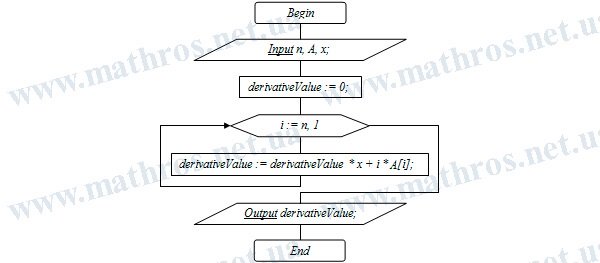
If you are interested in programming, try turning your knowledge of derivatives into a small practical project. The flowchart below shows an algorithm that finds the value of the derivative of a polynomial at a given point: the program takes the degree, the coefficients, and the value of \( x \), and then calculates the result.
This is a great opportunity to see how differentiation rules and the table of derivatives work not only on paper, but also in code. Implement this algorithm in Pascal, Python, JavaScript, C++, or any other language you like. Isn’t it interesting to make a mathematical formula work like a real computational tool?