The derivative of the natural logarithm is one of the basic topics in mathematical analysis that is important not only to memorize, but also to truly understand. It appears very often when studying functions, finding derivatives of more complicated expressions, and solving practical problems. That is why it is useful to see not only the final formula, but also the sequence of steps that leads to it.
In this article, we will look at the main formula, its derivation from the definition of the derivative, and several examples with detailed solutions. First, let us focus on the theoretical part, and then move on to practical applications.
Derivative of the Natural Logarithm: What You Need to Know First
Let us start with the main point. For the function \( y=\ln(x) \), its derivative is
\[
\frac{d}{dx}\bigl(\ln(x)\bigr)=\bigl(\ln(x)\bigr)’=\frac{1}{x}, \quad x>0.
\]
This is the formula you need to know well. At the same time, it is worth not only remembering it, but also interpreting it correctly. A derivative shows how fast a function changes at each point. So, for the natural logarithm at the point \( x \), the value of the derivative is \( \frac{1}{x} \).
What does this mean in practice? If \( x \) is positive and very small, then the value of \( \frac{1}{x} \) is large. Because of this, in that part of the graph the function increases quite quickly. If \( x \) becomes larger, then the value of \( \frac{1}{x} \) becomes smaller. As a result, the function \( \ln(x) \) still increases, but more slowly. So, the logarithm does not decrease on its domain, but its growth gradually slows down.
It is also important to pay attention right away to the condition \( x>0 \). This condition is not accidental. The reason is that the function \( \ln(x) \) is defined only for positive values of the argument. Therefore, the formula for its derivative is considered exactly on the interval \( (0; +\infty) \).
The graph of the function and the graph of its derivative clearly show how this formula works. Since \( \frac{1}{x}>0 \) for all \( x>0 \), we immediately see that the function \( \ln(x) \) increases on its entire domain. In addition, the value of \( \frac{1}{x} \) decreases as \( x \) grows. And this explains why the graph of the logarithm gradually becomes less steep.
Below is an image of the graph of the function \( \ln(x) \) and its derivative.
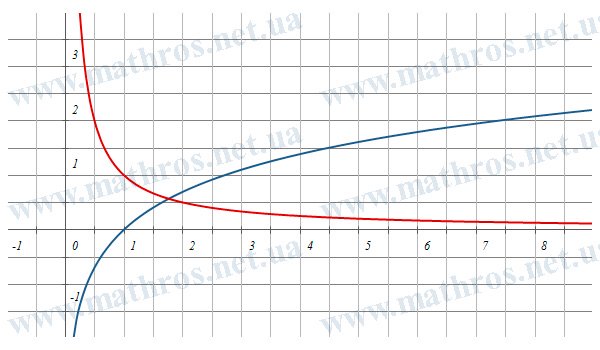
So, even at this stage, we see not just a short formula, but a real connection between the formula and the behavior of the function. This is especially useful for further study of the topic, because later the natural logarithm will often appear inside more complicated expressions, where this basic formula is essential.
Deriving the Formula: How to Get It from the Definition of the Derivative
Now let us move on to the proof. This is exactly where it becomes clear that the formula
\[
\frac{d}{dx}\bigl(\ln(x)\bigr)=\frac{1}{x}
\]
is not just some random statement that has to be memorized. On the contrary, it follows naturally from the definition of the derivative and the properties of the logarithm.
Let \( y=\ln(x) \). Then, by the definition of the derivative, we have
\[
\frac{d}{dx}\bigl(\ln(x)\bigr)=\lim_{h\to 0}\frac{\ln(x+h)-\ln(x)}{h}.
\]
At this step, we need to use a property of logarithms: the difference of two logarithms is equal to the logarithm of the quotient. That is,
\[
\ln(a)-\ln(b)=\ln\bigl(\frac{a}{b}\bigr).
\]
So we can rewrite the numerator as
\[
\ln(x+h)-\ln(x)=\ln\bigl(\frac{x+h}{x}\bigr).
\]
Next, we have
\[
\ln\left(\frac{x+h}{x}\right)=\ln\left(1+\frac{h}{x}\right).
\]
Therefore, the expression for the derivative takes the form
\[
\frac{d}{dx}\bigl(\ln(x)\bigr)=\lim_{h\to 0}\frac{\ln\left(1+\frac{h}{x}\right)}{h}.
\]
Now it is convenient to make a substitution. Let
\[
t=\frac{h}{x}.
\]
Then
\[
h=x\cdot t.
\]
Since \( h\to 0 \), and \( x \) is treated as a fixed number, it follows that \( t\to 0 \) as well. After this substitution, we get
\[
\frac{d}{dx}\bigl(\ln(x)\bigr)=\lim_{t\to 0}\frac{\ln(1+t)}{x\cdot t}.
\]
Now we can take the factor \( \frac{1}{x} \) outside the limit:
\[
\frac{d}{dx}\bigl(\ln(x)\bigr)=\frac{1}{x}\cdot \lim_{t\to 0}\frac{\ln(1+t)}{t}.
\]
And this is exactly where one of the basic limits of mathematical analysis appears:
\[
\lim_{t\to 0}\frac{\ln(1+t)}{t}=1.
\]
This limit is usually studied as a separate important result, and it is often used in topics related to logarithmic and exponential functions. So, at this stage, we rely on a fact that is already known from the course. Substituting it into the previous expression, we obtain
\[
\frac{d}{dx}\bigl(\ln(x)\bigr)=\frac{1}{x}\cdot 1=\frac{1}{x}.
\]
So, the formula has been derived:
\[
\frac{d}{dx}\bigl(\ln(x)\bigr)=\frac{1}{x}, \quad x>0.
\]
Now it is useful to briefly summarize the logic of the proof. First, we wrote the derivative using its definition. Then we applied a logarithm property to combine the difference into a single logarithm. After that, we made a substitution that allowed us to isolate a standard limit. That is exactly how, step by step, we arrived at the formula we needed.
This approach is important in the learning process because it shows the full chain of steps. You see not only the final answer, but also why it is correct. And that is especially valuable when you later need to find derivatives of more complicated logarithmic expressions, where simply remembering one short formula is no longer enough.
Derivative of the Natural Logarithm: Solved Examples
After the theoretical discussion, it is natural to move on to calculations in specific expressions. It is in practice that we most clearly see how the natural logarithm combines with polynomials, trigonometric functions, and fractions, and also when we need to apply the product rule, quotient rule, or chain rule. So next, let us look at several typical examples and follow the full solution step by step.
Example 1. Find the derivative of the function \( y=\ln(3 \cdot x^2+1)\cdot x \)
Here we have a product of two functions: \( \ln(3 \cdot x^2+1) \) and \( x \). So, we apply the product rule:
\[
y’=\bigl(\ln(3 \cdot x^2+1)\bigr)’\cdot x+\ln(3 \cdot x^2+1)\cdot (x)’.
\]
The second term is found immediately, because \( (x)’=1 \). So it is simply equal to \( \ln(3 \cdot x^2+1) \).
Now let us find \( \bigl(\ln(3 \cdot x^2+1)\bigr)’ \). This is a composite function. The outer part is the natural logarithm, and the inner part is the expression \( 3 \cdot x^2+1 \). Let us denote
\[
u=3 \cdot x^2+1.
\]
Then
\[
\frac{d}{dx}\bigl(\ln(x)\bigr)=\frac{1}{u}\cdot \frac{du}{dx}.
\]
The derivative of the inner expression is
\[
\frac{du}{dx}=(3 \cdot x^2+1)’=6 \cdot x.
\]
Therefore,
\[
\bigl(\ln(3 \cdot x^2+1)\bigr)’=\frac{1}{3 \cdot x^2+1}\cdot 6 \cdot x=\frac{6 \cdot x}{3 \cdot x^2+1}.
\]
Now let us go back to the product rule:
\[
y’=\frac{6 \cdot x}{3 \cdot x^2+1}\cdot x+\ln(3 \cdot x^2+1).
\]
Now we multiply in the first term. So,
\[
y’=\frac{6 \cdot x^2}{3 \cdot x^2+1}+\ln(3 \cdot x^2+1).
\]
Example 2. Find the derivative of the function \( y=\dfrac{\ln(2 \cdot x-1)}{x^2+4} \)
Here we have a quotient, so we apply the quotient rule. Let
\[
u=\ln(2 \cdot x-1),\quad v=x^2+4.
\]
Then
\[
y’=\frac{u’\cdot v-u\cdot v’}{v^2}.
\]
First, let us find the derivative of the denominator:
\[
v’=(x^2+4)’=2 \cdot x.
\]
Now let us move to the numerator. We need to find \( u’=\bigl(\ln(2 \cdot x-1)\bigr)’ \). Again, this is a composite function. Let us denote
\[
t=2 \cdot x-1.
\]
Then
\[
u’=\frac{1}{t}\cdot \frac{dt}{dx}.
\]
The derivative of the inner expression is
\[
\frac{dt}{dx}=(2 \cdot x-1)’=2.
\]
Therefore,
\[
u’=\frac{1}{2 \cdot x-1}\cdot 2=\frac{2}{2 \cdot x-1}.
\]
Now we substitute everything into the formula for the derivative of a quotient:
\[
y’=\frac{\frac{2}{2 \cdot x-1}\cdot (x^2+4)-\ln(2 \cdot x-1)\cdot 2 \cdot x}{(x^2+4)^2}.
\]
So,
\[
y’=\frac{\frac{2 \cdot (x^2+4)}{2 \cdot x-1}-2 \cdot x \cdot \ln(2 \cdot x-1)}{(x^2+4)^2}.
\]
Example 3. Find the derivative of the function \( y=\ln(x^3-5 \cdot x+2) \)
This is a composite function where the outer part is the natural logarithm, and the inner part is the polynomial \( x^3-5 \cdot x+2 \). So here the chain rule applies.
Let us denote
\[
u=x^3-5 \cdot x+2.
\]
Then
\[
\frac{dy}{dx}=\frac{1}{u}\cdot \frac{du}{dx}.
\]
The derivative of the inner part is
\[
\frac{du}{dx}=(x^3-5 \cdot x+2)’=3 \cdot x^2-5.
\]
Now we substitute this into the formula:
\[
y’=\frac{1}{x^3-5 \cdot x+2}\cdot (3 \cdot x^2-5).
\]
Therefore,
\[
y’=\frac{3 \cdot x^2-5}{x^3-5 \cdot x+2}.
\]
In this example, it is especially important not to forget the derivative of the inner expression. The natural logarithm by itself gives the factor \( \frac{1}{u} \), but the calculation does not end there. After that, you must multiply by the derivative of what is inside the logarithm.
Example 4. Find the derivative of the function \( y=\ln(x^2+1)\cdot \sin(x) \)
Again, we have a product, so we use the product rule. Let
\[
u=\ln(x^2+1),\quad v=\sin(x).
\]
Then
\[
y’=u’\cdot v+u\cdot v’.
\]
The derivative of \( v=\sin(x) \) is well known:
\[
v’=\cos(x).
\]
Now let us find \( u’=\bigl(\ln(x^2+1)\bigr)’ \). Let us denote
\[
t=x^2+1.
\]
Then
\[
u’=\frac{1}{t}\cdot \frac{dt}{dx}.
\]
The derivative of the inner expression is
\[
\frac{dt}{dx}=(x^2+1)’=2 \cdot x.
\]
Therefore,
\[
u’=\frac{1}{x^2+1}\cdot 2 \cdot x=\frac{2 \cdot x}{x^2+1}.
\]
Now we substitute everything into the product rule:
\[
y’=\frac{2 \cdot x}{x^2+1}\cdot \sin(x)+\ln(x^2+1)\cdot \cos(x).
\]
So,
\[
y’=\frac{2 \cdot x \cdot \sin(x)}{x^2+1}+\ln(x^2+1) \cdot \cos(x).
\]
Here it is worth paying attention to one thing. In examples like this, it is easy to focus only on the logarithm and accidentally forget the derivative of the second factor. That is why it is helpful to first clearly split the expression into \( u \) and \( v \), and only then find each derivative one by one.
Example 5. Find the derivative of the function \( y=\ln(2 \cdot x+3)\cdot \cos(4 \cdot x) \)
Here we also have a product, but now both factors require careful attention. The first is a composite function with a natural logarithm, and the second is a trigonometric function with a composite argument. It is exactly in expressions like this that it becomes especially important not to lose any factor.
Let us denote
\[
u=\ln(2 \cdot x+3),\quad v=\cos(4 \cdot x).
\]
Then
\[
y’=u’\cdot v+u\cdot v’.
\]
Let us start with the second factor. For \( v=\cos(4 \cdot x) \), we have
\[
v’=-\sin(4 \cdot x)\cdot 4=-4 \cdot \sin(4 \cdot x).
\]
Now let us find \( u’=\bigl(\ln(2 \cdot x+3)\bigr)’ \). Let us denote
\[
t=2 \cdot x+3.
\]
Then
\[
u’=\frac{1}{t}\cdot \frac{dt}{dx}.
\]
The derivative of the inner expression is
\[
\frac{dt}{dx}=2.
\]
Therefore,
\[
u’=\frac{1}{2 \cdot x+3}\cdot 2=\frac{2}{2 \cdot x+3}.
\]
Now let us return to the product rule:
\[
y’=\frac{2}{2 \cdot x+3}\cdot \cos(4 \cdot x)+\ln(2 \cdot x+3)\cdot \bigl(-4 \cdot \sin(4 \cdot x)\bigr).
\]
So,
\[
y’=\frac{2 \cdot \cos(4 \cdot x)}{2 \cdot x+3}-4 \cdot \ln(2 \cdot x+3) \cdot \sin(4 \cdot x).
\]
Next Steps: Topics Worth Studying Further
After the topic of the natural logarithm, it is quite natural to move on to related derivatives that often appear in problems from mathematical analysis. These materials will help you better see how similar rules work in new expressions and how they are used when solving examples.
- Derivative of Natural Logarithm Squared: Formula, Proof, Examples — This article will discuss the derivative of a composite logarithmic expression, its derivation, and step-by-step solutions to typical problems.
- Derivative of the Exponential Function: Formula, Proof, Examples — Here it will be shown how to differentiate the exponential function, why its derivative has a special role, and how to use it in examples.
- Derivative of Square Root: Formula, Proof, Examples — This material will look at the derivative of a power function with a fractional exponent and its use in different expressions.
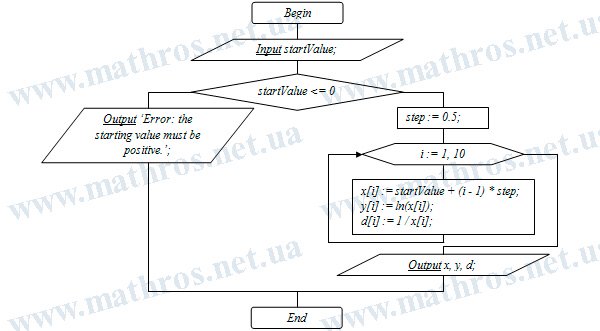
Derivative of the Natural Logarithm: From Flowchart to Program
After discussing the formula, the proof, and practical examples, it is quite appropriate to move to one more interesting level — software implementation. If you enjoy programming, try taking the ready-made flowchart from this section. Then recreate it on your own in your favorite programming language. In this way, you will better understand how the calculations for the natural logarithm and its derivative work, and you will also see how a mathematical idea turns into a sequence of clear commands, checks, and calculations.