The area of a pentagon refers to the region enclosed by all five of its sides. A pentagon is a two-dimensional geometric shape with five sides. The name comes from the Greek words “penta”, meaning “five”, and “gon”, meaning “angles”. In this article, we will use solved examples to guide you through the process of calculating the area of a pentagon.
Area of a Pentagon: Using the Apothem and Side
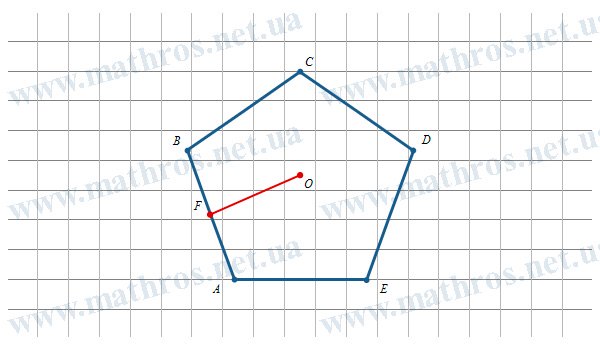
The area of a regular pentagon can be calculated using the length of its apothem and the length of one of its sides. For a pentagon \( ABCDE \), as shown below, we can use the following formula:
\[
A = \frac{5}{2} \cdot AB \cdot OF.
\]
Here, the apothem is the line segment that connects the center of the pentagon to one of its sides.
Additionally, the area of a regular pentagon can also be calculated using this formula:
\[
A = \frac{1}{4} \cdot \sqrt{5 \cdot (5 + 2 \cdot \sqrt{5})} \cdot AB^2.
\]
This formula is slightly more complex, but it allows you to calculate the area of a regular pentagon using only the length of one of its sides.
Note. To find the area of an irregular pentagon, you need to break it down into smaller polygons. Then, calculate and add the areas of those smaller polygons.
Proving the Formula by Dividing into Triangles
To prove the formula for the area of a pentagon, we use a diagram where the pentagon is divided into five isosceles triangles.
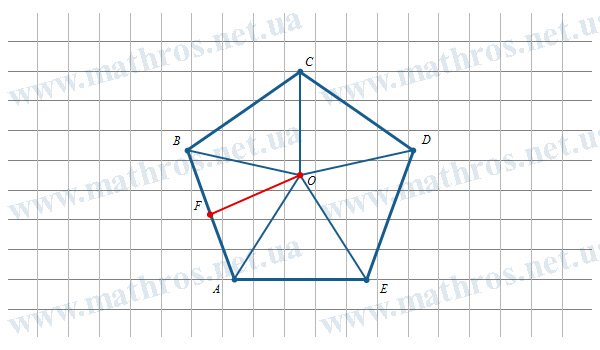
The area of any triangle is half the product of its base and the height drawn to that base. In the isosceles triangles above, the base is equal to the length of one side of the pentagon. The height of each triangle is the apothem of the pentagon. Therefore, the area of each triangle in pentagon \( ABCDE \) is:
\[
A_{AOB} = \frac{AB \cdot OF}{2}.
\]
Since there are five triangles, the total area of the pentagon is:
\[
A = 5 \cdot S_{AOB} = 5 \cdot \frac{AB \cdot OF}{2} = \frac{5}{2} \cdot AB \cdot OF.
\]
Note. If we denote the length of the side and the apothem of the pentagon by the letters \( a \) and \( h \), respectively, the area formulas can be rewritten in a more familiar form:
\[
A = \frac{5}{2} \cdot a \cdot h, \qquad A = \frac{1}{4} \cdot \sqrt{5 \cdot (5 + 2 \cdot \sqrt{5})} \cdot a^2.
\]
Area of a Pentagon: Examples with Solutions
To better understand how to calculate the area of a pentagon, let’s work through a few examples. While each example has a solution, try to perform the calculations on your own first and check your answers afterward.
Example 1. Find the area of a regular pentagon with sides measuring 10 cm and an apothem of 6.88 cm
In this case, the length of each side and the apothem of the pentagon are \( 10 \) cm and \( 6.88 \) cm, respectively. Using these values in the formula for the area, we get:
\[
A = \frac{5}{2} \cdot a \cdot h = \frac{5}{2} \cdot 10 \cdot 6.88 = 172.
\]
Therefore, the area of the pentagon is \( 172\ \text{cm}^2 \).
Example 2. What is the area of a regular pentagon with sides measuring 8 cm and an apothem of 5.51 cm?
Here, the side length and the apothem of the pentagon are \( 8 \) cm and \( 5.51 \) cm, respectively. Using these values in the formula for the area, we get:
\[
A = \frac{5}{2} \cdot a \cdot h = \frac{5}{2} \cdot 8 \cdot 5.51 = 110.2.
\]
Therefore, the area of the pentagon is \( 110.2\ \text{cm}^2 \).
Example 3. Find the apothem of a regular pentagon with an area of 84.3 cm² and side length of 7 cm
In this case, we need to find the apothem, given the area and side length of the pentagon. Using the same formula, we substitute the known values and solve for the apothem \( h \):
\[
A = \frac{5}{2} \cdot a \cdot h, \qquad 84.3 = \frac{5}{2} \cdot 7 \cdot h, \qquad 168.6 = 35 \cdot h, \qquad h = 4.82.
\]
Thus, the length of the apothem of the regular pentagon is \( 4.82 \) cm.
Example 4. Find the area of a regular pentagon with side length 5 cm
In this case, we are given only the length of the sides of the pentagon. Therefore, we can use the second formula for the area of a pentagon:
\[
A = \frac{1}{4} \cdot \sqrt{5 \cdot (5 + 2 \cdot \sqrt{5})} \cdot a^2 = \frac{1}{4} \cdot \sqrt{5 \cdot (5 + 2 \cdot \sqrt{5})} \cdot 5^2 = 43.
\]
Thus, the area of the pentagon is \( 43\ \text{cm}^2 \).
Example 5. Find the area of pentagon ABCDE with sides AB=4 cm, BC=5 cm, CD=5 cm, DE=4 cm, AE=8 cm
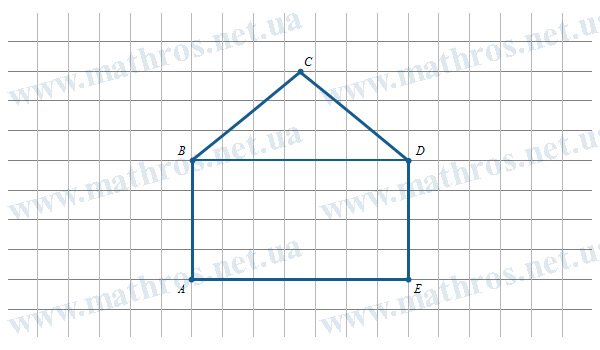
We can find the area of the pentagon by following these steps: first, divide the pentagon into triangle \( BCD \) and rectangle \( ABDE \).
Next, calculate the area of triangle \( BCD \) and the area of rectangle \( ABDE \):
- Since we know the three sides of the triangle (\( BC = 5 \) cm, \( CD =5 \) cm, \( BD = 8 \) cm), we can calculate its area using Heron’s formula. Substituting the known values into the formula:
\[
A_{BCD} = \sqrt{p \cdot (p – BC) \cdot (p – CD) \cdot (p – BD)} = \sqrt{9 \cdot (9 – 5) \cdot (9 – 5) \cdot (9 – 8)} = \sqrt{144} = 12.
\]
- The area of the rectangle is the product of its length and width. In this case, the length \( AE = 8 \) cm, and the width \( AB = 4 \) cm. Thus:
\[
A_{ABDE} = AE \cdot AB = 8 \cdot 4 = 32.
\]
Now, add the areas of the triangle and the rectangle:
\[
A = A_{BCD} + A_{ABDE} = 12 + 32 = 44.
\]
Therefore, the area of the irregular pentagon \( ABCDE \) is \( 44\ \text{cm}^2 \).
See Also: Where to Go Next?
Want to deepen your understanding of pentagons and avoid getting confused by formulas? Then these resources will be a great follow-up.
- Apothem of a Pentagon: Formulas and Examples — Learn how to find the apothem and why it is directly related to the area of a regular pentagon.
- Perimeter of a Pentagon: Formulas and Examples — Discover how to quickly calculate the perimeter using different data and check your solutions in practice.
- Interior Angles of a Polygon: Formula and Examples — We explain how to find the sum and measure of the angles in a pentagon and how to apply this in problems.
From Theory to Code: Calculating the Area of a Pentagon
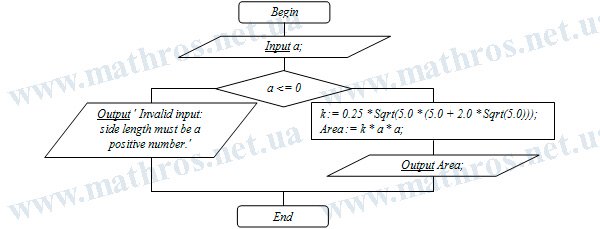
If you enjoy programming, this flowchart is a great opportunity to quickly turn a mathematical formula into a working program: choose your favorite language (Python, JavaScript, C#, Java, or any other), recreate the logic for input verification and area calculation, and then add a user-friendly output format. You’ll have your own mini calculator for the area of a regular pentagon, which can easily be expanded for use in applications or educational projects.