The diagonals of a rhombus are key segments that connect opposite vertices of this fascinating geometric figure. These diagonals make the rhombus distinct from other quadrilaterals. But what exactly should you know about them? Let’s explore the essential properties and learn how to calculate these diagonals using the most common formulas.
What Are the Diagonals of a Rhombus: Definition and Properties
Simply put, the diagonals of a rhombus are the line segments that connect its opposite vertices.
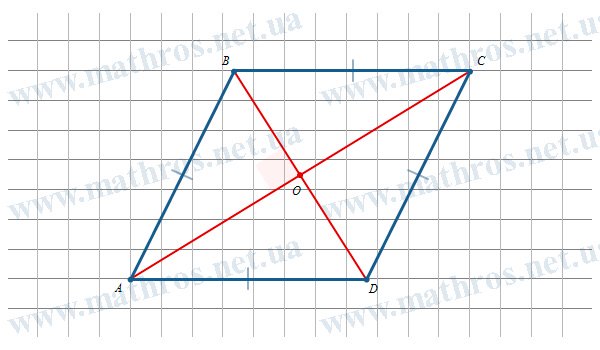
Every rhombus always has two diagonals. For example, in rhombus ABCD, the diagonals are AC and BD.
Main Properties of the Diagonals of a Rhombus
Let’s break down the key characteristics of these diagonals:
- Intersecting at a right angle (90°). This means the diagonals of a rhombus are always perpendicular to each other.
- Bisecting each other. The point of intersection divides both diagonals into two equal parts.
- Acting as angle bisectors. The diagonals divide the internal angles of the rhombus in half.
- Dividing the rhombus into four identical right triangles.
Thanks to these properties, solving problems involving the diagonals of a rhombus becomes much simpler.
How to Calculate the Length of the Diagonals of a Rhombus: Simple Formulas
To calculate the diagonals of a rhombus, you can use several simple formulas. For instance, if the side of the rhombus (AB) and one of its diagonals (AC) are known, applying the Pythagorean theorem is very helpful. Let’s see how this works.
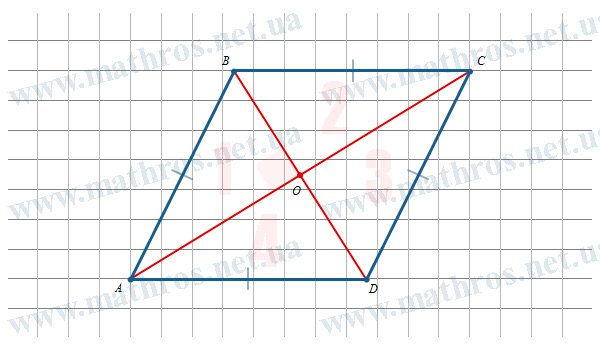
Imagine a rhombus ABCD, where diagonals AC and BD intersect at point O. Given the properties of the rhombus, we know that the diagonals bisect each other and form a right angle. Therefore, triangle ABO is a right triangle, and the Pythagorean theorem can be applied as follows:
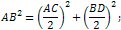
From this formula, we can easily find diagonal BD:

This method is very useful when one diagonal and the side of the rhombus are known. However, there are also two other formulas commonly used.
Diagonals of a Rhombus Through the Side and Angle
If we know the side of the rhombus and one of its internal angles, we can use the following simple formulas. Let’s assume that in rhombus ABCD, the side AB and the internal angle BAD (denoted as α) are known. Then, the diagonals of the rhombus are calculated as follows:

Why these formulas? It’s quite simple: the diagonals of the rhombus not only intersect at a right angle but also bisect the angles of the rhombus.
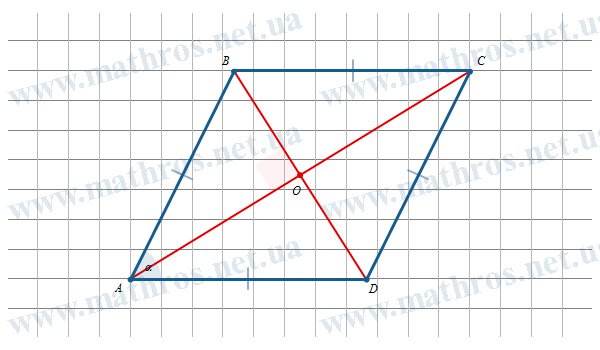
In triangle ABO, where O is the point of intersection of the diagonals, the angle BAO is half of angle BAD (i.e., α/2). This triangle is right-angled, so:
- Half of diagonal AC (segment AO) equals AB⋅sin(α/2).
- Half of diagonal BD (segment BO) equals AB⋅cos(α/2).
By doubling AO and BO, we obtain the lengths of the full diagonals AC and BD.
Diagonal of a Rhombus Through the Area
Another popular and very convenient formula connects the diagonals of a rhombus to its area. If the area (S) and one diagonal (such as AC) are known in rhombus ABCD, the second diagonal BD can easily be found using the formula:

Why is this so? Because the area of a rhombus is half the product of its diagonals:

The diagonals divide the rhombus into four equal right triangles, each with the same area. This means the area of the rhombus can easily be expressed through its diagonals. Therefore, knowing the area of the rhombus and one diagonal, we can quickly calculate the other diagonal.
As you can see, finding the length of the diagonals of a rhombus is not difficult when you know a few simple parameters.
Note: If we denote the length of the sides and diagonals of the rhombus as a, d1, and d2 respectively, the formulas we discussed can be written in the more familiar form:

Practice Finding the Diagonals of a Rhombus: Examples with Solutions for Better Understanding
Now that you’ve learned the formulas and properties of the diagonals of a rhombus, it’s time to practice applying this knowledge. Below are several interesting problems to help you solidify the information. Try to solve them yourself first, then check your answers with the provided solutions.
Example 1: Find the Length of the Diagonal of a Rhombus if Its Area is 54 cm2 and One of the Diagonals is 6 cm
We have a rhombus with one diagonal of 6 cm and an area of 54 cm2. Using the formula for calculating the unknown diagonal based on the area:

Thus, the second diagonal is 18 cm long.
Example 2: One of the Diagonals of the Rhombus is 16 cm, and Its Side is 10 cm. What is the Length of the Other Diagonal?
Given that the side (a) of the rhombus is 10 cm and one diagonal (d1) is 16 cm, we can use the Pythagorean theorem to find the second diagonal:

Thus, the second diagonal is 12 cm long.
Example 3: The Perimeter of the Rhombus is 100 cm, and One of Its Diagonals is 40 cm. What is the Length of the Other Diagonal?
The perimeter of the rhombus is 100 cm, and since all sides are equal, the length of one side is 100/4=25 cm. Now, using the Pythagorean theorem, we find the second diagonal:

Thus, the second diagonal is 30 cm long.
Example 4: The Area of the Rhombus is 48 cm2, and One of the Diagonals is 12 cm. Find the Length of the Other Diagonal
We know the area of the rhombus is 48 cm2, and one diagonal is 12 cm. Using the area-based formula:

Thus, the second diagonal is 8 cm long.
Example 5: The Side of the Rhombus is 8 cm, and Its Acute Angle is 30°. Calculate the Lengths of the Diagonals of the Rhombus
For this rhombus, the side a=8 cm, and the acute angle α=30°. Using the formulas involving the side and angle:
The shorter diagonal of the rhombus is:

The longer diagonal of the rhombus is:

Thus, the shorter diagonal is approximately 4 cm, and the longer one is approximately 15 cm.
Want to Learn More? What Else Can You Read About the Rhombus?
If you found the topic of the diagonals of a rhombus interesting and want to dive deeper into the properties of this fascinating geometric figure, we suggest checking out additional resources:
- What is a Rhombus and What Are Its Properties? – This article offers a simple and clear explanation of what a rhombus is, its features, and how it differs from other quadrilaterals.
- How to Find the Perimeter of a Rhombus – This article explains how to quickly and accurately calculate the perimeter of a rhombus with clear formulas and examples.
- How to Calculate the Area of a Rhombus – Learn how to calculate the area of a rhombus using detailed formulas and real-world examples.
These articles are a great way to expand your understanding of rhombuses, boost your geometry skills, and gain confidence in solving geometric problems. Choose a topic that interests you and continue learning!
Calculating the Diagonals of a Rhombus: Create Your Own Program
If you’re into programming and want to apply your knowledge practically, creating a program to calculate the lengths of the diagonals of a rhombus is a great idea. This task will help you grasp both the geometry and the principles of algorithm writing. Below is a flowchart to guide you through the steps of calculating the diagonals of a rhombus based on its sides and angles. Adapt the flowchart to your chosen programming language and start solving this interesting problem!