The diagonal of a parallelogram is a crucial element of this geometric figure, providing insight into its structure. By studying the diagonals, we can determine several key properties of the parallelogram. But how do we calculate the lengths of these diagonals? Which formulas should we use, and why do they work? Let’s dive into this topic in a simple and understandable way!
What is the Diagonal of a Parallelogram: Definition and Properties
First, let’s quickly recall that a parallelogram is a quadrilateral with opposite sides being parallel. When we label a parallelogram as ABCD, the diagonal is the line segment that connects two opposite vertices of the shape. This gives us two diagonals: AC and BD.
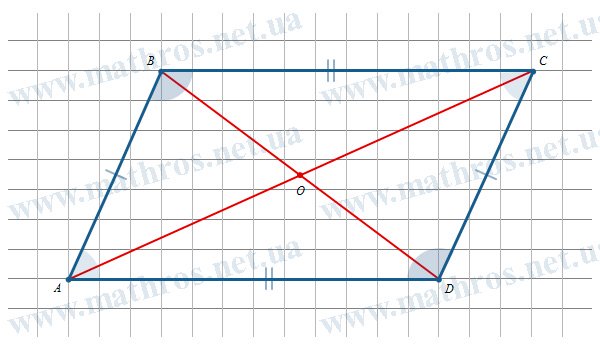
Why should we care about diagonals? The answer is simple: diagonals not only determine the size of the parallelogram but also help identify its type. The diagonals have fascinating properties that are essential to remember.
Properties of the Diagonals of a Parallelogram
Here are the main properties of the diagonals of a parallelogram:
- Diagonals always intersect and bisect each other. This means that the point where they intersect is always the midpoint of each diagonal.
- In a rectangle, diagonals are equal in length but not necessarily perpendicular.
- In a rhombus, diagonals always intersect at right angles, but their lengths can differ.
- In a square, which is both a rhombus and a rectangle, the diagonals are equal and always intersect at right angles.
These properties help us quickly identify the type of parallelogram and simplify solving various geometric problems.
How to Calculate the Length of the Diagonals of a Parallelogram: Simple Formulas
Now, let’s get to the most exciting part: how do we calculate the lengths of the diagonals of a parallelogram? There are simple yet effective formulas, and remembering them is easy!
Let’s assume the parallelogram ABCD has adjacent sides AB and AD, with the angles between the sides labeled as:
- α – the angle at vertices A and C.
- β – the angle at vertices B and D.
The formulas for calculating the diagonals are:

Here’s another useful formula that connects both diagonals with the sides of the parallelogram:

This formula is often used for quick verification of calculations.
You may be wondering, “Where do these formulas come from, and why do they work?”. The answer is simple – all of these formulas come from the Law of Cosines.
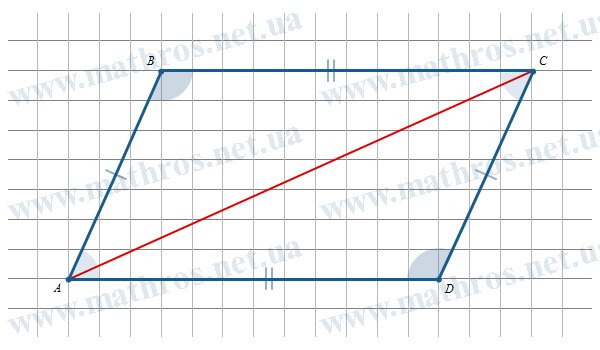
When you look closely, the diagonals of a parallelogram divide it into two triangles. For example, diagonal AC divides parallelogram ABCD into triangles ΔABC and ΔCDA. Let’s apply the Law of Cosines to triangle ΔABC to find AC:

Taking the square root of both sides, we get the formula for AC.
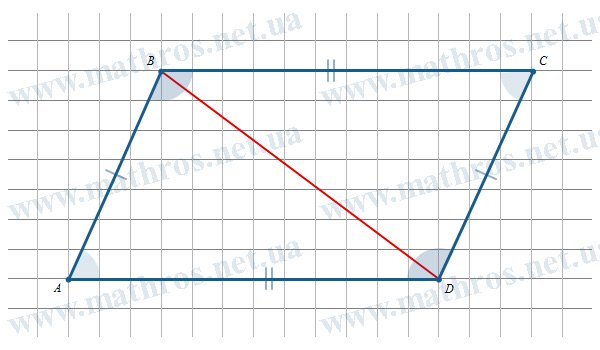
Similarly, for the second diagonal BD, we use triangle ΔABD:

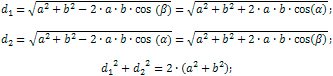
To obtain the second equality in the formulas, we recall that in a parallelogram, angles β and α sum to 180°, so β=180°-α. Since cos(180°-α)=-cos(α), the formulas have alternative forms with an opposite sign.
The final formula, relating both diagonals, comes from adding the first two formulas. In doing so, the cosine terms cancel out, leaving only the squares of the sides.
Note: If we use generic notations a and b for the lengths of adjacent sides, and d1 and d2 for the diagonals, the formulas become:
Diagonal of a Parallelogram: Examples for Practical Application
Now that we know the formulas and why they work, let’s practice applying this knowledge! Below are several examples to help you understand the topic better. Before reading the solutions, try solving the problems yourself to test your understanding.
Example 1: Find the Diagonals of a Parallelogram with Sides 6 cm and 10 cm, and an Angle of 30°
We have a parallelogram with sides 6 cm and 10 cm, and an angle of 30°. These values are enough to find the lengths of both diagonals. Let’s use the formulas and substitute the values:

So, the diagonals of a parallelogram are 15.5 cm and 5.7 cm.
Example 2: What are the Diagonals of a Parallelogram with Sides 10 cm and 13 cm, and an Angle of 40°?
Given two sides of the parallelogram—10 cm and 13 cm, and an angle of 40°, substitute these values into the formulas:

So, the diagonals of a parallelogram are 21.6 cm and 8.3 cm.
Example 3: A Parallelogram has Sides 8 cm and 14 cm, and Angle α Equals 45°. What is the Length of Its Diagonals?
For this parallelogram with sides 8 cm and 14 cm, and an angle of 45°, let’s use the formulas:

So, the diagonals of a parallelogram are 20.4 cm and 10.1 cm.
Example 4: What Are the Diagonal Lengths of a Parallelogram with Sides 5 cm and 7 cm and Angle 40°?
For a parallelogram with sides 5 cm and 7 cm, and an angle of 40°, let’s apply the formulas:

Thus, the diagonals of a parallelogram are 11.3 cm and 4.5 cm.
Learn More: What Else to Read About Parallelograms?
If you enjoyed learning about the diagonal of a parallelogram, check out these related articles to expand your knowledge:
- What is a Parallelogram and Its Properties? – This article provides clear explanations of the key features of a parallelogram and shows how it differs from other quadrilaterals.
- Perimeter of a Parallelogram – Curious about how to calculate the perimeter of a parallelogram? This article offers simple formulas and clear examples.
- Area of a Parallelogram – Need help calculating the area of a parallelogram? This article offers step-by-step guidance and practical exercises.
These articles will deepen your understanding of parallelograms and help you tackle geometry problems with confidence. So, pick a topic and start sharpening your skills today!
Flowchart for Programmers: Calculating the Diagonal of a Parallelogram
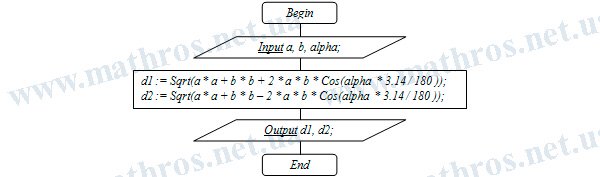
If you’re into programming and looking for a fun project, try writing a program to calculate the diagonals of a parallelogram! The flowchart below will come in handy, as it clearly shows all the steps you need to take to properly calculate the diagonals based on the given sides and angle. Use this chart as a guide, adapt it to your programming language, and improve your algorithmic thinking and coding skills!