When studying geometry, one of the basic shapes you’ll encounter is the parallelogram. This unique quadrilateral has specific characteristics that make it essential in mathematics. Let’s dive in to understand what is a parallelogram, its properties, and the key formulas you need to know to easily solve problems involving parallelograms.
What is a Parallelogram and How to Recognize It?
A parallelogram is a quadrilateral in which opposite sides are both parallel and equal in length. To make this clearer, imagine a quadrilateral ABCD. If sides AB and CD are parallel to each other, and likewise sides BC and AD are parallel, this shape is definitely a parallelogram.
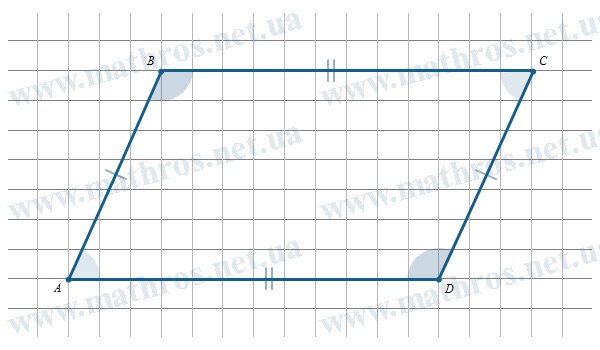
Another important feature of a parallelogram is that opposite angles are equal. Moreover, if you add two adjacent angles, you’ll always get 180°. This is crucial for solving many problems!
There are also special types of parallelograms:
- Rectangle: A parallelogram with all right angles.
- Rhombus: – A parallelogram with all sides equal in length.
- Square: A parallelogram where all sides are equal and all angles are right angles.
Now, let’s talk a bit about the height of a parallelogram. The height is the perpendicular segment from a vertex to the opposite side (or its extension). For example, in parallelogram ABCD, the heights could be segments EF, BG, CH, BI, AJ, as shown in the diagram.
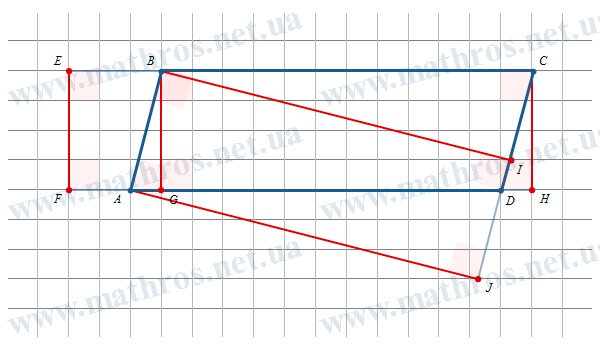
Here, heights EF, BG, CH are drawn to sides BC and AD, while heights BI, AJ are perpendicular to sides AB and CD, respectively.
Key Properties of a Parallelogram: What Makes It Special?
A parallelogram has some fascinating properties. Let’s explore these essential properties together!
Opposite Sides of a Parallelogram Are Equal
Let’s examine parallelogram ABCD and draw diagonal AC. This creates two triangles, ABC and CDA.
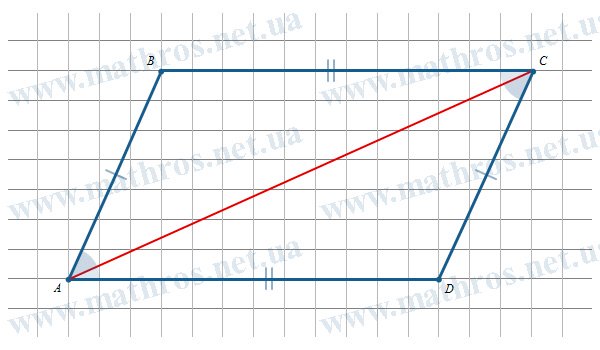
In this case:
- Side AC is common to both triangles.
- Angles ∠BAC=∠DCA (because they are alternate interior angles when parallel lines AB and DC are intersected by transversal AC).
- Angles ∠BCA=∠DAC for the same reason (with parallel lines AD and BC).
The triangles are congruent by the AA criterion (two angles and the side between them). Therefore, their corresponding sides must be equal: AB=CD and BC=AD. Thus, we have proven the first property!
Opposite Angles of a Parallelogram Are Equal
Let’s take parallelogram ABCD again with diagonal AC. As we have already established, ΔABC=ΔCDA. This means the corresponding angles of these triangles are equal:
- ∠ABC=∠CDA.
- ∠BAD=∠DCB.
So, this property is also proven!
Diagonals of a Parallelogram Bisect Each Other
Let’s draw diagonals AC and BD, which intersect at point O.
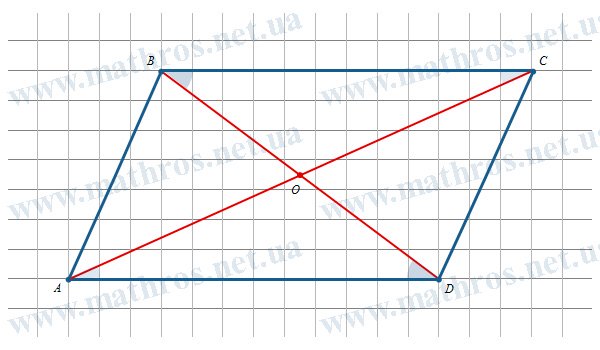
In the triangles AOD and BOC:
- ∠OAD=∠OCB (alternate interior angles with parallel lines AD and BC and transversal AC).
- ∠ADO=∠CBO (alternate interior angles with parallel lines AD and BC and transversal BD).
- AD=BC (opposite sides of the parallelogram).
Since the triangles are congruent, we conclude that AO=OC and BO=OD. Therefore, the diagonals bisect each other at the intersection point O.
What is a Parallelogram Without Formulas? Need Diagonals, Perimeter, and Area? Check This Table!
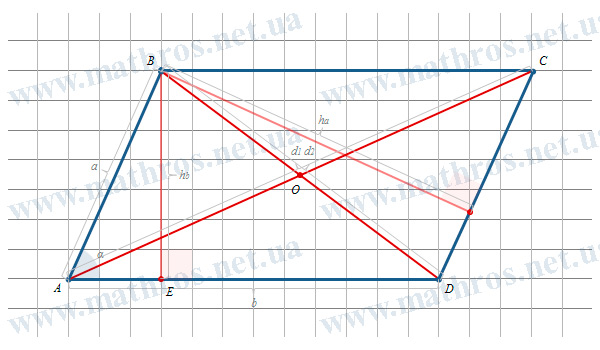
To easily solve geometry problems, it’s important to know the basic formulas for a parallelogram. For your convenience, here’s a table summarizing the key formulas:
| Term | Definition | Formula |
|---|---|---|
| Diagonals of a parallelogram | A segment connecting two opposite vertice | 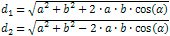 |
| Perimeter of a parallelogram | The space enclosed by the sides, calculated by multiplying any side by its corresponding height |  |
| Area of a parallelogram | Space enclosed by sides; calculated by multiplying base by height |  |
Where:
- a and b are the lengths of adjacent sides of the parallelogram.
- α is the angle between sides a and b.
- ha and hb are the heights corresponding to sides a and b.
Practical Exercises: Testing and Reinforcing Your Knowledge of Parallelograms
Now that you know all the key information about parallelograms, it’s time to practice! Below are a few interesting exercises that will help you apply what you’ve learned and solidify your understanding. Let’s go ahead and practice together!
Example 1: What is a Parallelogram in Geometry?
A parallelogram is a special type of quadrilateral. Its opposite sides are both parallel and equal in length. Additionally, its opposite angles are also equal.
Example 2: Is a Parallelogram a Regular Polygon?
A regular polygon is one where all sides and angles are equal. In a parallelogram, only opposite sides and angles are equal, not all of them. So, a parallelogram is not a regular polygon.
Example 3: In Parallelogram ABCD, Angle A is 90 Degrees. Prove All Angles are Right Angles
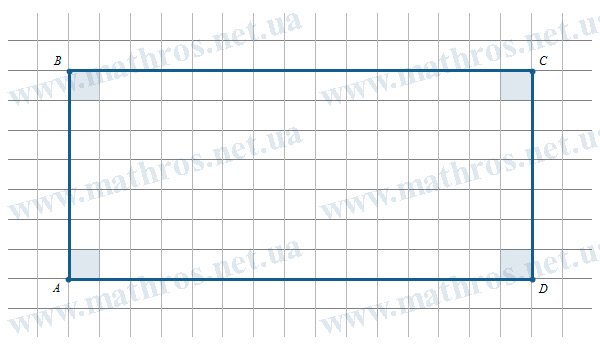
We already know that opposite angles of a parallelogram are equal. If ∠A=90°, then the opposite angle ∠C must also be 90°. Also, the sum of adjacent angles in a parallelogram is 180°. So, if ∠A=90°, then the adjacent angle ∠D must be 180°-90°=90°. Similarly, the opposite angle ∠B will also be 90°. Thus, all angles in parallelogram ABCD are right angles.
Example 4: The Bisector of an Obtuse Angle in a Parallelogram Divides One Side in a 2:1 Ratio. Find the Sides of the Parallelogram if Its Perimeter is 60 cm
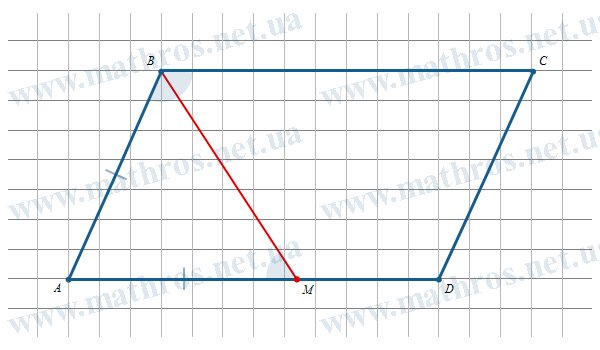
Let the bisector of angle B intersect side AD at point M, and according to the problem, AM:MD=2:1. The bisector divides the angle into two equal parts, making triangle ABM isosceles. Therefore, AB=AM. Denote the smaller segment MD as x, then AM = 2⋅x, and AD=AM+MD=3⋅x. Using the formula for the perimeter of the parallelogram: P=2(AB+AD), we substitute the known perimeter of 60 cm and solve for x:

Thus, AB=12 cm and AD=18 cm.
Diagonals, Perimeter, Area… Where to Find More Explanations and Examples?
Want more details and examples? Here are a few useful links to help expand your understanding of the main formulas and properties of parallelograms. In each of these topics, you’ll find detailed explanations and visual examples that will make the learning process even more engaging.
- Diagonals of a Parallelogram – Learn how to calculate the diagonals of a parallelogram and how to apply this knowledge in solving various problems.
- Perimeter of a Parallelogram – Understand how to find the perimeter of a parallelogram, and learn why this is important for solving different geometry problems.
- Area of a Parallelogram – Get to know the formulas to find the area of a parallelogram, and try applying them in real examples to reinforce your learning.
Programming the Shape: Is It Really a Parallelogram?
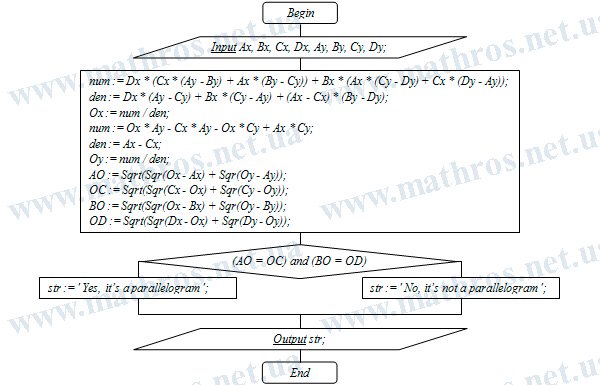
Combining geometry and programming opens up exciting opportunities for learning and practical experimentation. Imagine how fun it would be to write a simple application that determines whether a given quadrilateral is a parallelogram. Below is a flowchart that can help you design the logic of the program: simply check if each diagonal is bisected at the intersection point, and if so, the program will return a clear answer: “Yes, it’s a parallelogram“ or “No, it’s not a parallelogram“.
This approach will be a great exercise for applying both geometry knowledge and basic algorithmic structures, showing how theory can turn into a useful tool in real time.